

1. A Human Story
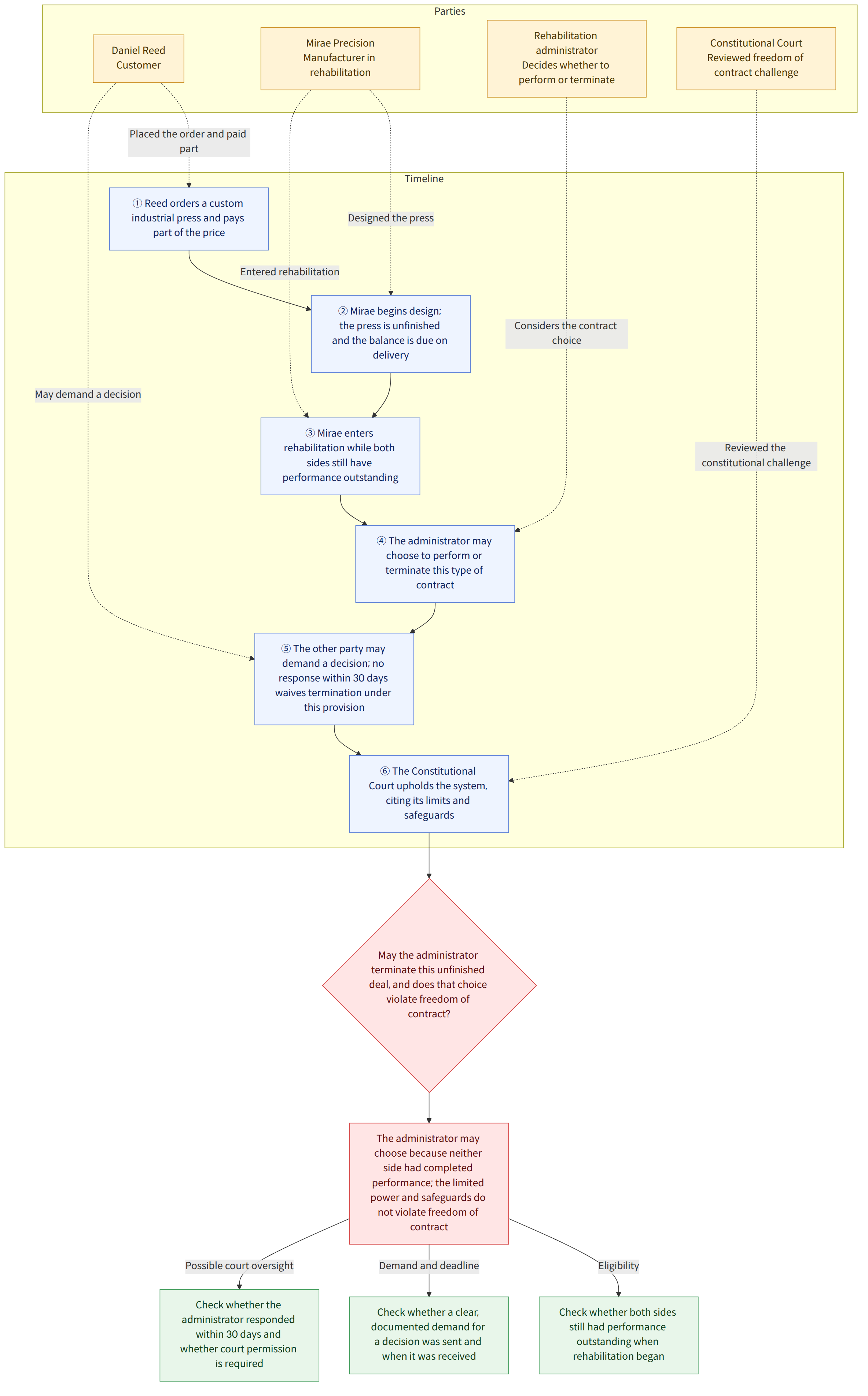
When Daniel Reed placed an order for a custom industrial press, he expected the machine to anchor a new production line at his small factory. He paid part of the price, and Mirae Precision, the manufacturer, began designing the equipment. The remaining payment was due on delivery, but the press had not yet been completed.
Then Mirae Precision entered corporate rehabilitation proceedings. Daniel’s production plans were already behind schedule when he learned that the company’s court-appointed administrator was considering ending the order. Daniel had not received the press; Mirae had not received the full price. Both sides still had important obligations to perform, and neither could be sure whether the deal would survive.
2. The Legal Question
When a company enters rehabilitation, may its administrator terminate a contract that both sides have yet to complete—even if the other party wants the agreement honored? And does giving the administrator that choice violate the other party’s constitutional freedom of contract?
3. What Korean Law Says
Korea’s Debtor Rehabilitation and Bankruptcy Act gives an administrator a choice in certain bilateral contracts with performance still outstanding on both sides. The aim is to help preserve the debtor’s business and promote the interests of creditors as a group. The administrator may decide whether the debtor will perform the agreement or terminate it.
The power is not unlimited. It applies only when, at the start of rehabilitation proceedings, neither the debtor nor the other party has completed its performance. If either side has already fully performed, the administrator cannot use this particular termination power.
The law limits the administrator’s choice to contracts that remain unperformed by both parties when rehabilitation begins. If either party has completed its performance, the administrator may not terminate under this provision.
The Act also provides safeguards for the other party:
- A demand for a decision: The other party may formally ask the administrator to say whether the contract will be performed or terminated.
- A 30-day deadline: If the administrator does not respond within 30 days after receiving that demand, the administrator is treated as having given up the right to terminate.
- Possible court oversight: The law allows court permission to be required for an administrator’s termination decision in circumstances where that safeguard applies.
These rules seek to prevent the other party’s position from remaining uncertain indefinitely and to guard against arbitrary use of the administrator’s power.
4. How Korean Courts Approach This
Korea’s Constitutional Court has considered whether this system improperly restricts freedom of contract. It concluded that it does not. The court recognized that an administrator’s decision can affect the other party’s contractual expectations, but emphasized that the power serves legitimate purposes: giving a financially distressed debtor a chance to recover and protecting the creditor body as a whole.
The court’s reasoning turned on the limits and protections built into the law. The administrator cannot undo a deal under this provision if either side has already completed performance. The counterparty can also force a decision by making a formal demand, and the 30-day rule prevents the administrator from leaving the matter unresolved after that demand. Court approval may provide an additional check where required.
The constitutional balance rests not on giving the administrator an unrestricted escape from contracts, but on a narrowly defined choice accompanied by safeguards for the other party.
5. Applying the Law to Daniel’s Case
Daniel’s order appears to fall within the category of contracts covered by the provision. Mirae Precision had not finished making the press, and Daniel had not paid the full price or received the machine. On the facts described, neither party had completed its performance when rehabilitation began.
That means the administrator may choose whether Mirae Precision will carry on with the contract or terminate it. Daniel’s preference to receive the press does not, by itself, take that statutory choice away. The law gives the administrator room to consider whether continuing the order is compatible with the company’s rehabilitation and the interests of its creditors.
But Daniel is not required to wait without knowing where he stands. He can send the administrator a clear, documented demand asking for a decision on performance or termination. If the administrator does not answer within 30 days after receiving it, the law treats the administrator as having waived the right to terminate under this provision.
If the administrator decides to terminate, Daniel can ask whether court permission is required in the circumstances and should keep the contract, payment records, correspondence, and proof of when any demand was delivered. The constitutional challenge does not create an automatic right to insist that the original deal be performed; rather, the administrator must act within the statutory limits and safeguards.
If you are dealing with a similar issue, attorney Ji-sun Ahn of Ijun Law Firm can review the rehabilitation or bankruptcy order, your contract, and any schedule or filing of claims with you. These details can help clarify which options apply to your situation.
6. Conclusion: What Happened, and What Should You Do?
Mirae Precision’s administrator may lawfully terminate Daniel’s order because, when rehabilitation began, both sides still had performance outstanding. The rule is a real restriction on the counterparty’s contractual expectations, but Korean constitutional law treats it as a proportionate one: its reach is limited, and the other party has ways to prevent prolonged uncertainty and check the administrator’s conduct.
If you face a similar situation:
- Check what had been performed when rehabilitation began. This statutory power applies only if neither side had completed its performance.
- Make any demand for a decision in writing and keep proof of delivery. The 30-day period runs from the administrator’s receipt.
- Get prompt legal advice before responding to a proposed termination. Ask whether court permission is required and what claims or steps may remain available under your contract and the rehabilitation process.

















