

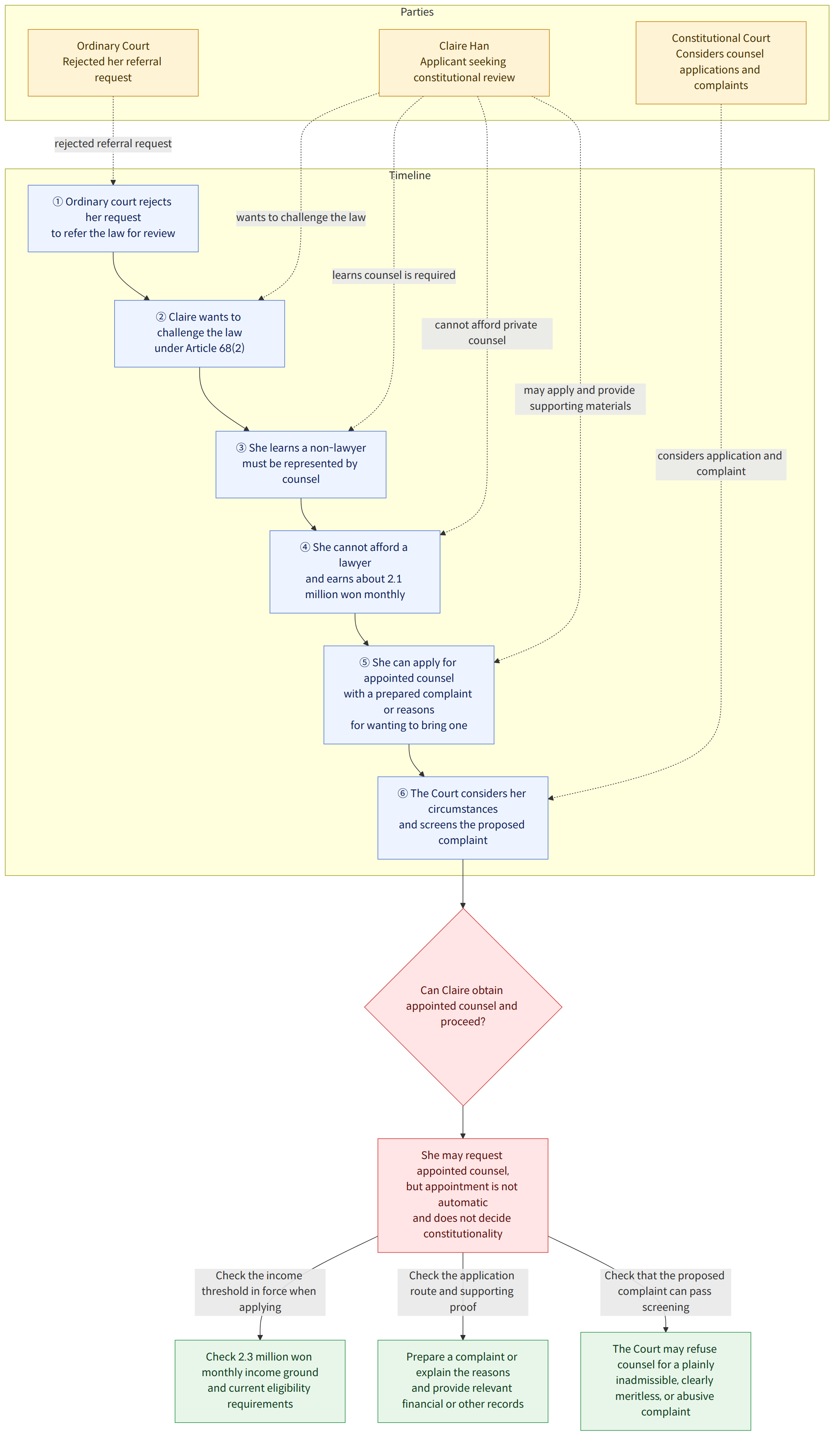
1. A Human Story
When Claire Han received the court’s decision, she read it twice at her kitchen table. The ordinary court had rejected her request to refer a disputed law to the Constitutional Court for review. Claire believed the law had violated her constitutional rights and wanted to bring a constitutional complaint under Article 68(2) of the Constitutional Court Act. But she earned about 2.1 million won a month, supported herself on a tight budget, and could not afford to hire a lawyer.
Claire had assumed that a constitutional complaint was simply a form she could complete herself. Then she learned that, unless the complainant is a lawyer, a lawyer must represent them in the proceedings. The requirement seemed to put the remedy just out of reach. A friend suggested that she ask the Constitutional Court to appoint counsel instead—and that changed Claire’s next step from giving up to gathering documents.
2. The Legal Question
Can someone who cannot afford a lawyer still bring a constitutional complaint in South Korea, and what must they do to obtain appointed counsel? The answer is yes, in appropriate circumstances—but financial hardship alone does not make appointment automatic, and the complaint itself must still meet the Court’s procedural and legal requirements.
3. What Korean Law Says
A constitutional complaint may be available to a person seeking constitutional review, but a complainant who is not a lawyer must be represented by counsel. The appointed-counsel system is intended to prevent the cost of representation from blocking access to constitutional justice for people who genuinely need it.
A non-lawyer bringing a constitutional complaint must appoint a lawyer to act as counsel. A person who cannot reasonably afford one may ask the Constitutional Court to appoint counsel.
A person seeking appointed counsel should submit an application to the Constitutional Court. There are two practical routes:
- Submit the application together with a constitutional complaint already prepared; or
- Submit an application that explains the reasons for wanting to bring a complaint, even if the applicant has not yet drafted the complaint itself.
The grounds for appointment include circumstances such as:
- Monthly average income below 2.3 million won.
- Receipt of benefits under the National Basic Living Security system.
- Status as a person of national merit, or as an eligible bereaved family member or relative under the relevant legislation.
- Other circumstances that make it unreasonable to expect the person to hire private counsel—for example, certain physical or mental disabilities, or the financial situation of the applicant or their family.
The applicant should provide materials that help establish the relevant circumstances. Depending on the ground relied upon, these might include income or benefits records, documents showing national-merit status, or information about a disability or household finances. The listed income figure should be checked against the requirements in force when applying, as rules and thresholds can change.
The Court may appoint counsel in the public interest even when an applicant does not fit the listed eligibility categories. But it may decline to appoint counsel if the proposed complaint is plainly inadmissible, clearly without merit, or an abuse of the right to bring proceedings.
4. How Korean Courts Approach This
The Constitutional Court’s approach reflects two principles that must work together. First, the lawyer-representation requirement is a procedural safeguard: constitutional proceedings raise complex legal questions, and the Court expects a case to be presented through counsel. Second, that requirement should not make the remedy inaccessible to people who cannot reasonably pay for a lawyer. Appointed counsel is the mechanism for reconciling those aims.
Appointment is therefore not simply a reward for having a low income. The Court considers whether the applicant’s circumstances justify public assistance, while also screening the proposed case. A person may satisfy an eligibility category and still be refused counsel if the complaint is plainly inadmissible, clearly unfounded, or abusive. Conversely, the Court may appoint counsel in the public interest even when an applicant does not fall neatly within the listed categories.
The important distinction is that appointment addresses access to legal representation; it does not decide the constitutional dispute in the applicant’s favor. A lawyer’s appointment is not a ruling that the complaint will be accepted or that the challenged law is unconstitutional.
5. Applying the Law to the Case
Claire’s situation can be assessed in several steps.
- She needs counsel. Claire is not a lawyer, so she cannot simply represent herself in the constitutional complaint. The representation requirement is the obstacle she must address first.
- She has a plausible basis to seek appointment. Her stated monthly income of about 2.1 million won is below the 2.3 million won figure identified as an eligibility ground. She should support that statement with reliable records, such as recent pay statements or other income documents. The Court will apply the relevant requirements at the time of her application.
- She can apply before completing the complaint. Claire does not have to solve the entire legal drafting problem before asking for help. She can submit an appointed-counsel application explaining that the ordinary court rejected her request for constitutional review, why she believes the issue is constitutional, and why she cannot hire a lawyer. She can also apply alongside a complaint she has prepared, if one is ready.
- Her financial circumstances are not the only consideration. The Court may examine the supporting evidence and the circumstances of her proposed case. If the complaint is plainly inadmissible, clearly without merit, or an abuse of process, the Court may refuse to appoint counsel even if her finances meet an eligibility ground.
- Appointment would let the case proceed with representation, not guarantee a victory. If counsel is appointed, Claire gains the legal assistance needed to pursue the complaint. The constitutional issue will still have to be evaluated on its own merits and under the applicable procedural rules.
In Claire’s fictional case, she submits the application with recent income records and a concise explanation of the dispute. The Court finds that her financial circumstances support appointment and that her proposed complaint is not plainly inadmissible or abusive. It appoints counsel. That decision gives Claire a fair opportunity to present her constitutional argument; it does not predetermine the outcome.
If you are dealing with a similar issue, attorney Ji-sun Ahn of Ijun Law Firm can review the court notice, any ruling on costs, and documents about legal fees or eligibility for litigation aid with you. These details can help clarify which options apply to your situation.
6. Conclusion: What Happened, and What Should You Do?
Claire’s inability to pay did not, by itself, shut her out of the Constitutional Court. Because she documented her income and explained the constitutional issue she wanted to raise, the Court appointed counsel in her case. Her lawyer could then help present the complaint, while the Court remained free to decide whether the claim met the legal requirements and had merit.
For readers facing a similar situation:
- Apply for appointed counsel promptly, and explain the reason for the proposed complaint even if you have not drafted the full filing.
- Attach evidence of income, benefits, national-merit status, disability, or other circumstances that make hiring a lawyer unreasonable; check the current eligibility requirements rather than relying on an old income figure.
- Remember that appointment is not a ruling on the merits. Explain the constitutional issue clearly and seek legal help with the applicable procedure and deadlines.

















