

1. A Human Story
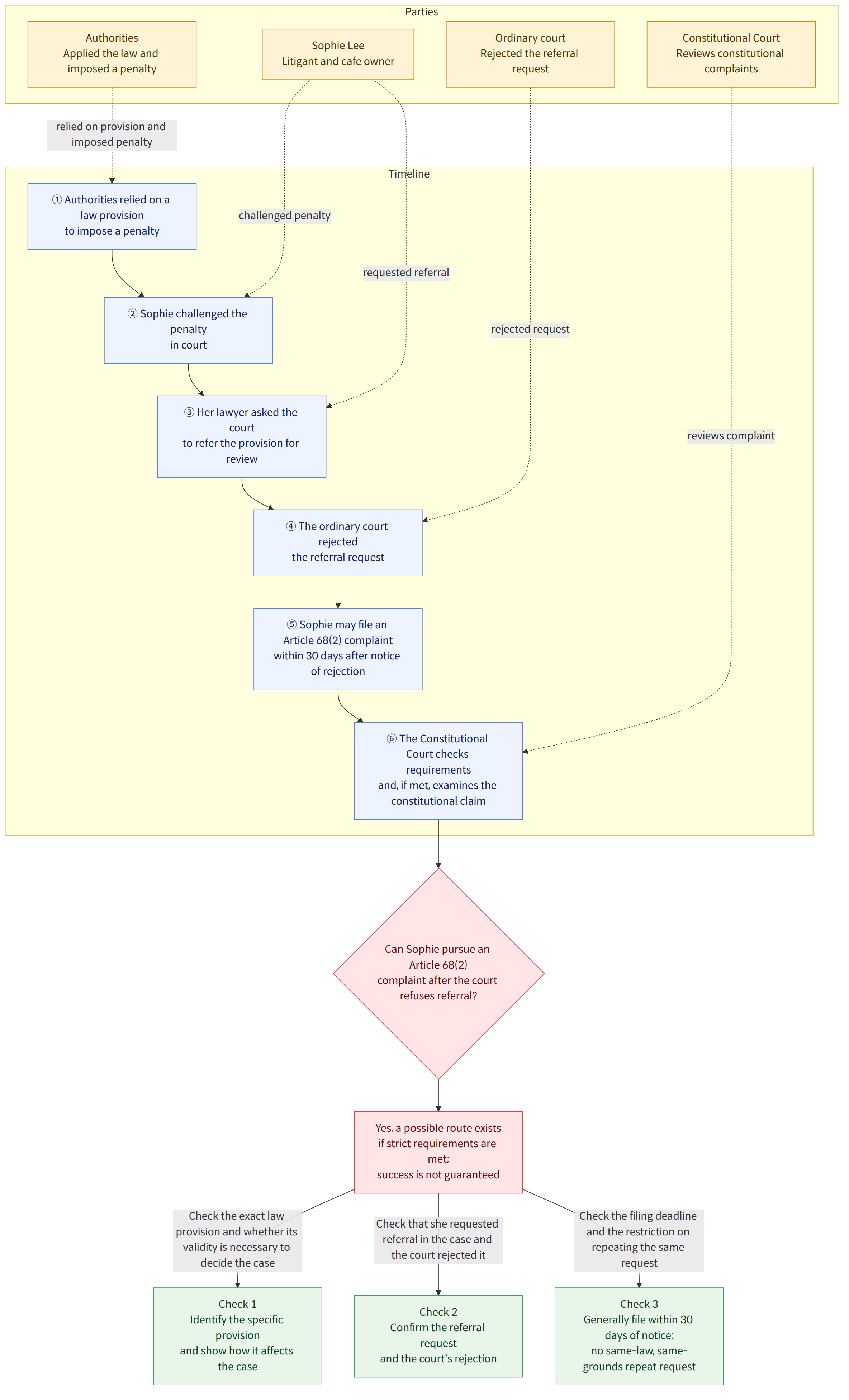
Sophie Lee had built her neighborhood café one early morning at a time. Then a licensing dispute put the business at risk: the authorities relied on a provision of a national law to impose a penalty, and Sophie believed that provision unfairly restricted her constitutional rights.
She challenged the penalty in court. As the case proceeded, her lawyer asked the judge to refer the disputed provision to the Constitutional Court, arguing that the law itself was unconstitutional and that its validity mattered to the outcome. The judge refused. Sophie was left with a difficult question: could she ask the Constitutional Court directly, or did the refusal end the matter?
2. The Legal Question
When a law that affects a court case may violate a person’s constitutional rights, can a litigant take the constitutional issue to the Constitutional Court after the ordinary court rejects a request for constitutional review?
3. What Korean Law Says
A constitutional complaint is a legal procedure for seeking relief when the exercise or non-exercise of public power infringes a constitutionally protected basic right. Both individuals and, where the right is compatible with a legal entity’s nature, corporations may bring such complaints.
Korean law provides two distinct routes under the Constitutional Court Act:
- Article 68(1): A person may generally complain that public power has infringed a basic right. Where another legal remedy is available, the complainant ordinarily must use it first.
- Article 68(2): A party to a court case may challenge the constitutionality of a law when that question is a necessary premise of the case, the party has asked the court to refer the issue to the Constitutional Court, and the court has rejected that request.
Article 68(2) is a route for challenging the constitutionality of a law—not a way to appeal every unfavorable decision made by an ordinary court.
To use the Article 68(2) route, a litigant generally must establish that:
- There is an actual court case involving the litigant.
- The constitutionality of a particular law is relevant to deciding that case.
- The litigant asked the court handling the case to refer the law for constitutional review.
- That court rejected the request.
- The constitutional complaint is filed within the applicable deadline. Under the Constitutional Court Act, the Article 68(2) complaint must generally be filed within 30 days after the litigant receives notice of the rejection.
There is also an important restriction: after bringing an Article 68(2) complaint, the party may not make another request in the same court proceedings for constitutional review of the same law on the same grounds.
4. How Korean Courts Approach This
Korean courts distinguish carefully between a constitutional question and an ordinary disagreement about the facts or the judge’s application of the law. A constitutional complaint is not simply another appeal, and the Constitutional Court does not act as a higher court that reweighs every decision in the underlying case.
For an Article 68(2) complaint, the connection between the challenged law and the court case is central. The law’s constitutionality must be a genuine premise for deciding the dispute; a party cannot invoke the procedure merely because they dislike the result or want a separate ruling on a law that does not affect the case.
A rejected request to refer a law for review opens a possible path to the Constitutional Court; it does not prove that the law is unconstitutional or guarantee that the complaint will succeed.
The Constitutional Court considers whether the procedural requirements are met and, if they are, examines the constitutional claim. The underlying court case and the constitutional complaint raise related but distinct questions: one concerns the dispute between the parties, while the other concerns whether the law complies with the Constitution.
5. Applying the Law to the Case
Sophie’s next steps depend on the facts of her litigation, not simply on her belief that the licensing rule is unfair.
- Identify the exact legal provision. Sophie and her lawyer must specify which provision the authorities relied on. A broad objection to the licensing system is not enough if the complaint does not identify the law whose constitutionality is being challenged.
- Show why the provision matters to the case. If the court can decide Sophie’s dispute without applying that provision, the constitutional question may not be a necessary premise of the case. But if the penalty depends on the provision, its validity may directly affect the result.
- Make the request in the ordinary court case. Sophie did this by asking the court to refer the provision for constitutional review. A constitutional complaint under Article 68(2) is not available merely because she thinks the law is unjust; the required request to the court must first be made and rejected.
- Act promptly after the rejection. Once Sophie receives notice of the court’s refusal, she must observe the filing deadline—generally 30 days. She should keep the written decision and proof of when she received it, and obtain legal advice promptly about the application’s requirements.
- Understand what the complaint can—and cannot—do. Sophie can ask the Constitutional Court to review the law’s constitutionality. She cannot use this procedure simply to ask the Constitutional Court to reconsider every factual or legal ruling in her licensing case. Nor does filing by itself mean she has won or that the penalty has been cancelled.
On these facts, the court’s refusal does not shut the door. If the disputed provision is genuinely central to Sophie’s case and she files a properly prepared complaint on time, Article 68(2) gives her a route to seek constitutional review. Whether the provision actually violates the Constitution is a separate question for the Constitutional Court.
If you are dealing with a similar issue, attorney Ji-sun Ahn of Ijun Law Firm can review the request for constitutional review, the court’s response, and proof of the date you received it with you. These details can help clarify which options apply to your situation.
6. Conclusion: What Happened, and What Should You Do?
Sophie did not treat the judge’s refusal as a ruling that the law was constitutional. She obtained the written decision, confirmed the date she received it, and filed an Article 68(2) complaint within the deadline. That gave her a chance to have the constitutional issue considered; it did not guarantee that the Constitutional Court would strike down the provision or resolve every aspect of her underlying case in her favor.
For anyone facing a similar situation:
- Pinpoint the law and explain how it affects your court case. A constitutional objection must be tied to a real legal issue before the ordinary court.
- Keep the referral request and rejection decision. Record when you received notice, because the filing deadline is short.
- Get advice quickly and distinguish the two procedures. An Article 68(2) complaint challenges a law after a referral request is rejected; it is not a substitute for an ordinary appeal or a general complaint about government unfairness.

















