

1. A Human Story
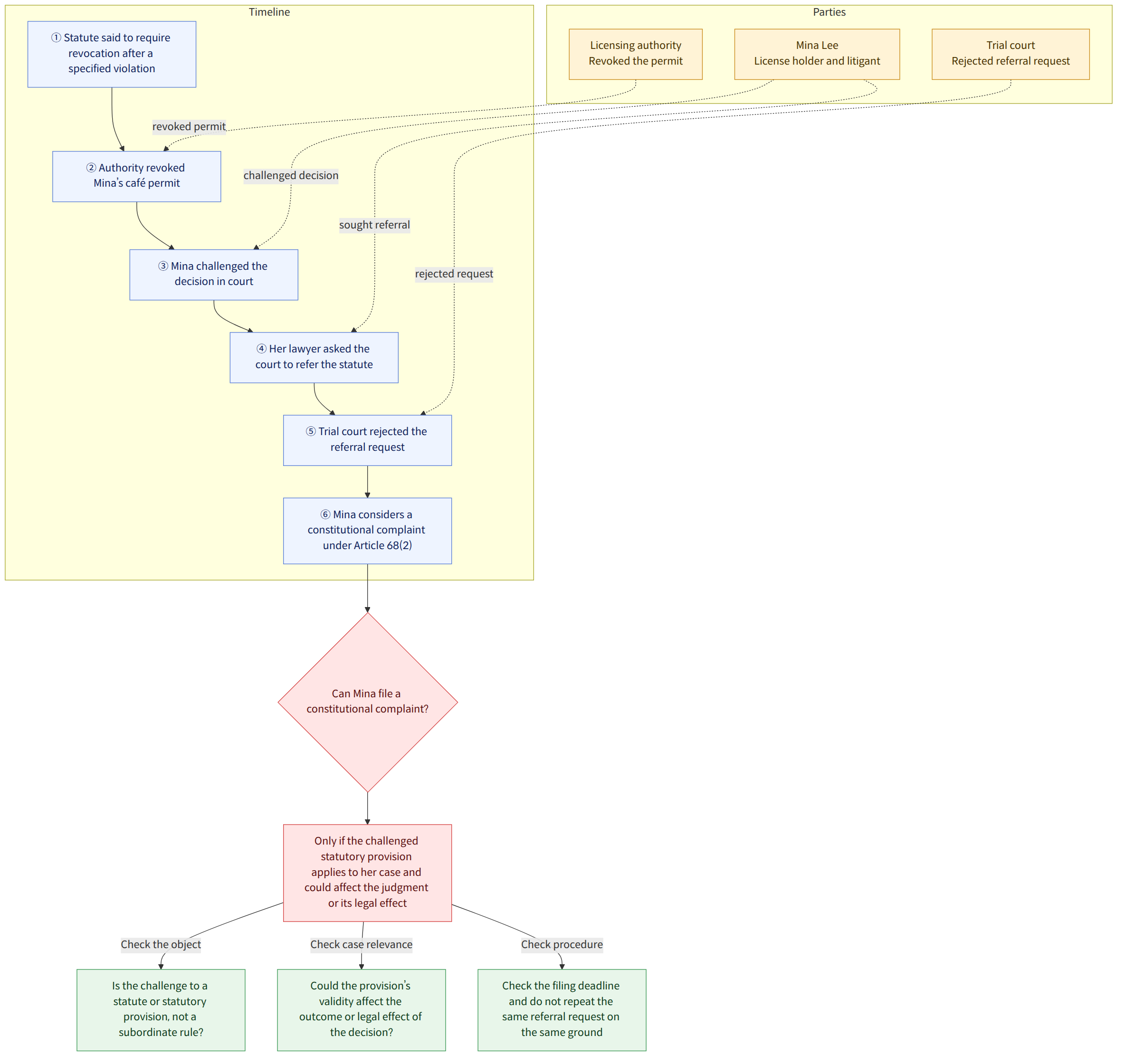
When Mina Lee opened the letter from the licensing authority, she read the same sentence twice: her small café’s operating permit had been revoked. The authority said a provision of a national statute required the revocation after a particular kind of violation. Mina believed the rule was unfairly broad and, more importantly, unconstitutional.
She challenged the decision in court. During the case, her lawyer asked the trial court to refer the statutory provision to the Constitutional Court for review. The judge refused. Mina wondered whether that ended the constitutional argument—or whether she could bring it to the Constitutional Court herself.
2. The Legal Question
When may a party in a Korean court case file a constitutional complaint after the court rejects a request to refer a statute for constitutional review?
The answer is not simply “whenever a law seems unconstitutional.” This procedure has specific requirements about who may apply, what kind of rule may be challenged, and how that rule must matter to the pending case.
3. What Korean Law Says
Article 68(2) of the Constitutional Court Act provides a route to the Constitutional Court for a party whose request for a court referral has been rejected.
If a request to refer the constitutionality of a law for review under Article 41(1) is rejected, the party that made the request may file a constitutional complaint with the Constitutional Court. The party may not make another request, on the same ground, for constitutional review in the proceedings of that case.
In practical terms, the principal requirements are:
- The applicant must be a party to an ongoing court case. The route is tied to litigation in which the party sought a referral from the court hearing the case.
- The party must first have asked that court to refer the legal question. A complaint under Article 68(2) follows the court’s rejection of that request; it is not a general way to ask the Constitutional Court for an advisory opinion.
- The challenge must concern a statute or a provision of a statute. This procedure does not cover a presidential decree or another subordinate rule as the object of the complaint.
- The challenged provision must be a prerequisite to the court’s decision. It must be a provision that applies to the case, and its constitutionality must be capable of affecting the judgment’s result or the legal meaning or effect of the decision.
- The same referral request cannot be made again in the same case on the same ground. The law directs the party toward the constitutional-complaint procedure after rejection, rather than repeated applications to the trial court.
The constitutional question must be connected to the actual lawsuit. A disagreement with a law, standing alone, is not enough: the provision must apply, and its validity must matter to the court’s decision or its legal consequences.
A party considering this route should also check the filing deadline and other procedural requirements promptly. Constitutional proceedings can involve strict time limits, and a missed deadline may prevent review even where the underlying argument is substantial.
4. How Korean Courts Approach This
Korean courts generally treat the “prerequisite to the judgment” requirement as a practical test, not a formality. They examine whether the challenged statutory provision governs the dispute before them and whether the result—or the legal significance of the result—could change depending on whether the provision is constitutional.
That means a court may reject a referral request even if the party raises a serious constitutional concern. For example, the provision might not apply to the facts, another legal rule might independently resolve the case, or the constitutional question might have no bearing on the judgment’s order or legal effect.
The distinction between statutes and lower-level rules also matters. Article 68(2) is a particular procedure for challenging a law after a court refuses a referral request. It does not turn every dispute about a regulation or administrative rule into an Article 68(2) complaint. Different legal routes may apply to other kinds of challenges, but they have their own requirements.
5. Applying the Law to the Case
Mina’s situation can be assessed in a series of steps.
- Was she a party to a court case? Yes. She had brought an action challenging the licensing authority’s decision.
- Did she first ask the court to refer a constitutional question? Yes. Her lawyer asked the trial court to refer the relevant statutory provision, and the court rejected that request. This satisfies the procedural sequence required for an Article 68(2) complaint.
- Is she challenging the right kind of rule? On the facts described, the alleged source of the revocation is a provision of a national statute. That is the kind of legal provision Article 68(2) addresses. If Mina’s real objection were only to a presidential decree or another subordinate rule, this particular route would not be available on that basis.
- Does the statute matter to her lawsuit? The licensing authority relied on the statutory provision to revoke her permit. If the court must apply that provision to decide whether the revocation was lawful, the provision is relevant to the case.
- Could the constitutional answer affect the decision? If the provision is unconstitutional, the legal basis for the revocation—and therefore the court’s ruling or the legal effect of that ruling—could change. That would support the required connection between the constitutional question and the case. But if the court can resolve Mina’s challenge on an independent ground, without applying the disputed provision, the necessary connection may be absent.
The court’s refusal to refer the question does not itself establish that Mina’s constitutional argument is wrong. It means the trial court did not grant her request. Whether her later complaint can proceed depends on the statutory requirements, including the provision’s actual role in the litigation and compliance with procedural deadlines.
If you are dealing with a similar issue, attorney Ji-sun Ahn of Ijun Law Firm can review the request for constitutional review, the court’s response, and proof of the date you received it with you. These details can help clarify which options apply to your situation.
6. Conclusion: What Happened, and What Should You Do?
Mina has a potential path to the Constitutional Court because she was a litigant, asked the trial court to refer a statutory provision, and was refused. Her next step is not automatic, however. She must show that the provision applies to her licensing case and that its constitutionality could affect the court’s decision or the legal meaning or effect of that decision. If those conditions are met and she files within the applicable time limit, she may pursue an Article 68(2) constitutional complaint. She cannot simply repeat the same referral request in the same proceedings.
For readers facing a similar situation:
- Identify the exact rule. Confirm whether the challenge concerns a statute or only a lower-level regulation; Article 68(2) is limited to statutes and statutory provisions.
- Explain why the rule matters to the case. Connect the provision to the facts, the court’s decision, and how the outcome or its legal effect could change if the provision were unconstitutional.
- Act quickly after a rejection. Obtain the written decision, check the filing deadline and required documents with a qualified Korean lawyer, and do not assume that repeated applications to the trial court will preserve your rights.

















