

1. A Human Story
When Eleanor Park opened a box of family papers after her grandfather’s funeral, she expected old photographs and letters. Instead, she found two documents that seemed to tell different stories. Her late uncle Thomas was listed in one family record as her grandfather’s son; another document left the relationship unclear.
The uncertainty mattered to Eleanor. Thomas had been estranged from the family for years, and she had recently received official confirmation that he, too, had died. She wanted the family’s legal records to reflect the truth, but wondered whether she had any right to go to court at all. She was not Thomas’s child or spouse—only his niece and her grandfather’s granddaughter.
2. The Legal Question
Can a relative bring a lawsuit asking a Korean court to determine whether a legal parent-child relationship exists simply because that person is a relative? And if both people whose relationship is disputed have died, what deadline applies?
3. What Korean Law Says
An action to confirm the existence or non-existence of a parent-child relationship asks a court to resolve whether two people are legally parent and child. It concerns legal family status, not merely a private disagreement about biology or family history.
Korean law requires the person bringing such a case to have a legal interest in obtaining the court’s confirmation. For relatives, the Civil Act defines the relevant family relationships in Article 777:
Under Civil Act Article 777, relatives include blood relatives within the eighth degree, relatives by marriage within the fourth degree, and spouses.
The Supreme Court has treated people within those categories as interested parties who may seek confirmation of the disputed parent-child relationship. In practical terms, the relative does not generally have to show some additional, separate harm beyond the legal interest that comes from the qualifying family relationship.
The proper defendant depends on whether the people whose relationship is in question are alive:
- If both are alive, the relative may bring the action against both of them.
- If one has died, the action may be brought against the surviving person.
- If both have died, the action may be brought against the prosecutor.
There is also an important difference between this action and an action to deny paternity. The latter is subject to a two-year filing period from the time the claimant learns the relevant facts. A parentage-confirmation action does not generally have that same two-year limit. But that does not mean every case can be filed at any time.
When a third party brings a parentage-confirmation action after both people whose relationship is disputed have died, the one-year period is counted from the day the third party learns that both have died.
This deadline follows from the way the Korean courts apply Civil Act Article 865(2) to such cases, together with the rules on who may be sued when the people concerned have died. The precise date on which the claimant learned of both deaths can therefore become decisive.
4. How Korean Courts Approach This
Korean courts treat parentage as a matter of legal status, not simply a question of what a family believes or what a single document appears to show. A court considers whether the person bringing the case has a legally recognized interest and whether the correct parties have been named.
For this type of lawsuit, the Supreme Court has recognized the relatives listed in Civil Act Article 777 as interested parties. The principle is significant: a qualifying relative need not first prove that the outcome will change an inheritance or cause some other specific financial consequence. The law recognizes an interest in having a disputed family status made legally clear.
The courts also distinguish between the ordinary rule and the special situation in which both people concerned have died. While the action is not generally subject to the two-year limit applicable to a paternity-denial action, a third party who sues after both parties have died must observe the one-year period tied to learning of both deaths. The rule prevents a case from being left open indefinitely once the people directly concerned can no longer take part.
5. Applying the Law to Eleanor’s Case
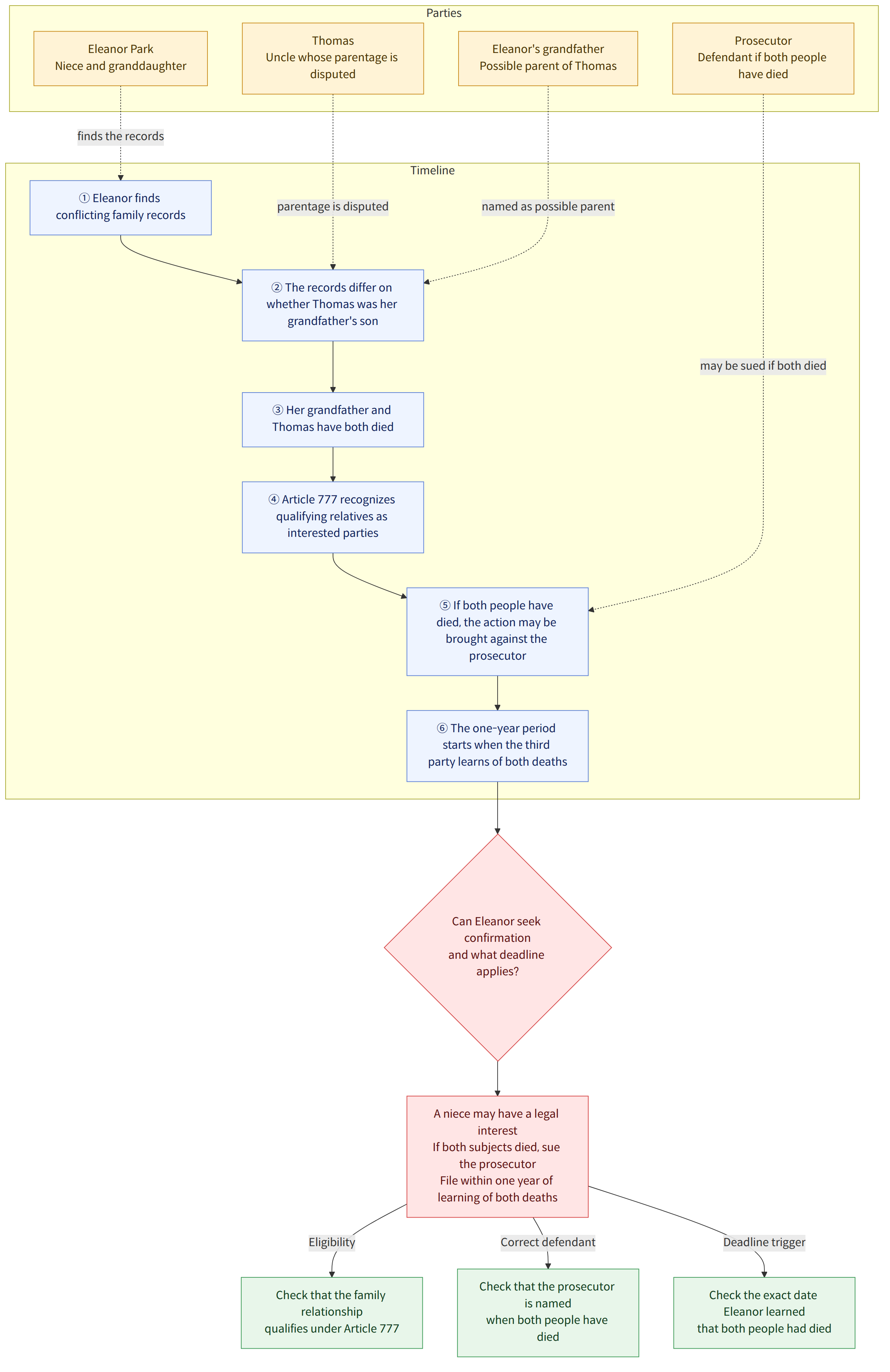
First, Eleanor must qualify as a relative under Article 777. She is Thomas’s niece and her grandfather’s granddaughter. Those are close blood relationships, comfortably within the statutory degrees. On the facts described, she has the kind of family-based legal interest recognized by the courts.
Second, the people whose relationship is disputed are the parties at the heart of the case. Eleanor is not asking the court to decide whether she herself is related to either man. She seeks a ruling on whether Thomas was legally the son of her grandfather. If both men were alive, she would ordinarily sue both. Since both have died, she may bring the action against the prosecutor instead.
Third, the filing date needs careful attention. Eleanor recently received official confirmation that Thomas had died. Her grandfather’s death was already known, so the key question is when she learned that Thomas had also died. If she files within one year of learning that both men were dead, she may satisfy the special time limit described above. If she had already known of both deaths for more than a year, discovering the conflicting records only recently would not necessarily restart that period.
Finally, her family connection gets her through the courthouse door, but it does not decide the underlying facts. Eleanor would still need to present evidence supporting the requested declaration. Family registers, birth records, correspondence, and other relevant material may matter. A court’s task is to determine the legal parent-child relationship, not simply to accept the family’s preferred account.
If you are dealing with a similar issue, attorney Ji-sun Ahn of Ijun Law Firm can review family registration records, dates of marriage and birth, and any earlier acknowledgment of paternity, test result, or ruling with you. These details can help clarify which options apply to your situation.
6. Conclusion: What Happened, and What Should You Do?
Eleanor is not disqualified just because she is a niece and granddaughter rather than one of the two people whose parentage is disputed. Her relationships fall within the statutory definition of relatives, so she may seek a judicial determination. Because both Thomas and her grandfather have died, the prosecutor is the appropriate defendant. If Eleanor files within one year after learning that both men were dead, the timing rule should not bar her case; she must still prove the claimed legal status with evidence.
For readers facing a similar situation:
- Map the family relationship precisely. Check whether you fall within Civil Act Article 777’s categories: a spouse, a blood relative within the eighth degree, or a relative by marriage within the fourth degree.
- Confirm who is alive and name the proper defendant. If both people whose relationship is disputed have died, seek prompt legal advice about proceeding against the prosecutor.
- Write down when you learned of each death and preserve the records. In a case involving two deceased parties, the one-year period may run from the date you learned that both had died—not from the date you found the disputed paperwork.

















