

1. A Human Story
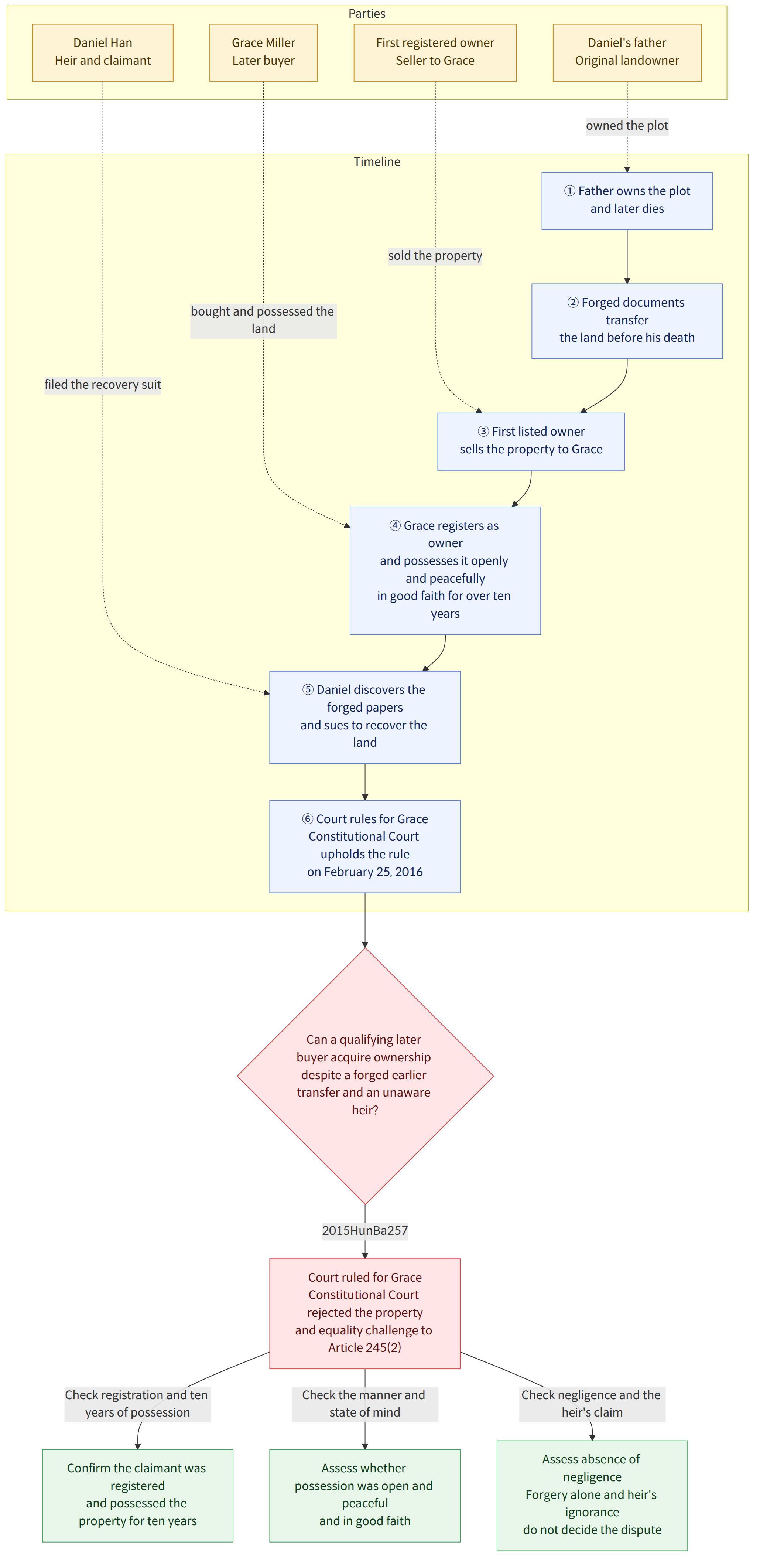
When Daniel Han sorted through his late father’s papers, he found a survey map of a small plot outside the city. His father had spoken of the land for years. But the registry showed that it had been transferred to someone else long before Daniel’s father died.
The transfer, Daniel discovered, rested on forged documents. He sued to cancel the registration and restore the land to his father’s estate. By then, however, the first person listed as owner had sold the property to Grace Miller. Grace had bought it believing the registry, taken possession openly and peacefully, and remained registered as owner for more than ten years. The court ruled for Grace, leaving Daniel unable to recover the land through his lawsuit.
2. The Legal Question
Can a later buyer acquire ownership of land under Korea’s registered-acquisition prescription rule even when an earlier transfer in the chain of ownership was based on forged documents—and the original owner’s heir did not know the land had been taken?
The related constitutional question is whether that rule unfairly takes property from the original owner or treats heirs unequally. The Constitutional Court has held that it does neither.
3. What Korean Law Says
Korea’s Civil Act recognizes a form of ownership acquisition through long, qualifying possession. Article 245(2) addresses a person who possesses real estate while registered as its owner. In simplified terms, that person can acquire ownership after ten years if the statutory conditions are met.
Under Article 245(2) of the Civil Act, a person who has been registered as the owner of real estate and has possessed it peacefully and openly, in good faith and without negligence, for ten years may acquire ownership.
The requirements are significant. A claimant must generally show that they:
- Possessed the property for ten years while registered as its owner.
- Possessed it peacefully and openly—not by force or in secret.
- Acted in good faith, believing they were entitled to the property.
- Were without negligence, meaning the circumstances did not reasonably call for them to discover the defect in their claimed ownership.
This rule is distinct from the more general possession-based route in Article 245(1), which generally requires twenty years of qualifying possession and registration. The ten-year rule applies to registered possession only when the additional good-faith and no-negligence conditions are satisfied.
Korea’s property system also places considerable importance on registration. Under Article 186 of the Civil Act, a change in ownership of real estate generally takes effect through registration. A registration may nevertheless be defective—for example, because it rests on forgery. Article 245(2) addresses the consequences when a later registered possessor meets the statutory conditions for a full ten years.
The rule does not mean that every buyer who relies on a registry automatically becomes the owner after ten years. The possession, good faith, absence of negligence, registration, and time requirements all matter.
4. How Korean Courts Approach This
In its decision of February 25, 2016, in 2015HunBa257, the Constitutional Court rejected a challenge to Article 245(2). It held that the provision did not violate the constitutional protection of property or the principle of equality.
The Court reasoned that the law may legitimately protect a person who has held themselves out as owner through registration and possessed the property openly and peacefully for ten years in good faith and without negligence. That protection serves a broader purpose: keeping property relationships and transactions stable rather than allowing them to remain uncertain indefinitely.
The Court also considered whether ten years was too short and whether the rule inadequately protected the original owner. It concluded that the period was not unreasonably brief and that the rule’s conditions themselves provided meaningful safeguards. A possessor must satisfy more than the mere passage of time.
Nor did the Court find a constitutional reason to give heirs a special exemption. Even when ownership passes by inheritance during the ten-year period, the need to protect a qualifying possessor and maintain the reliability of property dealings can remain. The Court therefore rejected the argument that heirs who did not know about inherited land must be treated differently from other owners.
5. Applying the Law to the Case
Daniel’s account begins with a serious wrong: his father’s property was transferred using forged papers. That fact matters, but it does not by itself settle the later dispute between Daniel and Grace.
- The first transfer and the later buyer are separate questions. Daniel established that the earlier registration was unauthorized. But the court also had to consider whether Grace herself later met the conditions for registered acquisition under Article 245(2).
- Grace’s registration and possession had to last ten years. The rule could not apply simply because she bought the land or found her name in the registry. She needed to have remained registered and possessed the property for the full statutory period.
- Her conduct had to meet the quality requirements. The court had to assess whether Grace possessed the land peacefully and openly, believed in good faith that she was entitled to it, and acted without negligence. If she knew of the forgery, or if warning signs made her failure to investigate unreasonable, those facts could undermine her claim.
- Daniel’s father’s lack of knowledge did not automatically stop the clock. Daniel argued, in effect, that the family could not protect a right it did not know had been lost. The Constitutional Court nevertheless found no general constitutional basis for excluding inherited property from the rule. The law’s concern for stable property relations can continue even when an owner dies and an heir succeeds to the interest.
- The constitutional challenge was not a substitute for proving the statutory conditions. The Court’s decision upholding Article 245(2) did not declare every disputed registration valid. It confirmed that the rule itself is constitutional. In an individual case, the evidence about the buyer’s possession, knowledge, care, registration, and the ten-year period remains central.
On the facts as described, the court found that Grace qualified for registered-acquisition prescription. That finding prevented Daniel from reclaiming the property, despite the forged documents in the earlier transfer.
If you are dealing with a similar issue, attorney Ji-sun Ahn of Ijun Law Firm can review the land register, agreements or permits affecting the property, and the dates when rights were registered or changed with you. These details can help clarify which options apply to your situation.
6. Conclusion: What Happened, and What Should You Do?
Daniel proved that the land had been taken from his father through forgery, but that victory did not undo Grace’s later ownership under Article 245(2). Because she had been registered as owner and had satisfied the ten-year possession requirements, the court recognized her claim. The Constitutional Court’s 2016 ruling means that a challenge arguing, in general, that the rule is unconstitutional is unlikely to succeed: the Court held that it does not violate property rights or equality.
For anyone facing a similar discovery:
- Check inherited property early. Review the property registry, tax records, and the land’s actual use rather than relying only on family papers.
- Preserve evidence promptly. Keep title documents, correspondence, photographs, payment records, and information about who possessed or used the property and when.
- Get tailored legal advice quickly. A lawyer can assess the registration history, possible fraud, the other party’s good faith and diligence, and whether the ten-year period has run.

















