

1 — A Human Story
When Daniel Lee, a Seoul-based restaurant owner, began investing through a financial company, he imagined the fund account as a quieter corner of his finances. One fund paid him a modest return. Later, as markets turned, another investment fell sharply in value. By the time Daniel reviewed the year as a whole, his losses were much larger than his earlier gains.
Then came the tax question. The fund company had withheld tax on income attributed to the profitable investment. Daniel felt the result was upside down: how could he owe tax on a gain when his overall experience had been a substantial loss? Surely, he thought, the losses should cancel the gains before the tax was calculated.
2 — The Legal Question
The central question is whether an investor may subtract losses from one collective investment fund from taxable gains earned through another fund when calculating Korean income tax.
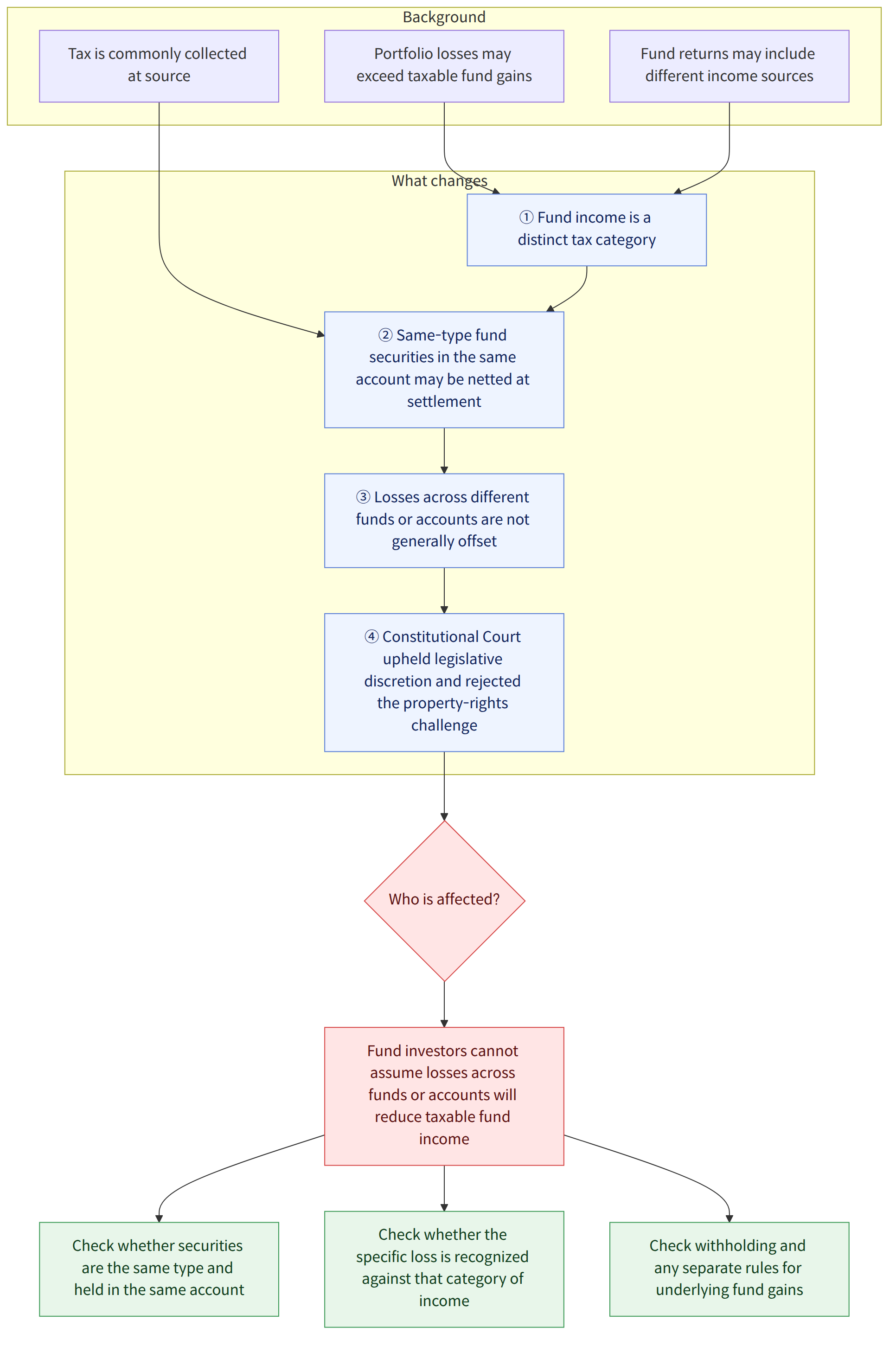
The short answer is that Korean law does not generally permit that broad, fund-to-fund offset. Some netting may be reflected within a defined account and among the same type of fund securities under the applicable rules, but an investor cannot assume that losses across different funds or accounts will reduce taxable fund income.
3 — What Korean Law Says
Korean tax law treats income from collective investment schemes—commonly called investment funds—as a particular category of income. It does not automatically calculate an individual investor’s tax by adding every gain and loss across the person’s entire investment portfolio.
The tax result for fund income is not necessarily the same as the investor’s overall economic result. A taxable gain from a fund may remain taxable even when losses elsewhere leave the investor worse off overall.
The rules reflect several features of fund investment:
- Fund income can come from different sources. A fund’s returns may include interest, dividends, realized gains, or other forms of income, each with a different economic character.
- The investor’s return is indirect and may be intermittent. Unlike income from an ongoing business, fund income is generated through pooled assets and may be recognized at particular distribution or settlement points.
- Tax is commonly collected at source. Withholding tax allows tax to be collected through the financial institution when income is paid or recognized, rather than requiring investors to reconcile every fund transaction themselves.
- Some netting is possible within a prescribed unit. Under the relevant rules, gains and losses among same-type fund securities held in the same account may generally be reflected together at settlement. That limited calculation should not be confused with an entitlement to net every fund against every other fund.
- The treatment of some underlying gains is already shaped by separate rules. For example, certain capital gains generated within funds from listed shares may be excluded from the taxable calculation under specified conditions.
A loss in one fund does not automatically erase taxable income from another. Whether any loss is recognized depends on the statutory category, the account, the type of fund security, and the applicable calculation rules.
The Constitutional Court has held that the legislature may decide which income is taxable and how far losses may be deducted. In assessing that choice, it may weigh tax fairness and market policy against the simplicity and efficiency of collecting tax. The Court concluded that refusing general cross-fund netting did not exceed the legislature’s discretion or violate the investor’s property rights.
4 — How Korean Courts Approach This
Korean courts generally distinguish between economic loss and tax-deductible loss. A person may have lost money overall without the tax code allowing every loss to be deducted from every taxable receipt. The legal question is not only whether the investor’s portfolio declined, but whether the relevant tax rules recognize that particular loss against that particular category of income.
The courts also give the legislature room to design tax systems. In the fund context, the Constitutional Court has emphasized that lawmakers may account for the mixed sources of fund returns, the existing tax treatment of some market gains, and the practical difficulty of sharing information across financial institutions.
Courts do not ordinarily replace a tax system chosen by the legislature with a different system simply because another method—such as portfolio-wide netting—might also be reasonable. The key question is whether the statutory choice falls outside the legislature’s permissible policy discretion.
That approach does not mean every tax calculation is automatically correct. It means a general challenge to the rule against cross-fund loss offsets is unlikely to succeed merely because the investor’s total investment performance was negative.
5 — Applying the Law to Daniel’s Case
First, identify what produced the taxable amount. Daniel must determine whether the amount was income recognized from a collective investment scheme, rather than assuming it represents the net change in the value of all his investments. A fund’s tax statement and the financial institution’s withholding records are important starting points.
Second, identify where the loss arose. If Daniel’s loss came from a different fund, a different type of fund security, or a separate account, the general rule is that he cannot simply subtract it from the earlier fund income. His overall portfolio loss does not, by itself, create a tax deduction against that income.
Third, check whether the limited same-account calculation applies. If the gain and loss concern the same type of fund securities in the same account, applicable settlement rules may already combine them when the taxable amount is calculated. Daniel should check the account-level statement and ask the institution how it applied those rules. The answer may differ from a broad attempt to combine unrelated funds.
Fourth, consider the constitutional argument. Daniel could argue that taxing gains while disregarding larger losses is unfair. But that argument closely resembles the challenge the Constitutional Court rejected. The Court accepted that lawmakers could choose not to allow general cross-fund netting, considering the nature of fund income, market policy, and the costs of administering a broader system.
On the facts given, Daniel’s losses in other investments would therefore not automatically reduce the taxable income from his profitable fund. His best practical route is to verify the specific classification and calculation—not to assume that his portfolio’s total loss controls the tax result.
If you are dealing with a similar issue, attorney Ji-sun Ahn of Ijun Law Firm can review the statements for each investment fund, records of realized gains and losses, and the tax calculation with you. These details can help clarify which options apply to your situation.
6 — Conclusion: What Happened, and What Should You Do?
Daniel checked the statements and learned that the loss was recorded in a different fund from the one that had generated the taxable income. The limited same-account, same-type netting rule did not apply. The withholding was therefore not cancelled merely because his combined investment position was negative. He remained responsible for the tax calculated under the fund-income rules, although he could still challenge a mistake in the institution’s classification or arithmetic.
For readers in a similar position:
- Separate your overall investment performance from your tax calculation. Obtain the annual tax statement and identify the exact fund and income category behind each taxable amount.
- Ask whether the same-account, same-type netting rules apply. Request a written explanation from the financial institution if the calculation is unclear, and check the rules for the relevant tax year.
- Get advice before filing or disputing the amount. Fund structures and tax treatment vary, and a tax professional can determine whether a particular loss is legally deductible or whether the issue is simply an incorrect withholding calculation.

















