

1. A Human Story
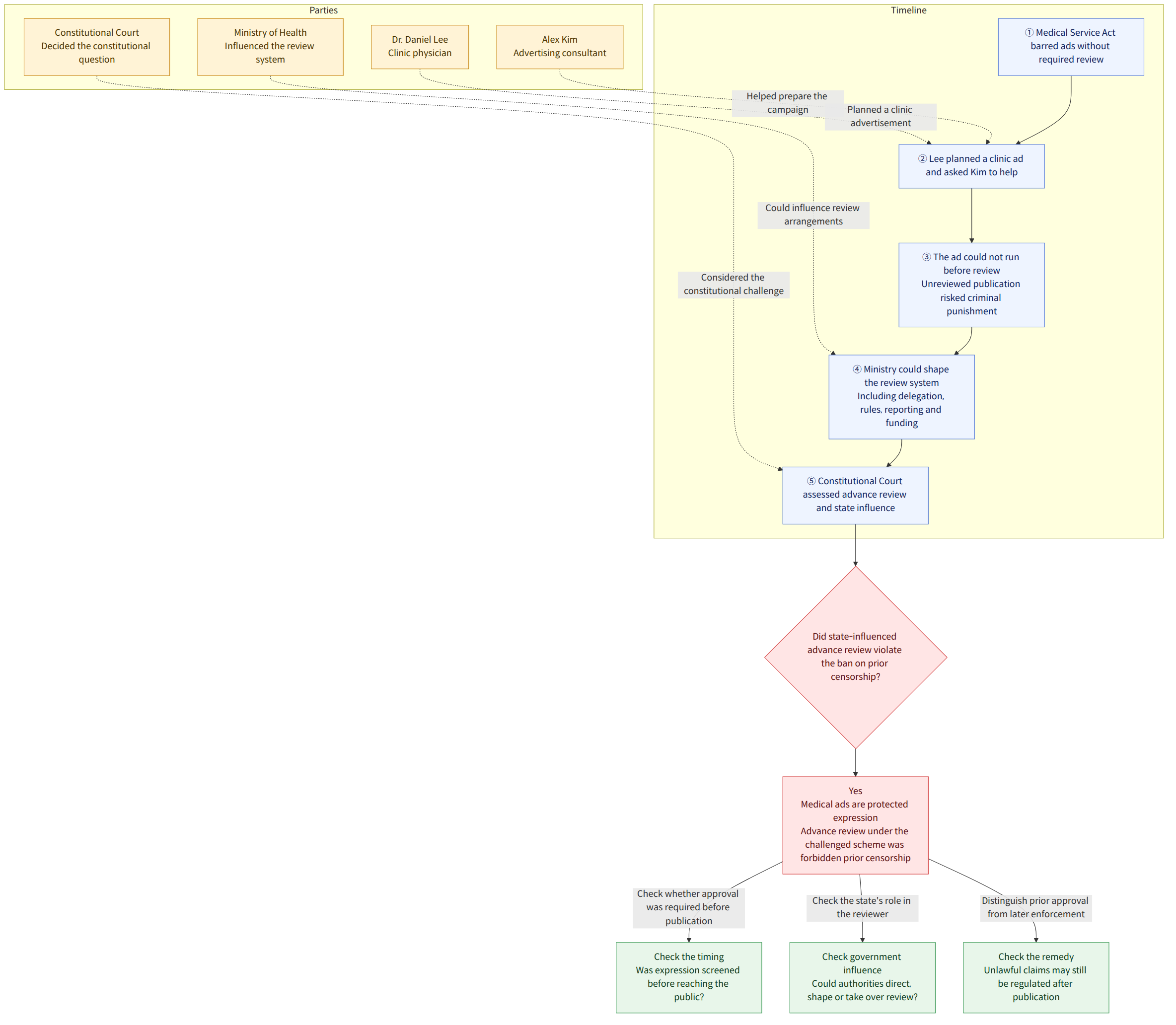
Dr. Daniel Lee had spent years building a small neighborhood clinic. He wanted to advertise a new service and explain, in ordinary language, what patients could expect. He asked Alex Kim, an advertising consultant who also sold medical devices, to help prepare the campaign. Their proposed material was ready, but they were told that it could not run unless it first went through a medical-advertising review process.
The requirement seemed more than a technical hurdle. Under the law then in force, publishing an advertisement without the required review could expose those responsible to criminal punishment. Daniel and Alex wondered whether the government could make permission a condition of speaking about a medical service at all. Their dispute became a constitutional question: can health advertising be screened before publication by a body operating under substantial government influence?
2. The Legal Question
The central question was whether prohibiting medical advertisements that had not received advance review—and criminally punishing that conduct—violated South Korea’s constitutional ban on prior censorship of speech and the press.
3. What Korean Law Says
The relevant constitutional guarantee is direct:
The Constitution provides that licensing or censorship of speech and the press shall not be recognized.
The Medical Service Act provisions at issue barred medical corporations, medical institutions, and medical professionals from publishing an advertisement that had not received the review required by the Act. A separate provision imposed criminal punishment for violating that prohibition.
The Constitutional Court treated the issue as one of prior censorship: a system that examines expression before it reaches the public and can prevent publication. Its reasoning rested on several principles:
- The ban is categorical. The Constitution does not create an exception allowing prior censorship simply because a particular kind of speech is considered especially sensitive or in need of regulation.
- Medical advertising is protected expression. Its commercial nature and connection to health care do not remove it from the protection against prior censorship.
- The reviewer’s formal identity is not decisive. A professional association may conduct the review, but the court looks at whether the state retains meaningful control or influence over the process.
- Post-publication regulation is different. The ruling did not give advertisers permission to make false, deceptive, or otherwise unlawful claims. It addressed the requirement that an advertisement receive approval before publication under the challenged scheme.
In assessing government influence, the Court considered the structure of the review system, including whether the ministry could withdraw its delegation and take over the work, whether regulations shaped the review committee, whether review results had to be reported to the ministry, whether the ministry could provide financial support, and whether rules on standards and procedures were set through government regulations.
4. How Korean Courts Approach This
The Constitutional Court’s approach is to examine how a review system operates in practice, not merely what it is called. Describing a process as professional self-regulation does not settle the constitutional question if government authorities can direct, supervise, or meaningfully shape the reviewers’ work.
Where a system screens protected expression before publication and the state retains significant influence over the screening body, the process may amount to constitutionally forbidden prior censorship.
The Court also rejected the idea that certain subjects can simply be excluded from this protection because advance control might be useful. The constitutional rule is not limited to speech that courts consider harmless or low-risk. At the same time, a ban on prior censorship does not prevent the government from enforcing valid rules against unlawful advertising through measures that do not require state-controlled approval before publication.
5. Applying the Law to the Case
The Court’s reasoning maps closely onto Daniel and Alex’s situation.
- The advertisements were subject to advance review. Daniel and Alex could not publish the proposed medical advertising without first obtaining a review under the statutory scheme. That was a condition imposed before the speech reached its audience.
- The review body was not sufficiently independent of government influence. Although medical associations carried out the reviews, the ministry had several forms of influence over the arrangement. It could withdraw the delegation and perform the review itself; government rules shaped the committee’s composition and the review framework; and the review bodies had reporting obligations to the ministry. The ministry could also provide financial support to medical organizations.
- Calling the process professional review did not remove the constitutional problem. The relevant question was whether the reviewers could act independently and autonomously. Considering the ministry’s powers and the regulatory structure as a whole, the Court concluded that this independence could not be assumed.
- Criminal punishment strengthened the restriction. The law did not merely encourage review. It prohibited unreviewed advertisements and attached criminal liability to that conduct. The state therefore used punishment to enforce a system that required advance screening.
The Constitutional Court held that the challenged portions of the Medical Service Act were unconstitutional: the provision barring advertisements that had not received the required review, and the corresponding portion of the criminal-punishment provision. The decision concerned those particular provisions and that particular review structure; it should not be read as a declaration that every later or differently designed review system is automatically unconstitutional.
If you are dealing with a similar issue, attorney Ji-sun Ahn of Ijun Law Firm can review the provision applied in your case, the ruling or notice you received, and the dates relevant to challenging it with you. These details can help clarify which options apply to your situation.
6. Conclusion: What Happened, and What Should You Do?
Daniel and Alex’s constitutional objection succeeded. The Court concluded that the statutory scheme they faced amounted to prior censorship because it required medical advertisements to be reviewed before publication by bodies that were not sufficiently independent of government influence. The challenged prohibition and the linked criminal penalty were struck down.
The ruling did not mean that Daniel could advertise anything he wished. Medical claims can still be subject to lawful restrictions, including rules against false or misleading statements. Nor does the decision alone establish the rules that apply to every current advertising scheme; the governing legislation and review arrangements may have changed since the provisions challenged in the case.
For anyone planning a medical advertisement in Korea:
- Check the current rules before publishing. Confirm which requirements apply to your type of service, product, and advertising channel, rather than relying only on an older court ruling.
- Keep evidence for factual claims. Retain reliable support for statements about results, benefits, risks, and professional qualifications.
- Get advice when the rules are unclear. A Korean lawyer familiar with medical-advertising regulation can help distinguish a lawful content restriction from an unconstitutional demand for advance approval.

















