
1. A Human Story
For Daniel Park, the hardest part of prison was not the locked door but the narrow strip of floor he had to share with the men around him. In a crowded cell, there was scarcely room to stretch his arms and legs. At night, he had to lie turned on his side, pressed close to others, trying to sleep without taking space someone else needed.
The conditions lasted for days, not just a single uncomfortable night. Daniel found it difficult to rest and to carry out the basic routines of life with any sense of privacy or ease. He began to wonder whether overcrowding was simply an unavoidable consequence of imprisonment—or whether the state had a constitutional duty to provide more room.
2. The Legal Question
Can a prison’s cramped living conditions themselves violate an inmate’s human dignity, even though confinement is part of a lawful sentence? And how do Korean courts decide when overcrowding has become so severe that it crosses that constitutional line?
3. What Korean Law Says
The Korean Constitution protects human dignity and value. Imprisonment restricts liberty, but it does not erase a person’s status as a human being. The state’s authority to punish therefore has limits: the conditions of confinement cannot deprive someone of the basic space and circumstances needed to live with minimum human dignity.
When the space available to each prisoner is so small that even basic human needs cannot reasonably be met, the conditions may exceed the limits of the state’s power to punish and violate human dignity.
There is no single square-meter figure that automatically decides every overcrowding claim. A court examines the circumstances as a whole, including:
- Actual usable space per person, rather than merely the cell’s stated or gross floor area.
- The number of people held and the layout and condition of the cell.
- How long the overcrowded conditions lasted.
- How the facility was operated overall, as well as other relevant circumstances, including budget considerations.
These factors matter because the same measurement may have different implications depending on the cell, the length of confinement, and the practical ability of inmates to meet basic needs.
4. How Korean Courts Approach This
Korean courts treat extreme overcrowding as more than a matter of inconvenience. They consider whether a prisoner was left with so little personal space that ordinary physical needs and basic activities became difficult, and whether the conditions were severe enough to cause or risk substantial physical or mental distress.
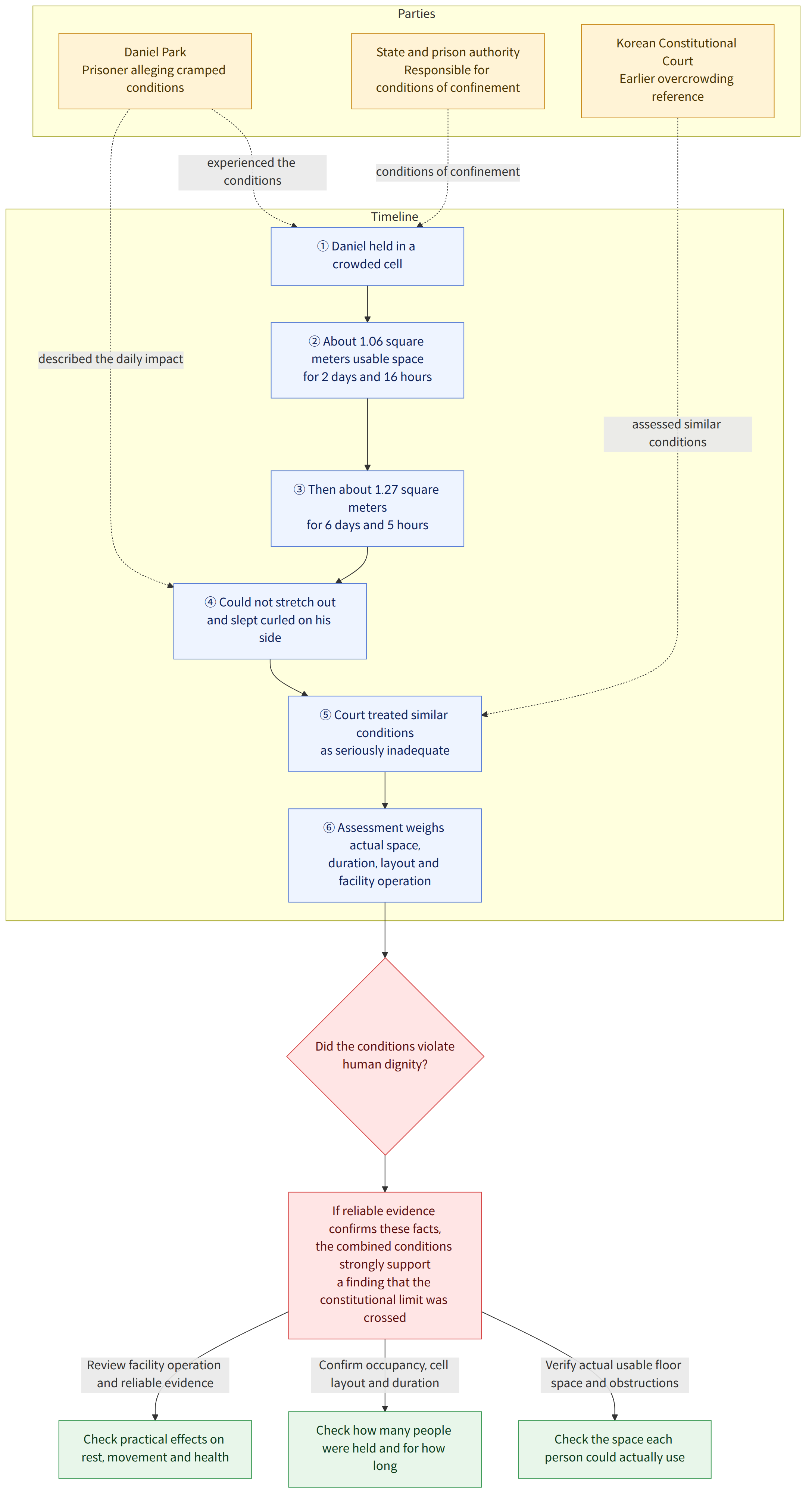
In assessing that question, the Constitutional Court has treated as seriously inadequate conditions in which an adult male had only 1.06 square meters of actual personal space for two days and sixteen hours, and 1.27 square meters for six days and five hours. The Court reasoned that a person of average adult male height would struggle to stretch out and might have to sleep tightly curled on his side. Such conditions could seriously affect health and deny a person the basic conditions needed to function as an individual.
Those measurements are important reference points, not a universal legal formula. A court still looks at the duration and reality of the confinement and the facility’s circumstances. Limited public resources may form part of that assessment, but they do not automatically make conditions compatible with human dignity.
5. Applying the Law to Daniel’s Case
Daniel’s claim would turn first on what space he could actually use. If the available floor area was divided by the number of people in the cell, the result would need to reflect obstructions and the practical layout—not simply the cell’s total area on a plan.
Next, the length and severity of the conditions would matter. In Daniel’s fictional case, records show that he had approximately 1.06 square meters of usable personal space for two days and sixteen hours, followed by 1.27 square meters for six days and five hours. Those periods and measurements are comparable to conditions Korean constitutional reasoning has regarded as exceptionally cramped. His account that he could not stretch out and had to sleep curled on his side would also help explain what the figures meant in daily life.
Finally, a court would consider the wider circumstances: the number of people held in the cell, its layout, how the facility was operated, and whether the conditions persisted. No single measurement guarantees a result. But if Daniel’s records and reliable evidence establish the facts described above, the combination of extremely limited usable space, the duration, and the practical inability to rest or move normally strongly supports a finding that his treatment crossed the constitutional limit.
6. Conclusion: What Happened, and What Should You Do?
On the facts assumed here, Daniel’s conditions were not merely uncomfortable. His personal space was extraordinarily limited for sustained periods, and the cell left him unable to stretch out or sleep normally. Applying the Korean constitutional principles described above, his treatment should be regarded as a violation of human dignity, subject to confirmation of the facility records and the surrounding circumstances.
For anyone facing a similar situation:
- Keep a dated record of the cell, the number of occupants, the duration of each placement, and the practical effects on sleep and basic daily activities.
- Preserve documents and evidence that may establish the cell’s dimensions, layout, occupancy, or changes in conditions; distinguish usable personal space from the cell’s gross area.
- Seek an individual review before making a claim. The relevant records and the exact periods of confinement can determine how the general constitutional principles apply.
A review of cell-assignment records, occupancy figures, floor plans, and the dates Daniel spent in each cell could help clarify the actual usable space and duration relevant to a constitutional claim; a reader in a similar position could ask attorney Ji-sun Ahn of Ijun Law Firm to review those documents and the specific facts.

















