
1. A Human Story
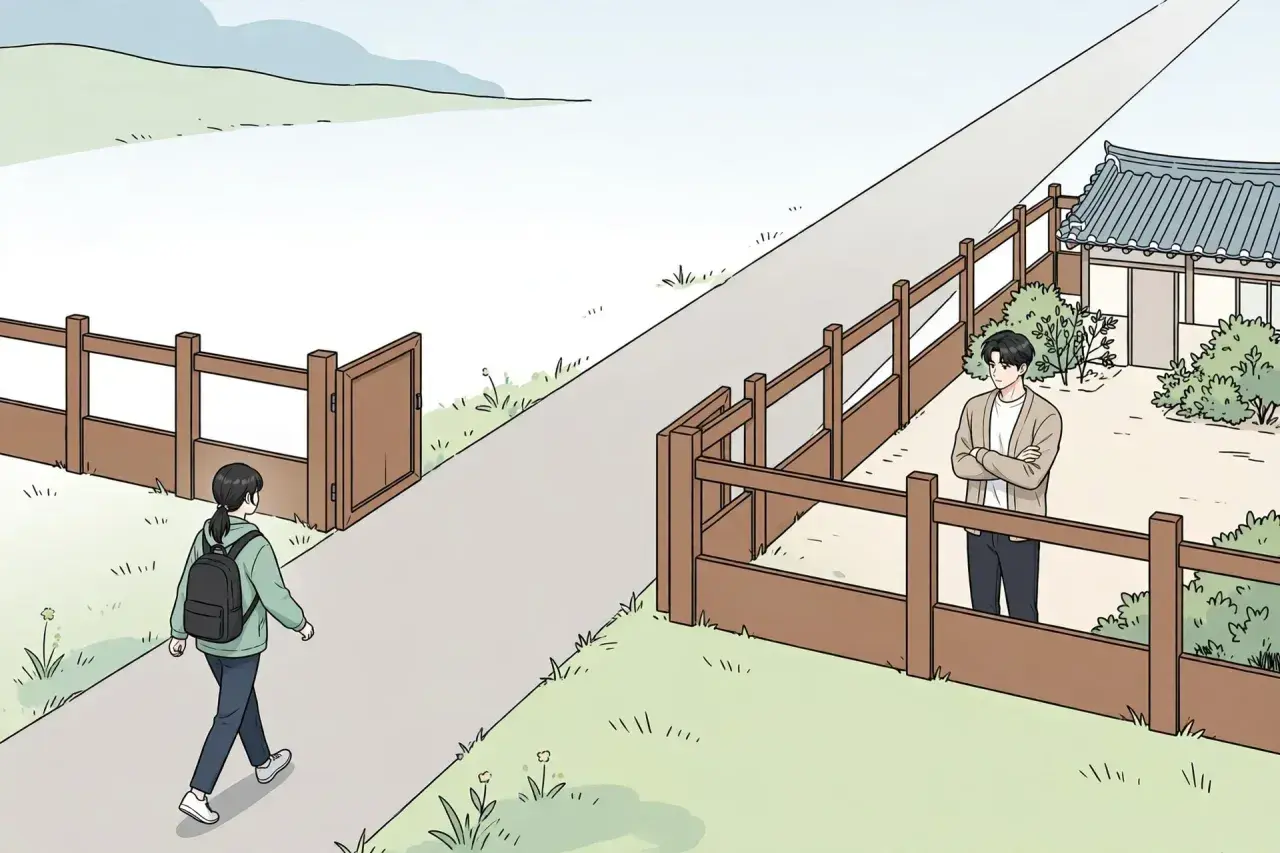
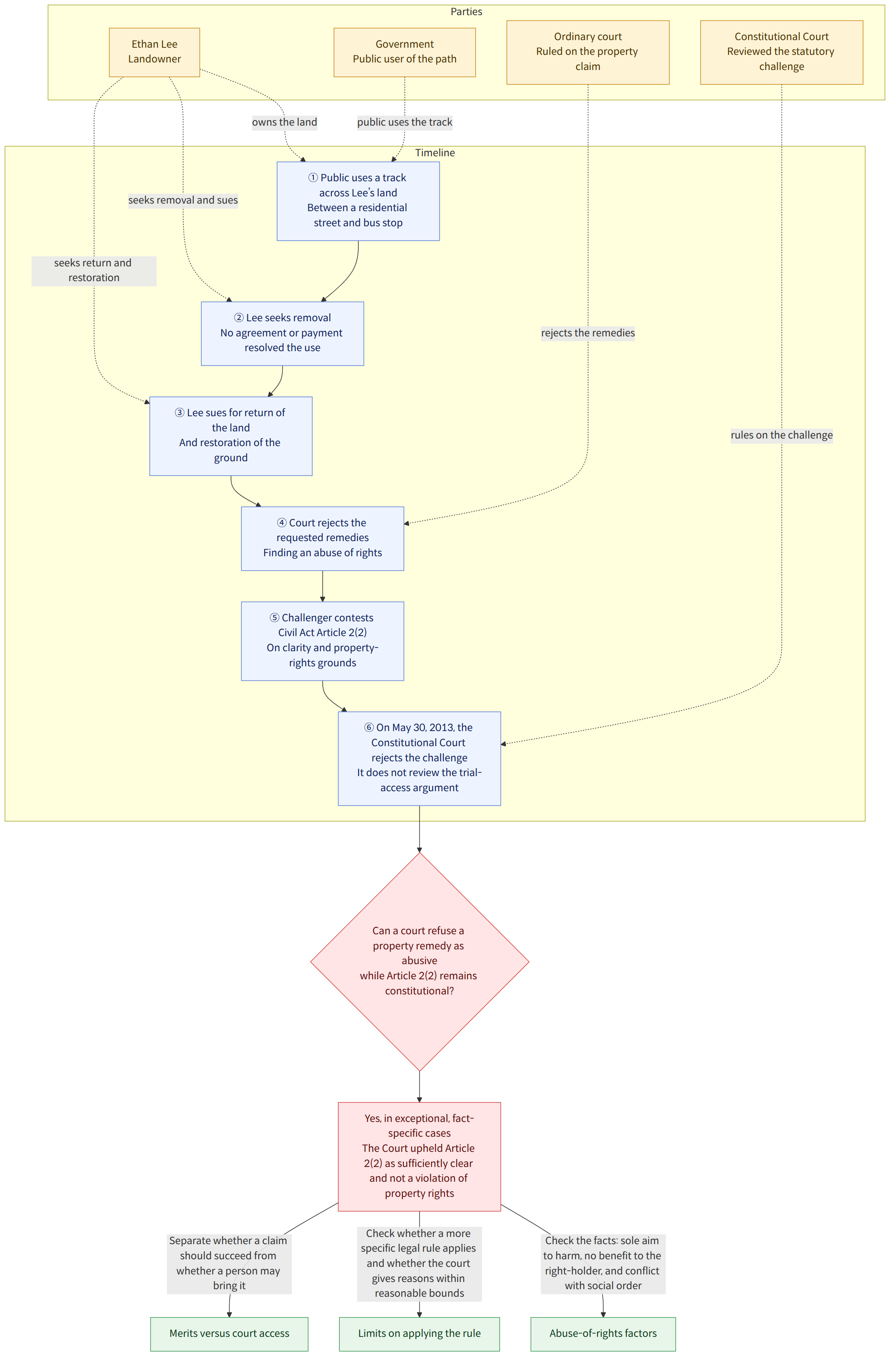
For years, a narrow track across Ethan Lee’s land had served as a convenient route between a residential street and a bus stop. The public used it as though it were an ordinary walkway. Ethan had never agreed to let the government use the strip, and no formal arrangement or payment had resolved the matter.
After asking for the path to be removed without success, Ethan sued. He wanted the land returned to him and the ground restored. But the court rejected his claim, finding that, in the circumstances, insisting on those remedies would amount to an abuse of rights. Ethan felt the result turned property ownership on its head: if the land was his, he asked, how could the law prevent him from reclaiming it?
2. The Legal Question
Ethan’s dispute raises two connected questions: Can a Korean court refuse to enforce a property right because exercising it would be abusive? And is the Civil Act’s abuse-of-rights rule so vague or restrictive that it violates the Constitution’s protections for clarity and property?
3. What Korean Law Says
Article 2(2) of Korea’s Civil Act states:
“The exercise of rights and the performance of duties shall be in accordance with the principle of good faith. No abuse of rights shall be permitted.”
The rule does not mean that courts may disregard ownership whenever a claim seems inconvenient. It addresses the exceptional case in which a right appears valid on its face, but using it would be inconsistent with the right’s social purpose or with the social nature of rights.
In practical terms, courts consider the circumstances surrounding the exercise of the right. A Supreme Court formulation, cited by the Constitutional Court, describes abuse where the right is exercised solely to cause the other party pain or loss, the person exercising it receives no benefit, and the conduct is objectively contrary to social order. The rule is applied through judicial examination of the particular facts, not through an automatic bar on property claims.
The Constitutional Court has also emphasized two limits on the provision:
- It is a general principle used when the dispute cannot be appropriately resolved by applying a more specific legal provision.
- Courts must identify the relevant conditions and apply the rule within reasonable bounds; it is not enough merely to say that a claim feels unfair.
In a decision dated May 30, 2013, the Constitutional Court rejected a challenge to Article 2(2). It held that the phrase “abuse of rights” was not too unclear to satisfy the constitutional principle of clarity, and that the provision did not violate property rights. The Court reasoned that the concept could be understood by reference to the social purpose of a right and that courts had confined its application through defined principles.
The challenger also invoked the right to seek a trial. The Constitutional Court did not include that argument in the issues it would review, reasoning that Article 2(2) does not itself restrict access to the courts. The provision concerns whether a claim should succeed on its merits, not whether a person may bring a case.
4. How Korean Courts Approach This
Korean courts generally begin with the premise that a right recognized by law may be exercised. The abuse-of-rights doctrine is a narrow qualification, not a general license to balance away a person’s rights whenever another outcome seems more useful to the public.
Courts examine both the purpose and the effects of the particular exercise of a right. The Supreme Court’s stated test highlights a combination of factors: an aim solely to harm another, no meaningful benefit to the right-holder, and conduct objectively at odds with social order. The circumstances matter, and the conclusion must be supported by the facts.
That restraint also explains the Constitutional Court’s approach. It viewed the provision as a supplementary principle for difficult cases, with the ordinary courts responsible for applying it in a reasoned and limited way. The rule’s flexibility, in other words, did not make it unconstitutional in itself.
5. Applying the Law to the Case
Ethan’s claim involved more than an abstract disagreement over wording in the Civil Act. He asked a court to order the government to stop using a strip of his land as a public passage and to restore it. The court considered that specific request and ruled against him on the ground that it was an abuse of rights.
The legal analysis proceeds in stages:
- Ownership does not settle every question about how a right may be exercised. Ethan’s ownership gave him a serious legal interest in controlling the land. But Article 2(2) permits a court to consider whether the particular demand for possession and restoration crossed the narrow line into abuse.
- The court had to assess the exercise of the right in context. The relevant question was not simply whether Ethan owned the strip or whether the public used it. It was whether, in the circumstances, insisting on the requested remedies departed from the social purpose of the right and met the demanding judicial standards for abuse. The source facts do not establish every detail the court considered, so it would be wrong to assume that public convenience alone was enough.
- A constitutional challenge was not a substitute for disputing the factual application. The Constitutional Court concluded that Article 2(2) is sufficiently clear because its meaning can be understood through the social purpose of rights and the courts’ developed standards. It also found no unconstitutional deprivation of property: the provision is applied as a limited, case-specific principle, not as a blanket rule against owners.
- The right to bring a case remained distinct from the right to win it. Ethan was able to ask a court to decide his claim. The Constitutional Court did not treat the abuse-of-rights provision as a restriction on that access; it excluded the argument from review on that basis.
On these facts, then, Ethan’s constitutional challenge would not by itself invalidate the rule or reopen the dispute simply because he disagreed with the court’s conclusion. The key legal contest was whether the lower court had properly applied the narrow abuse-of-rights standard to the evidence in his case.
If you are dealing with a similar issue, attorney Ji-sun Ahn of Ijun Law Firm can review the land register, agreements or permits affecting the property, and the dates when rights were registered or changed with you. These details can help clarify which options apply to your situation.
6. Conclusion: What Happened, and What Should You Do?
Ethan’s case ends with a difficult distinction: ownership remains protected, but Korean law does not treat every exercise of ownership as automatically permissible. The Constitutional Court upheld Article 2(2), finding it neither too vague nor an unconstitutional infringement of property rights. It did not decide that every public use of private land is lawful, or that every owner’s demand to reclaim land is abusive. The outcome depends on the particular circumstances and on whether the ordinary court applies the doctrine within its proper limits.
For owners facing a similar situation:
- Document the occupation and your response. Keep records of when the use began, who controls or maintains the route, your requests to stop it, and any effects on the property.
- Get advice before choosing a remedy. A lawyer can assess ownership documents, possible claims, and the facts a court may weigh when deciding whether a demand is an abuse of rights.
- Challenge the application, not just the rule. If you believe a court applied Article 2(2) too broadly, focus on the evidence and reasoning in your case. A general claim that the provision is unconstitutional is unlikely to succeed on its own.

















