

1. A Human Story
When Daniel Reed inherited a narrow strip of land beside a local river, he imagined a modest project: repairing an old shed and planting a small garden. The property had been in his family for decades, and his name was now on the title. To Daniel, it was plainly his land.
Then a local official explained that the parcel was designated as land forming part of a local river under Korea’s River Act. Daniel could still transfer ownership or use the land as security for a mortgage, the official said, but he could not simply use it as he pleased. Certain activities would require a river-occupation permit. Daniel wondered whether the law had left him with ownership in name only—and whether that was an unconstitutional taking of his property.
2. The Legal Question
Can Korea constitutionally restrict an owner’s ability to use land that forms part of a river, even when the land remains privately owned? And if such limits are lawful, what practical options remain for the owner?
3. What Korean Law Says
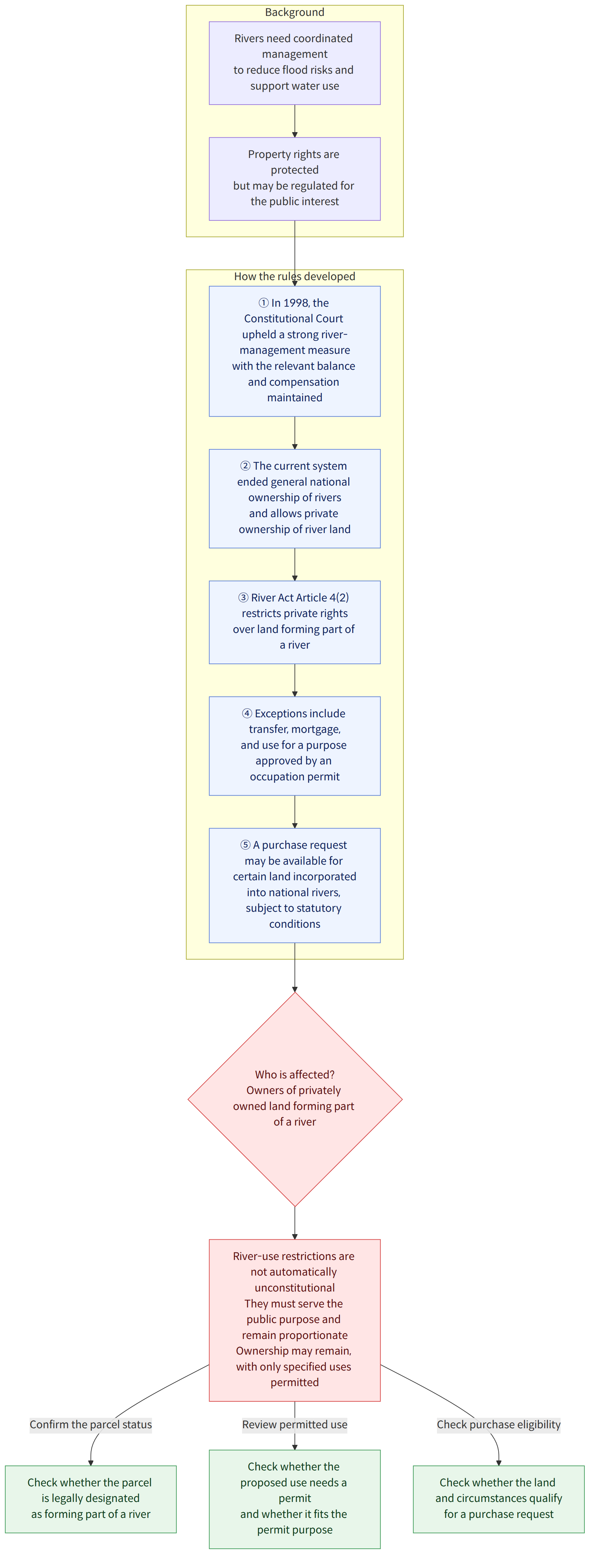
The governing rule is in Article 4(2) of the River Act. It restricts the exercise of private rights over land forming part of a river and other river facilities, while making specific exceptions.
“No private rights may be exercised over land constituting a river or other river facilities,” except in specified cases, including transfer of ownership, creation of a mortgage, and use for an approved purpose under a river-occupation permit.
In practical terms, the listed exceptions mean:
- Ownership may be transferred. The statutory restriction does not, by itself, prevent the owner from transferring title.
- A mortgage may be created. The land may be used as security in that legally recognized way.
- Use may be permitted. The owner—or another person with the owner’s consent—may use the land for a purpose authorized by a river-occupation permit under Article 33. The permit is limited to its approved purpose; it is not a general right to use the site however the holder wishes.
The constitutional backdrop is the protection of property rights under Article 23 of the Constitution. Property rights are protected, but they may be regulated by law for the public interest. The central question is whether the burden is justified and proportionate, rather than whether an owner faces any restriction at all.
The Constitutional Court has considered the public need to manage river land, including land beside the flowing channel, as a whole. In an earlier decision concerning the former River Act, it explained that lawmakers could choose between different management approaches—such as public ownership or restrictions on private use—after weighing river-management needs against the burden on property owners.
The legislature’s choice is generally respected unless it is plainly arbitrary or goes beyond what is proportionate to the public purpose. The Court also recognized the importance of appropriate compensation where a more severe measure, such as public acquisition, is used.
The legal framework has since changed. The current system abandoned the former general principle of national ownership of rivers and instead allows private ownership of river land while restricting the exercise of private rights. The law also provides a purchase-request mechanism for certain land incorporated into national rivers. Whether that mechanism is available depends on the land and the statutory conditions; it should not be assumed to apply to every parcel beside a local river.
4. How Korean Courts Approach This
Korean courts generally recognize that rivers are not ordinary pieces of land. They are part of a natural system that must be managed to reduce flood risks and support the proper use of water. A fragmented, parcel-by-parcel approach can make that management difficult.
At the same time, courts do not treat public benefit as a blank cheque. They look at the purpose and severity of the restriction, the distinctive features of river land, and the balance between effective river management and the owner’s loss of use. The legislature has room to choose how rivers are managed, but a measure that is obviously arbitrary or disproportionate may face constitutional difficulty.
In a 1998 decision reviewing provisions of the former River Act, the Constitutional Court accepted that a strong river-management measure could serve a major public interest and was not unconstitutional where the relevant balance—including appropriate compensation for the more severe measure under consideration—was maintained. That decision provides important context, but it concerned an earlier legal framework. It does not establish that every current restriction is lawful in every circumstance, nor does it automatically resolve what remedy a particular owner may have today.
5. Applying the Law to the Case
Daniel’s situation can be assessed in several steps.
- Confirm the legal status of the parcel. The first issue is whether his land is officially classified as land constituting a river under the River Act, rather than merely being near a river. He should obtain the relevant designation and boundary records from the responsible authority.
- Identify exactly what he wants to do. Repairing a structure, planting, building, or making another change may be treated differently depending on its nature and effect on river management. Daniel should not assume that ownership alone authorizes a proposed use.
- Check whether a permit is available. If his intended use requires a river-occupation permit, he can ask the authority about the application requirements and whether the proposal is compatible with the approved purpose of managing the river. If someone other than the owner seeks to use the land, the statute requires the owner’s consent for the permit route described in Article 4(2).
- Consider the constitutional balance. Daniel’s ability to use the land is significantly constrained, but the law preserves certain rights, including transfer and mortgage, and leaves open permitted use. The public purposes—river management, appropriate use, and flood-risk prevention—are substantial. Under the principles applied by the Constitutional Court, those features make it difficult to argue that the statutory rule is unconstitutional merely because it limits ordinary private use.
- Separate a constitutional challenge from a compensation or purchase question. A claim that the restriction is unconstitutional is not the same as asking the government to purchase the land or compensate for a particular loss. The purchase-request mechanism described in the current framework concerns certain land incorporated into national rivers. Daniel’s parcel is designated as part of a local river, so he should not assume that the national-river mechanism covers him. He must ask the competent authority whether any other statutory remedy or compensation route applies to his specific facts.
On the information available, Daniel’s strongest immediate course is not to treat the law as invalid on its face, but to establish the parcel’s exact status and test whether his intended use can be authorized. A constitutional challenge would face a demanding balancing analysis, although unusual facts—such as an application of the law that is arbitrary or imposes an exceptionally severe burden—could matter.
If you are dealing with a similar issue, attorney Ji-sun Ahn of Ijun Law Firm can review the land register, agreements or permits affecting the property, and the dates when rights were registered or changed with you. These details can help clarify which options apply to your situation.
6. Conclusion: What Happened, and What Should You Do?
Daniel obtained the river-boundary records and learned that his parcel was indeed covered by the River Act. He revised his garden plan and applied for permission for the work that required approval. The authority allowed the limited use specified in the permit, but not the unrestricted use he had first imagined. His title remained his, yet his options were shaped by the public rules governing the river.
For owners in a similar position:
- Verify the designation and boundaries through the responsible local or river-management authority before beginning work or concluding that the land is legally part of a river.
- Describe your proposed use precisely and ask whether an Article 33 river-occupation permit is required, available, and subject to conditions.
- Ask in writing about purchase or compensation options. Confirm which statutory scheme applies to the parcel; a mechanism for certain national-river land should not be assumed to cover local-river land.

















