

1. A Human Story
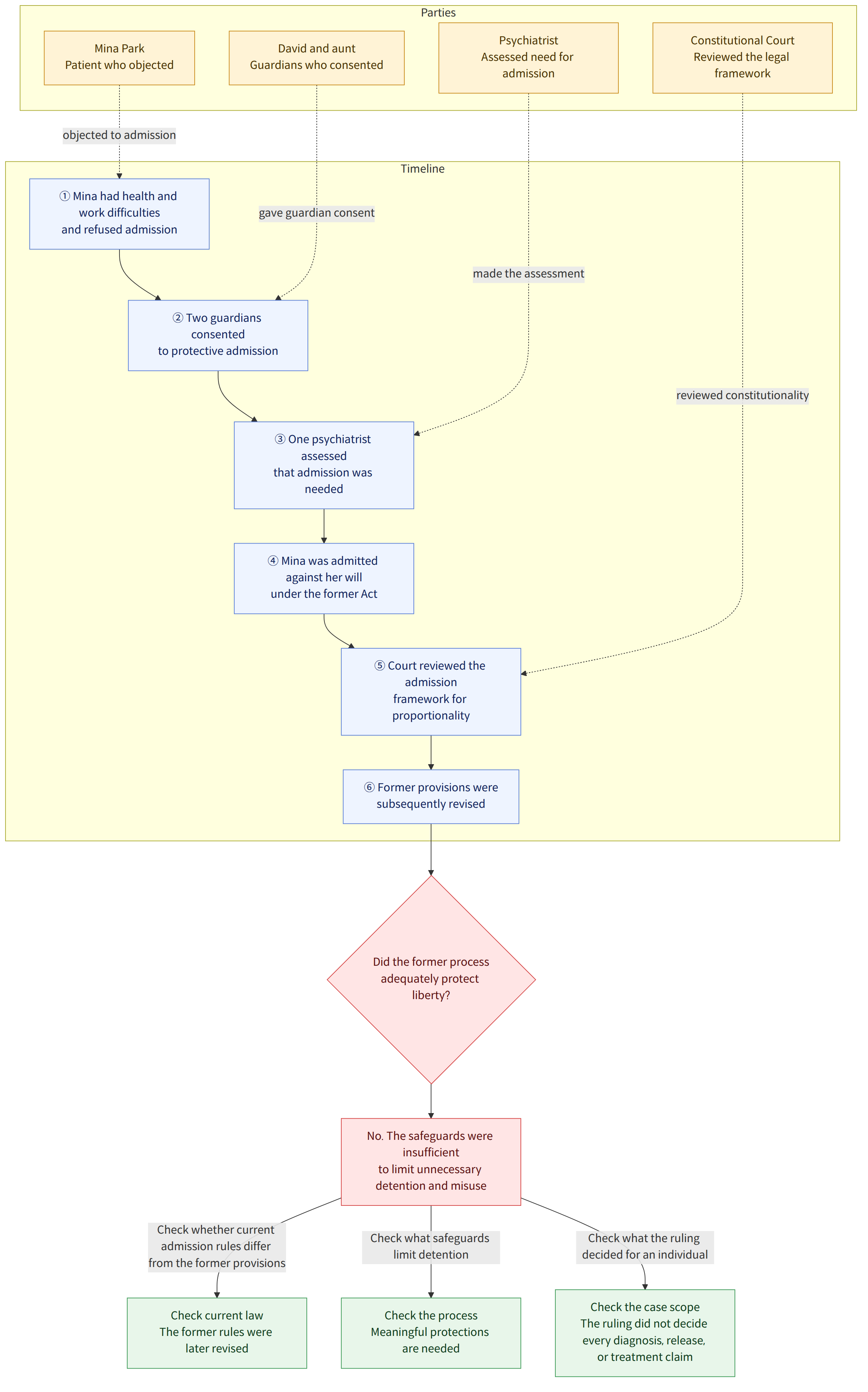
When Mina Park began sleeping through the day and missing work, her family grew frightened. Her older brother, David, and their aunt thought a hospital stay might keep Mina safe and help her recover. Mina disagreed. She said she wanted to see her own doctor and would not consent to being admitted.
Under the law then in force, David and their aunt could sign as her guardians, and a psychiatrist’s diagnosis could complete the process. Mina was taken to a psychiatric institution against her will. The arrangement could keep her there for up to six months, even though she had not agreed to treatment and could not simply decide to leave. Her family described the decision as protection. To Mina, it felt like confinement.
2. The Legal Question
Could the state permit a person to be hospitalized against their will for up to six months based on the consent of two guardians and the assessment of one psychiatrist, without adequate safeguards to protect the patient’s liberty?
3. What Korean Law Says
The dispute concerned provisions of the former Mental Health Act, as amended in 2011. Those provisions allowed a form of “protective admission” when two guardians consented and one psychiatrist diagnosed the patient as needing admission. A patient’s own objection did not, by itself, prevent admission, which could continue for up to six months under that framework.
The constitutional issue was not whether psychiatric treatment or public safety could ever justify a non-consensual admission. It was whether this particular process placed too great a burden on a person’s freedom, without enough checks against error or abuse.
Involuntary psychiatric admission can restrict freedom at a level comparable to physical detention. Its therapeutic or public-safety benefits do not remove the need to minimize that restriction and guard against misuse.
The Constitutional Court applied the principle of proportionality: a restriction on a constitutional right must pursue a legitimate goal, use a suitable method, go no further than necessary, and maintain a reasonable balance between the public benefit and the harm to the individual.
- Legitimate aim: Protecting a person in need of treatment and promoting public safety can be valid legislative aims.
- Suitable method: Hospitalization may, in some circumstances, help achieve those aims.
- Least-restrictive means: The system must include meaningful protections that limit unnecessary detention and reduce the risk of misuse.
- Balance of interests: The public benefit must be weighed against the serious loss of liberty imposed on the patient.
The Court accepted the legitimacy of the aims and the general suitability of the measure. But it concluded that the former provisions did not sufficiently meet the final two requirements. The constitutional defect lay in the safeguards—or lack of safeguards—in the admission process, not in the proposition that psychiatric care may ever be necessary.
4. How Korean Courts Approach This
Korean constitutional review treats personal liberty as a core right, not a benefit that can be set aside simply because others believe a person needs help. When the state authorizes confinement, courts examine both the reason for detention and the process used to impose it.
A protective purpose does not make confinement harmless. The law must guard against unnecessary detention and ensure that a person is not isolated from society merely because they have a mental illness.
In Mina’s situation, the Court recognized that treatment and safety could justify some carefully controlled admissions. But it also stressed that an involuntary process must not become a one-way route from a family’s concern to a lengthy loss of freedom. The law needed stronger ways to limit the intrusion and to prevent protective admission from being used as a means of excluding people from society.
The Court’s ruling addressed the constitutionality of the legal framework. It did not, on its own, establish that every person admitted under that framework had been improperly diagnosed, nor did it automatically resolve every individual patient’s release or treatment claim. The legal framework was subsequently revised; the former provisions should not be treated as a statement of the rules that govern admissions today.
5. Applying the Law to the Case
Mina’s case illustrates why each part of the constitutional analysis mattered.
- The aim was serious and legitimate. Her family and the state could have genuine reasons to worry about her health or safety. The Court did not dismiss those concerns or hold that involuntary treatment is never permissible.
- The means could sometimes help. A hospital may provide treatment and supervision that a person cannot receive elsewhere. That potential benefit, however, does not answer whether the particular admission process is adequately controlled.
- The restriction was exceptionally severe. Mina could not decide for herself whether to enter or leave the institution. A process that could keep her there for months therefore required safeguards proportionate to the gravity of the loss of liberty.
- The former system did not do enough to limit the intrusion. Two guardians’ consent and one psychiatrist’s diagnosis could authorize admission over Mina’s objection, but the Court found that the statutory arrangement did not sufficiently minimize the risk of unjustified confinement or misuse. Nor did it adequately prevent admission from becoming a tool for isolating a person from the community.
- The balance was therefore constitutionally deficient. Even if admission might benefit some patients or serve public safety, those benefits did not outweigh a serious restriction on liberty imposed through a process with insufficient protections.
Mina’s objection was not a trivial disagreement to be ignored. It was a reminder that a patient remains a rights-holder, even when family members and clinicians believe hospitalization is necessary. The constitutional problem was the law’s failure to give that liberty interest adequate protection.
If you are dealing with a similar issue, attorney Ji-sun Ahn of Ijun Law Firm can review the provision applied in your case, the ruling or notice you received, and the dates relevant to challenging it with you. These details can help clarify which options apply to your situation.
6. Conclusion: What Happened, and What Should You Do?
Mina’s constitutional challenge succeeded in exposing the flaw in the former admission system. The Constitutional Court found that the old provisions did not adequately protect personal liberty, despite the legitimate goals of treatment and public safety. The ruling challenged the legal framework and prompted its revision; it did not, by itself, declare that Mina—or every other person admitted under the old rules—was automatically entitled to immediate release. Her individual circumstances and the procedures applicable at the time still mattered.
For readers confronting a similar situation:
- Ask for the legal basis and written admission documents. Record who authorized admission, what diagnosis or assessment was relied on, and what review or challenge process is available.
- Seek independent help promptly. Contact a lawyer, a patient-rights advocate, or an independent clinician; do not assume that a family’s agreement settles the patient’s legal rights.
- Check the law currently in force. The former Mental Health Act provisions discussed here were revised, so the current requirements and review procedures must be confirmed for the specific admission.

















