
1. A Human Story
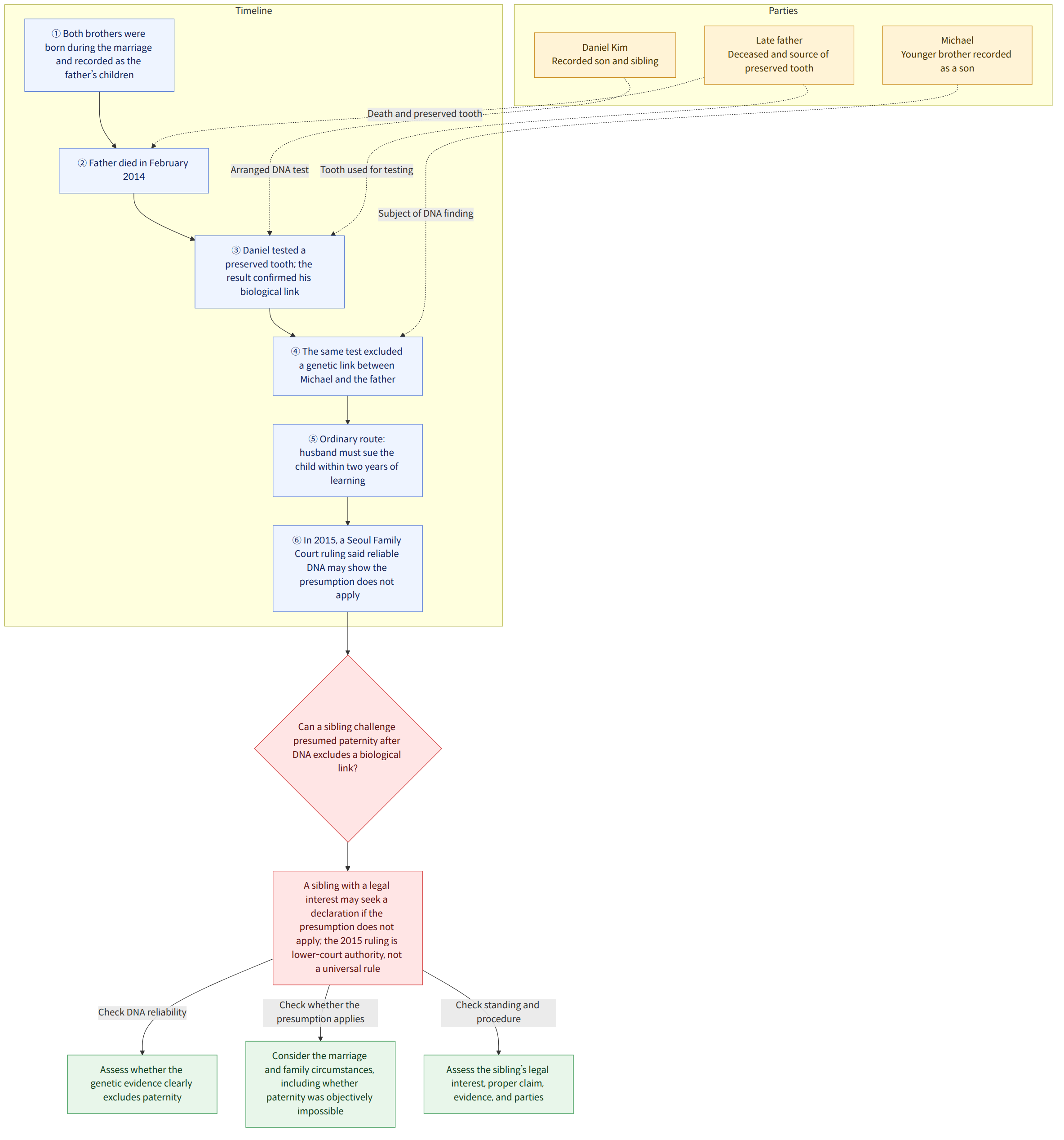
When Daniel Kim arranged a DNA test using a tooth preserved from his late father, he expected an answer about his own ancestry. His father had died in February 2014, and Daniel wanted to confirm that he was biologically related to the man who had raised him. The result confirmed that relationship.
The same test produced a more unsettling finding. Michael, Daniel’s younger brother in the family register, was not genetically related to their father. Both brothers had been recorded as their father’s children, and both had been born while their parents were legally married. With their father gone, Daniel wondered whether the record could still be challenged—and whether he, rather than the deceased father, could take the matter to court.
2. The Legal Question
Can a child recorded as the deceased man’s son or daughter bring a case against a sibling to establish that the sibling was not the deceased man’s child, when DNA testing excludes a biological relationship?
3. What Korean Law Says
Korean law begins with a strong presumption in favor of legal family status. Under Article 844 of the Civil Act, a child born to a woman during her marriage is generally presumed to be the child of her husband. The presumption applies as a matter of legal status; genetic truth alone does not automatically erase it.
The general rule: A child born during marriage is presumed to be the husband’s child, even if later evidence raises doubt about biological paternity.
The ordinary legal route for rebutting that presumption is an action to deny paternity. Under Articles 846 and 847, the husband must bring that action against the child within two years from the day he learns that the child is not his. This time limit and the designated procedure reflect the law’s interest in stability and certainty in family relationships.
But the presumption does not necessarily apply in every circumstance. Korean courts have recognized that it may be absent where it was obviously impossible for the husband to have fathered the child, for example, because the spouses were living apart under circumstances amounting to a factual separation.
A Seoul Family Court decision in 2015 considered whether modern DNA evidence could also matter. It reasoned that, just as the presumption may not apply when conception by the husband was plainly impossible, it need not apply where reliable genetic testing clearly shows that the husband could not be the biological father.
Important qualification: That 2015 decision was a lower-court ruling. It offers a legal argument for cases involving conclusive DNA evidence, but it should not be treated as a universal rule that any DNA test automatically defeats the statutory presumption.
If the presumption does not apply, a person with a legally recognized interest may seek a court declaration that the parent-child relationship does not exist. A sibling may have such an interest where the legal status of the other sibling affects their own family or inheritance position. The precise claim, evidence, and parties must be assessed in the circumstances of the case.
4. How Korean Courts Approach This
Korean courts generally give considerable weight to legal parentage established under the Civil Act. A person cannot ordinarily bypass the statutory paternity-denial procedure simply by presenting a genetic test: the rules are designed to protect the stability of a child’s legal identity and family relationships.
At the same time, courts have acknowledged the tension between that stability and scientific evidence. The 2015 Seoul Family Court ruling took the view that the presumption should not extend to a case where reliable DNA results decisively contradict biological paternity. It drew on the broader principle that a legal presumption should not apply where the possibility of the husband’s paternity is objectively excluded.
The distinction is important. The ruling supports an argument that the presumption never arose in the first place—not that a DNA test simply cancels an existing legal status. Because the decision came from a lower court, a court considering another case may examine the evidence, the surrounding family circumstances, and the applicable procedure differently.
5. Applying the Law to Daniel and Michael
Daniel’s situation raises two separate questions: whether Michael benefits from the marital presumption, and whether Daniel may ask the court to decide the issue.
- The starting point favors legal paternity. Michael was recorded as the deceased father’s child and, as Daniel understands it, was born while the parents were married. Article 844 would ordinarily presume that he was the husband’s child. The family register alone does not resolve whether that presumption can be challenged, but it makes the statutory rule relevant.
- The DNA result is powerful evidence, not an automatic judgment. The test using the father’s tooth reportedly confirms Daniel’s biological relationship to the father and excludes a biological relationship between the father and Michael. If the testing was properly conducted and its results are reliable, Daniel can argue that the presumption should not apply, following the reasoning of the 2015 Seoul Family Court decision.
- The father’s death complicates the ordinary route. The usual paternity-denial action is brought by the husband, within the statutory period after learning the relevant facts. Here, the father died in 2014 and cannot bring that action. Daniel’s proposed case is different: he would seek a declaration that the relationship between the deceased father and Michael does not exist.
- Daniel must show a legal interest in the declaration. As the deceased man’s legally recognized child, Daniel may be able to explain how Michael’s asserted status affects his own legal position, including matters connected with their family relationship or inheritance. The court would need to assess that interest and whether the chosen form of action is appropriate.
- The court must consider the whole evidentiary picture. The result’s reliability, how the tooth was identified and preserved, the testing method, and any available records may all matter. The court may also consider the circumstances of the parents’ relationship and the history of the family records.
On these facts, Daniel has a plausible basis to bring an action against Michael seeking confirmation that Michael and their late father did not have a parent-child relationship. The DNA evidence supports that claim, but the outcome is not guaranteed merely because a test exists.
If you are dealing with a similar issue, attorney Ji-sun Ahn of Ijun Law Firm can review the parentage registration, the test reports and records showing how samples were obtained, and any prior ruling with you. These details can help clarify which options apply to your situation.
6. Conclusion: What Happened, and What Should You Do?
Daniel filed a case against Michael asking the court to confirm that Michael was not the biological child of their late father and that no legal parent-child relationship existed. The case was not a simple matter of showing a DNA report: Daniel also had to establish his own legal interest, present reliable evidence, and persuade the court that the marital presumption did not apply in these circumstances. Given the conclusive test described, he had a substantial argument under the reasoning of the 2015 Seoul Family Court decision, though the final result would depend on the court’s assessment.
For readers facing a similar situation:
- Preserve the evidence. Keep the original test report and document how any sample—especially one from a deceased person—was identified, stored, and tested.
- Get advice before choosing the claim. A paternity-denial action and an action seeking a declaration that a parent-child relationship does not exist are not interchangeable; deadlines and who may sue can differ.
- Act promptly and establish your interest. Gather family-register records and documents showing how the disputed relationship affects your own legal position, and consult a Korean family-law attorney about the proper parties and procedure.

















