

1. A Human Story
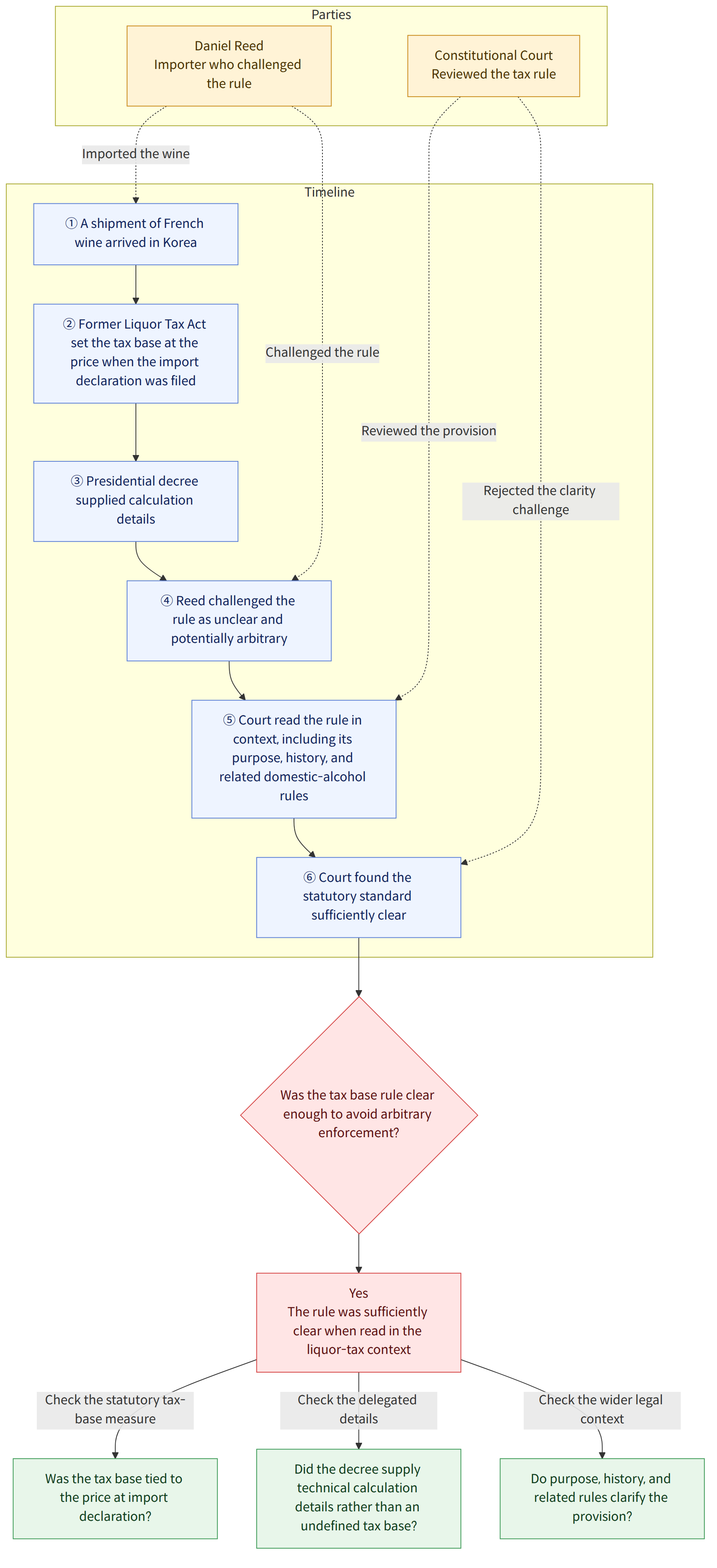
When Daniel Reed arranged to import a small shipment of French wine into Korea, he expected the difficult part to be persuading restaurants to try it. Instead, he found himself poring over customs paperwork and tax calculations. The amount of liquor tax depended on the price attributed to the wine when the import declaration was filed.
Daniel thought the rule sounded too open-ended. If the law simply referred to a “price” at that moment, he wondered, could tax officials choose whichever valuation method produced the largest bill? He challenged the rule, arguing that a taxpayer should be able to tell from the law how much tax is owed. His concern was not unusual: for importers, the difference between a clear valuation rule and an unpredictable one can shape the cost of doing business.
2. The Legal Question
The central question is whether a law that sets the tax base for imported alcohol by reference to its price when the import declaration is made is sufficiently clear—or whether leaving the calculation details to further regulation gives tax authorities too much discretion.
3. What Korean Law Says
Korea’s former Liquor Tax Act provided that, for imported alcoholic beverages other than spirits, the tax base was the price at the time the import declaration was filed. The law did not spell out every technical step for calculating that price in the statute itself. Instead, it left the necessary details to a presidential decree.
The statutory rule: The relevant tax base was the price of the imported beverage when the import declaration was made.
This question involves the constitutional principle of clarity in taxation. In everyday terms, a tax law should tell people what conduct or property is taxable and how the tax obligation is determined clearly enough for them to understand their potential liability.
That principle does not necessarily require the legislature to put every calculation detail into the statute. Some tax questions involve technical matters that are more appropriately addressed in regulations, provided the law’s basic meaning and limits can still be understood.
In considering the rule, the Constitutional Court looked to more than the word “price” in isolation. It considered:
- The history and purpose of the provision.
- How the liquor-tax rules fit together as a whole.
- The relationship between the tax base for imported alcohol and the tax base for alcohol made in Korea.
- The role of a presidential decree in setting out technical details needed to calculate the price.
A tax provision is not unconstitutionally vague merely because technical calculation details are set out in subordinate regulations. The question is whether the statute, read in context, provides a sufficiently understandable standard and avoids arbitrary enforcement.
4. How Korean Courts Approach This
Korean constitutional review of tax laws balances two concerns. Taxpayers need a stable, reasonably predictable basis for understanding what they owe. At the same time, a statute may use a general standard where the subject requires technical rules and the standard can be understood in the context of the wider legal framework.
Courts therefore do not assess clarity by isolating a single phrase. They examine the provision’s wording alongside its purpose, legislative history, related rules, and the way the tax system treats comparable transactions. They also consider whether delegated rules are filling in technical details or, instead, creating the essential tax obligation without a sufficient basis in the statute.
In Daniel’s situation, the Constitutional Court concluded that the statutory reference to the price at the time of import declaration had a clear meaning when read in the context of the liquor-tax system. The provision was not so abstract or uncertain that it invited arbitrary decisions by tax officials or undermined taxpayers’ legal certainty and ability to anticipate their obligations.
5. Applying the Law to the Case
The reasoning in Daniel’s case can be followed step by step.
- Identify the statutory measure. The law tied the tax base for the relevant imported beverages to their price at the time the import declaration was filed. It did not leave the tax base entirely unspecified.
- Read the phrase in context. The Court considered the provision’s purpose and history, as well as the structure of the liquor-tax rules. This broader context helped explain what the statutory reference to price was meant to do.
- Compare the treatment of imported and domestic products. The Court considered how the rule for imported alcohol related to the tax base for alcohol manufactured in Korea. That comparison supported a coherent reading of the import provision within the overall system.
- Assess the delegation. The statute left the details needed to calculate the relevant price to a presidential decree. The Court viewed those details as technical and specialized, rather than as an invitation for tax officials to invent their own standard.
- Consider the risk of uncertainty. The Court asked whether the rule gave officials unfettered discretion or made a taxpayer’s liability impossible to foresee. It concluded that, understood in context, the provision did neither.
Daniel’s argument—that the word “price” alone might leave too many unanswered questions—did not persuade the Court. The legal question was not whether the statute contained every detail in one sentence, but whether the law as a whole gave a sufficiently clear basis for calculating the tax.
If you are dealing with a similar issue, attorney Ji-sun Ahn of Ijun Law Firm can review the applicable permit, business records or advertisements, and the legal grounds given by the authority with you. These details can help clarify which options apply to your situation.
6. Conclusion: What Happened, and What Should You Do?
Daniel’s constitutional challenge failed. The Constitutional Court held that the former rule did not violate the clarity principle for tax laws. The statutory reference to the price at the time of import declaration could be understood in light of the provision’s purpose and its relationship to the rest of the liquor-tax system; the technical calculation details could be supplied by presidential decree.
For importers facing a similar issue, the practical lesson is to focus not only on the statutory wording but also on the regulations and supporting documents that govern the valuation. A rule can be constitutionally clear even if its technical application requires looking beyond the statute itself.
- Keep a complete valuation record: Preserve invoices, payment records, shipping documents, and any other material supporting the price declared at import.
- Check the rules in force on the declaration date: Tax treatment can depend on the version of the law and regulations that applied when the import declaration was filed.
- Challenge the right issue: If a valuation is disputed, distinguish between an argument that the law is unclear and an argument that officials applied a clear rule incorrectly. The evidence and legal analysis may differ.

















