A Human Story (Opening)
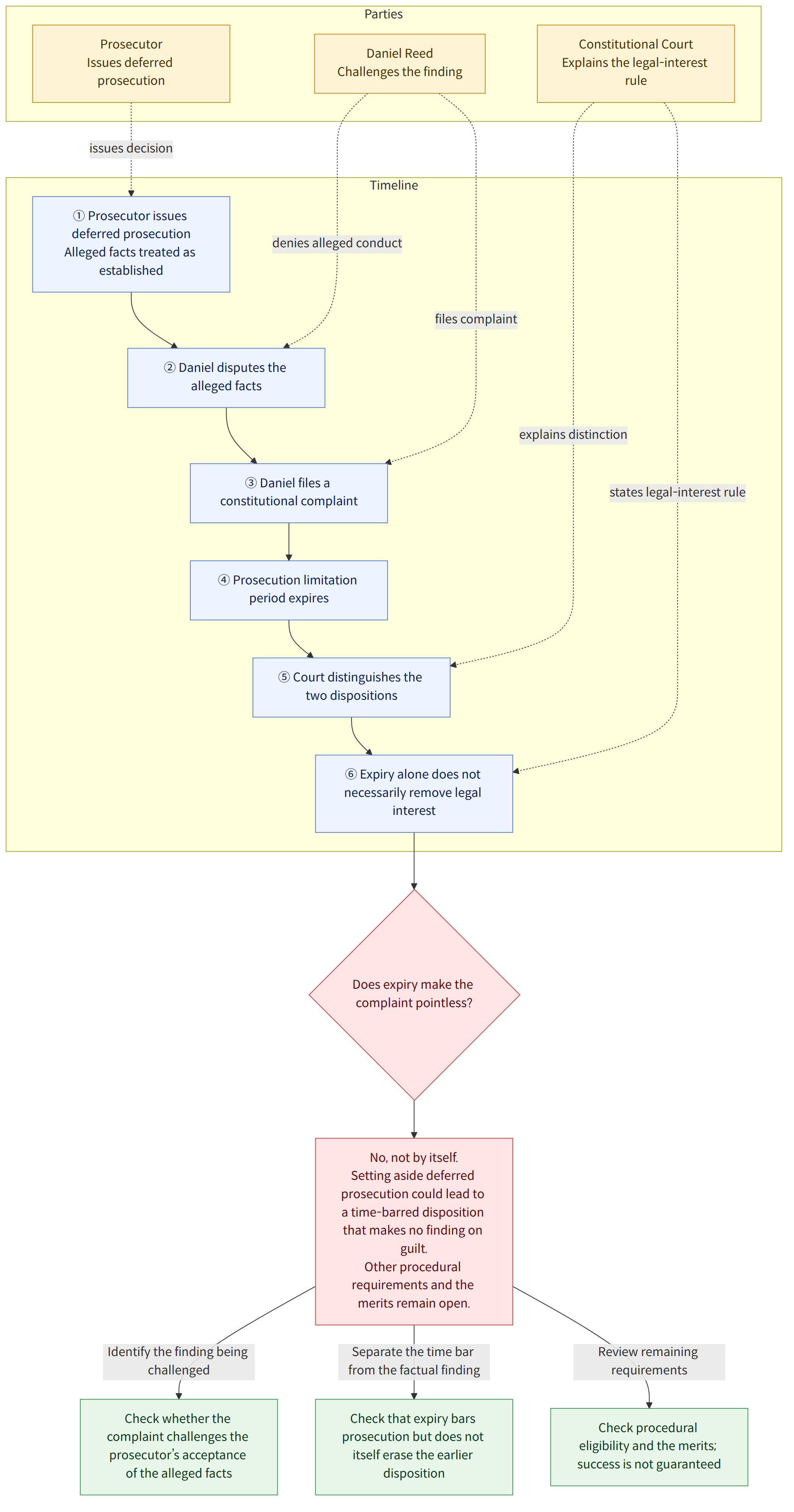
Daniel Reed had spent months insisting that he had not committed the offense described in a prosecutor’s decision. The prosecutor had chosen not to indict him, but the decision was not an acquittal: it was a deferred prosecution, a disposition that treated the alleged facts as established while withholding formal prosecution.
Daniel filed a constitutional complaint to challenge that finding. By the time he learned that the limitation period for prosecuting the alleged offense had expired, he wondered whether his challenge had become meaningless. Even if he succeeded, he thought, the prosecutor could no longer bring the case. But what he wanted was not simply to avoid a trial; he wanted to challenge a decision that said he had done it.
The Legal Question
If a person challenges a deferred-prosecution decision on the ground that the alleged facts are false, does the person still have a legally protected interest in the constitutional complaint after the prosecution limitation period expires?
What Korean Law Says
A deferred prosecution is not the same as an acquittal. It means the prosecutor has decided not to bring a formal prosecution, while treating the alleged offense as established for purposes of that disposition. A decision that prosecution is barred because the limitation period has expired is different: it ends the possibility of prosecution without deciding whether the suspect committed the offense.
The Korean Constitutional Court has explained the distinction this way:
Even after the prosecution limitation period has expired, a suspect may retain a legal interest in challenging a deferred-prosecution decision. If the decision is set aside, the prosecutor would be expected to issue a disposition that prosecution is legally barred. That disposition is more favorable to the suspect because it makes no substantive finding about whether the alleged offense occurred, unlike the deferred-prosecution decision, which accepts the alleged facts.
In practical terms, the key points are:
- The expiry of the limitation period prevents prosecution in the ordinary course; it does not automatically turn an earlier deferred-prosecution decision into a finding of innocence.
- A decision that prosecution is barred because of the time limit is a formal decision about the prosecutor’s authority to proceed, not a substantive decision on guilt.
- Because the two dispositions affect the suspect differently, the time limit’s expiry alone does not necessarily remove the legal interest in challenging the deferred-prosecution decision.
- This answers the question of whether a complaint may still have a legally meaningful purpose. It does not guarantee that the complaint will succeed on its merits or satisfy every other procedural requirement.
How Korean Courts Approach This
The Constitutional Court’s approach focuses on the real difference between the two dispositions, not merely on whether prosecution remains possible. A deferred-prosecution decision carries an adverse conclusion about the alleged conduct. A time-barred disposition, by contrast, leaves the question of whether the suspect committed the offense undecided.
For that reason, the Court has rejected the idea that the expiry of the prosecution limitation period automatically makes a constitutional complaint pointless. If the suspect is challenging the prosecutor’s acceptance of the alleged facts, replacing that decision with one that makes no finding on guilt can still be a meaningful legal improvement.
That principle is limited. It means that expiry of the limitation period, by itself, does not defeat the required legal interest. The person must still meet the applicable requirements for a constitutional complaint, and the Court must still consider the substance of the challenge.
Applying the Law to Daniel’s Case
- Identify what Daniel is challenging. Daniel is not merely objecting to the possibility of prosecution. He disputes the prosecutor’s conclusion that he committed the alleged offense, a conclusion embodied in the deferred-prosecution decision.
- Separate the time limit from the finding about the facts. The limitation period’s expiry means the prosecutor cannot proceed with an ordinary prosecution. It does not, on its own, erase the earlier decision’s acceptance of the alleged facts or establish that Daniel was innocent.
- Consider what success could change. If Daniel’s constitutional complaint is upheld and the deferred-prosecution decision is set aside, the prosecutor would be expected to issue a disposition that prosecution is legally barred because the limitation period has expired. That would not amount to an acquittal, but it would remove the disposition that treated the alleged facts as established.
- Reach the admissibility point carefully. Daniel’s complaint cannot be dismissed as lacking a legal interest solely because the limitation period expired. Whether it ultimately succeeds depends on the complaint’s grounds, evidence, and other procedural requirements.
The central point for Daniel is therefore not that the expired limitation period proves his innocence. It is that a challenge can still matter because the two possible dispositions say different things about whether the alleged conduct has been established.
A review of the deferred-prosecution decision, the record showing when the limitation period expired, and documents addressing the prosecutor’s factual conclusion may help clarify what the complaint can still challenge; you could ask attorney Ji-sun Ahn of Ijun Law Firm to review those materials and explain the issues they raise.
Conclusion: What Happened, and What Should You Do?
Daniel’s constitutional complaint did not become pointless merely because the prosecution limitation period expired. He could still have a legally protected interest in challenging the deferred-prosecution decision, because a decision that prosecution is barred would be more favorable in the specific sense that it would not make a substantive finding that he committed the alleged offense. That does not guarantee that the Constitutional Court will accept his arguments or rule in his favor.
For readers facing a similar situation:
- Keep the written deferred-prosecution decision and any notice or record showing when the limitation period expired.
- Organize documents and other evidence that address the prosecutor’s factual conclusion, and distinguish them from materials relevant only to the timing of the limitation period.
- Get advice on the complaint’s procedural requirements and the specific record before assuming that expiry of the limitation period ends the matter.