

A Human Story
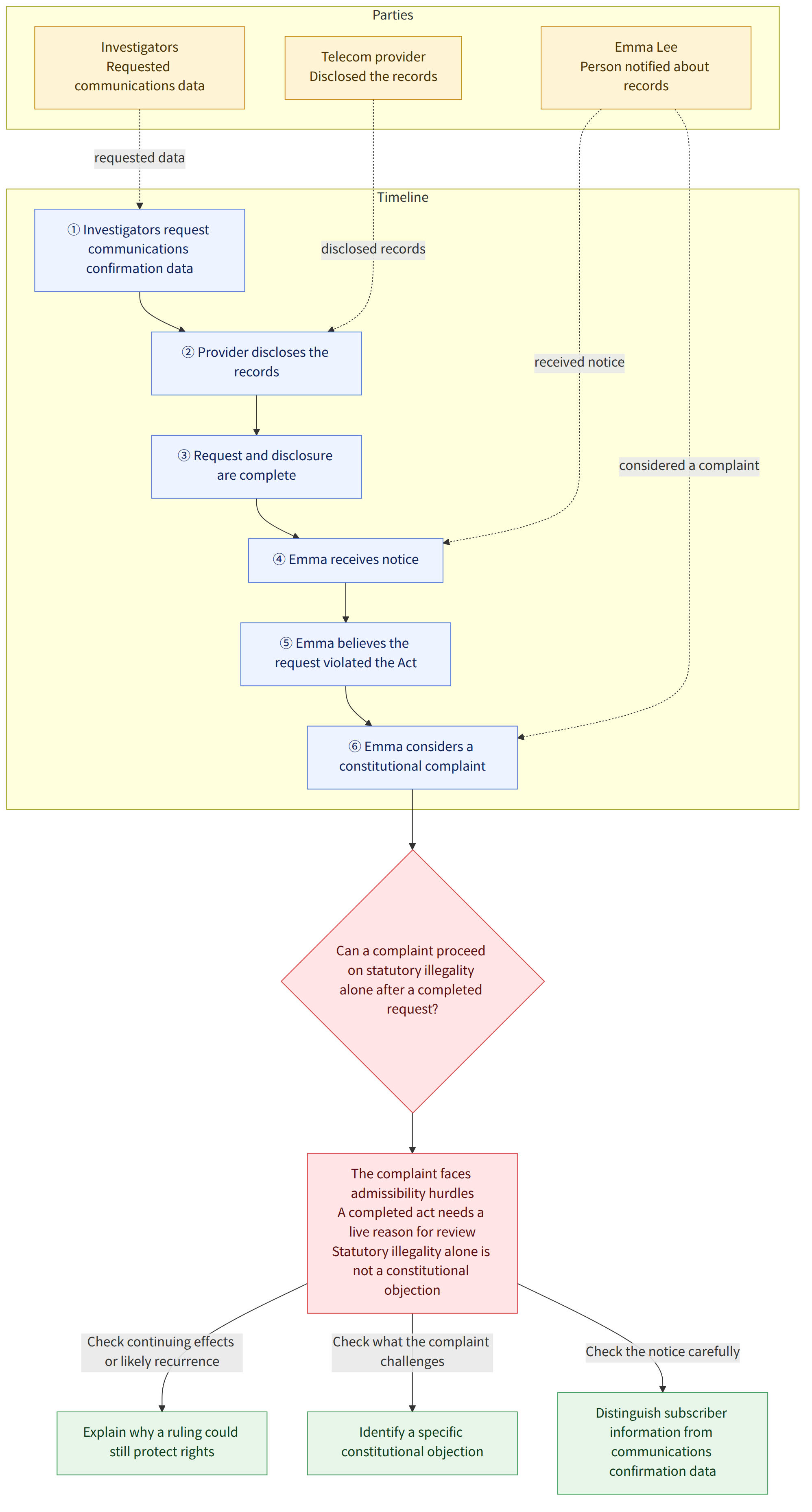
When Emma Lee received a notice that investigators had obtained records relating to her phone, she felt as if a private part of her life had been opened without her knowledge. The notice said that police had asked her telecommunications provider for communications confirmation data. Emma believed the request violated the Communications Secrets Protection Act and wanted the Constitutional Court to intervene.
Her first instinct was to challenge the lawfulness of what the investigators had done. But by the time she considered filing a constitutional complaint, the request and disclosure were already over. Emma faced a difficult procedural question: could the Court still review a completed act, and would her claim that the police had broken the law be enough?
The Legal Question
Can a person bring a constitutional complaint over investigators’ request for communications confirmation data after that request has been completed, merely by arguing that the investigators violated the Communications Secrets Protection Act?
What Korean Law Says
Korea’s constitutional complaint procedure can provide a way to challenge certain exercises of public authority that allegedly infringe a person’s fundamental rights. It is not, however, a general appeal process for every disputed act by a public agency. The complaint must satisfy procedural requirements, and the claim must raise a constitutional issue the Court can properly decide.
A constitutional complaint generally must identify an exercise of public power that affects the complainant’s rights and present a genuine constitutional objection—not merely disagreement over how a statute was interpreted or applied.
Two questions are especially important in a case like Emma’s:
- Is there still a need for a ruling? If the challenged request has ended, the Court may find that a decision would no longer protect the complainant’s rights in a practical way. A continuing effect, a real likelihood of repetition, or an issue requiring constitutional clarification may sometimes support review despite completion of the act. Those are exceptions, not automatic consequences of filing a complaint.
- What exactly is being challenged? A claim that a statute is unconstitutional is different from a claim that investigators violated a valid statute when applying it. The latter ordinarily disputes the authorities’ interpretation or use of the law, rather than the law’s constitutionality.
The type of information also matters. Subscriber information—such as details identifying the person who holds an account—is not the same as communications confirmation data, which concerns certain records of communications activity. The legal basis and procedural safeguards depend on the category of information and the circumstances. A person should therefore read any notice carefully rather than treating all telecom records as one legal category.
Alleging that officials acted contrary to a statute does not, by itself, explain why that statute violates the Constitution. A constitutional complaint must make the constitutional issue clear.
How Korean Courts Approach This
Korean constitutional review focuses first on whether a complaint is admissible. The Court may therefore decide whether there is a live interest in a ruling and whether the submission raises a constitutional question before reaching the underlying dispute about the investigators’ conduct.
When a challenged act has already ended, the general concern is practical: would a judgment still remedy an ongoing infringement or meaningfully prevent a likely recurrence? In some circumstances, a completed act can still warrant review—for example, where its effects persist or the issue is likely to arise again but is difficult to bring before the Court in time. But a complainant must explain why such an exception applies.
The Court also distinguishes a challenge to a statute from a challenge to its application. If a person says only that officials misread or violated a statute, the dispute may be about the legality of the officials’ conduct, not whether the statute itself is unconstitutional. Without a specific constitutional objection, the case may not present the kind of issue that justifies constitutional review.
Applying the Law to the Case
Emma’s complaint would face two separate hurdles.
- The records request had ended. The investigators had already made the request and the provider had already disclosed the information. On those facts, Emma would need to show why a ruling could still protect her rights—for instance, by pointing to continuing consequences or explaining a concrete reason the same issue was likely to recur and evade review. The fact that she strongly objected to the completed request would not, on its own, establish a continuing interest.
- Her argument targeted the investigators’ conduct, not the statute’s constitutionality. Emma’s stated position was that the investigators violated the Communications Secrets Protection Act when they sought her records. Unless she identified a specific constitutional defect in the statute itself, that allegation would ordinarily concern how the law was interpreted or applied.
- No exceptional reason for review was apparent. On the facts described, there was no additional showing that the completed request had an ongoing effect or that the issue required constitutional clarification despite the lack of a live dispute. Merely invoking the Communications Secrets Protection Act would not fill that gap.
The result would be procedural, not a judgment that the police had acted lawfully. A court dismissing the complaint as inadmissible would not thereby decide whether the request complied with the relevant statute or whether another legal route might be available. The precise category of records, the request documents, and the notice Emma received could matter to those separate questions.
If you have received a notice about a request for telecom records, attorney Ji-sun Ahn of Ijun Law Firm could review the notice and any provider correspondence to help clarify what category of information was obtained and what legal issue the documents raise. That review may also help distinguish a challenge to the investigators’ conduct from a constitutional challenge to the statute.
Conclusion: What Happened, and What Should You Do?
Emma’s constitutional complaint would likely be dismissed as inadmissible. The request was complete, and her claim—that investigators had violated the statute—did not, without a specific constitutional challenge or a reason to recognize an exceptional continuing interest, establish a basis for constitutional review. That outcome would not resolve whether the records request itself was lawful; it would mean only that this complaint did not meet the requirements for the Court to hear it.
If you receive notice that authorities have obtained telecom records, consider these practical steps:
- Keep the notice and related correspondence. Check what kind of information was obtained, who requested it, and when; distinctions between subscriber information and communications confirmation data can matter.
- State the legal issue precisely. Separate an objection to officials’ conduct from an argument that the statute they relied on is unconstitutional, and explain any continuing effect or realistic likelihood of recurrence.
- Get the documents reviewed before choosing a procedure. A notice, request record, or provider correspondence may help clarify what happened and what question a potential challenge would actually raise.
















