
1. A Human Story
When Daniel Kim learned that a file containing his resident registration number had been exposed, the news initially sounded abstract. Then came a series of unsettling calls: someone had tried to use his details to open a financial account, and a stranger appeared to know information he had never shared with them.
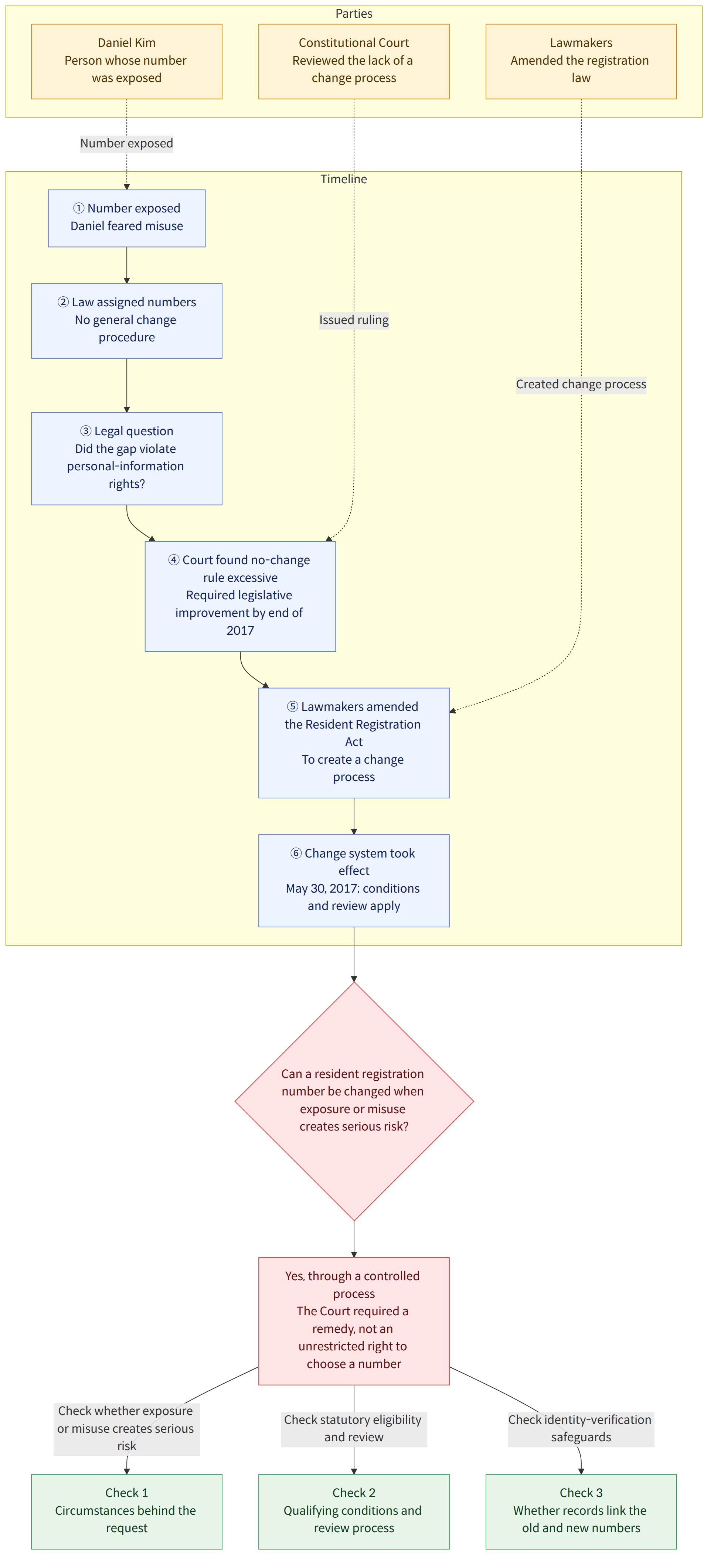
Daniel wanted to replace the number before the leak caused more serious harm. But at the time, Korean law assigned each person a resident registration number without providing a general way to change it. The number was not like a password he could simply reset. It followed him through dealings with institutions and services, making the exposure feel impossible to leave behind.
2. The Legal Question
Could the law violate a person’s constitutional right to control personal information by assigning resident registration numbers but providing no procedure to change one—even when it has been unlawfully exposed or misused?
3. What Korean Law Says
Korea’s Resident Registration Act established the system for assigning resident registration numbers. But the version considered by the Constitutional Court did not provide for changing a number after its assignment. That gap mattered because the number could act as a common identifier linking information held by different organizations.
The Court treated control over personal information as part of the constitutionally protected right to self-determination over personal information. The state may collect and use information under legal rules, but it also has a responsibility to protect people when the system itself creates a serious risk.
A number that links personal information across settings can make unlawful disclosure especially harmful. If exposure or misuse threatens a person’s privacy, safety, or property, the state must take the risk seriously and work to limit the resulting harm.
The Court’s reasoning had two sides:
- A national identification system can serve legitimate administrative purposes, including confirming identity.
- But a person should not be left with no meaningful remedy after a number is exposed or abused.
- A change process can be restricted to defined circumstances and decided through an objective review, rather than granted automatically.
- Records can link an old number to a new one for identity-verification purposes, reducing the risk of confusion and disruption.
The Court therefore held that allowing no changes at all was an excessive restriction on the right to control personal information. It did not, however, immediately strike down the statutory provision. Removing the legal basis for the numbering system outright could have created serious disruption, and lawmakers needed room to design the details. The Court issued a decision of constitutional nonconformity, leaving the rules in effect temporarily while requiring legislative improvement by the end of 2017.
Lawmakers later amended the Resident Registration Act to establish a process for changing a number in qualifying circumstances. The change system took effect on May 30, 2017. It is not a blanket right to choose a new number whenever one is preferred: eligibility depends on the statutory conditions and review process.
4. How Korean Courts Approach This
In cases involving a gap in legislation, Korean constitutional review asks whether the legislature has failed to provide protections that the Constitution requires. The issue is not simply whether a different policy might be better. The question is whether the existing rules impose an unjustifiable burden on a protected right.
Here, the Court weighed the administrative value of a stable identification system against the consequences of permanently tying a person to a number that had been exposed or misused. It recognized that a number’s linking function could magnify the damage: information disclosed in one setting might become a key to information elsewhere.
The Court’s approach was not that every person must be allowed to change a number on request. It was that a system with no change mechanism at all could impose an excessive burden—especially where exposure or misuse created a serious risk and safeguards could be designed.
The remedy reflected that balance. Rather than erase the statutory foundation of the system immediately, the Court gave the legislature time to create rules, eligibility criteria, and review procedures. That left the policy design to lawmakers while making clear that doing nothing was not an adequate answer.
5. Applying the Law to the Case
First, Daniel’s concern is more than a wish for a different identifier. His number had been unlawfully exposed, and there were signs it might be used to impersonate him. Because the number can connect information held in different places, the potential harm may extend beyond the original leak.
Second, the old law offered no tailored remedy. Privacy protections may limit how personal information is collected or shared, but those rules cannot necessarily undo a disclosure that has already happened. If the number remains usable after exposure, the affected person may still face continuing risks.
Third, the Court considered whether a change mechanism could be made safe. A new number need not make the person impossible to identify. A controlled system can preserve a link between the former and replacement numbers for legitimate verification, while limiting who may see or use that link. Objective review can also help prevent people from using a change request to evade lawful obligations.
Fourth, the constitutional ruling did not itself give Daniel an automatic replacement. It required lawmakers to address the gap, but did not decide that every reported leak would satisfy the eventual statutory test. Under the later system, Daniel would need to apply through the established process and support his request with evidence relevant to the law’s eligibility requirements. The seriousness of the exposure, the risk of resulting harm, and any evidence of misuse could all matter to that assessment.
If you are dealing with a similar issue, attorney Ji-sun Ahn of Ijun Law Firm can review notices about the incident, account activity logs, and records of when the affected parties learned about it with you. These details can help clarify which options apply to your situation.
6. Conclusion: What Happened, and What Should You Do?
Daniel’s situation exposed a flaw in a system that treated a resident registration number as permanent even when its secrecy had been compromised. The Constitutional Court concluded that the absence of any route to change the number could violate the right to control personal information. It gave lawmakers time to repair the system rather than dismantling the numbering framework, and a statutory change procedure later took effect.
For someone facing a similar problem today, the practical lesson is not that a leaked number will automatically be replaced. It is that the law now provides a controlled route to seek a change when the statutory requirements are met. Daniel’s request would therefore be considered under that process, with approval depending on the evidence and the applicable criteria—not on the leak alone.
- Preserve evidence: Keep notices of the breach, messages, transaction records, and reports to relevant organizations or authorities. Document any attempted fraud or other harm.
- Use official channels promptly: Contact the institution responsible for the exposure and ask what protective steps it has taken. If you believe the legal criteria for a number change may apply, seek guidance on the formal application process.
- Limit further risk: Monitor accounts and important records, challenge suspicious activity quickly, and avoid sharing identification details unless there is a clear legal or practical need.

















