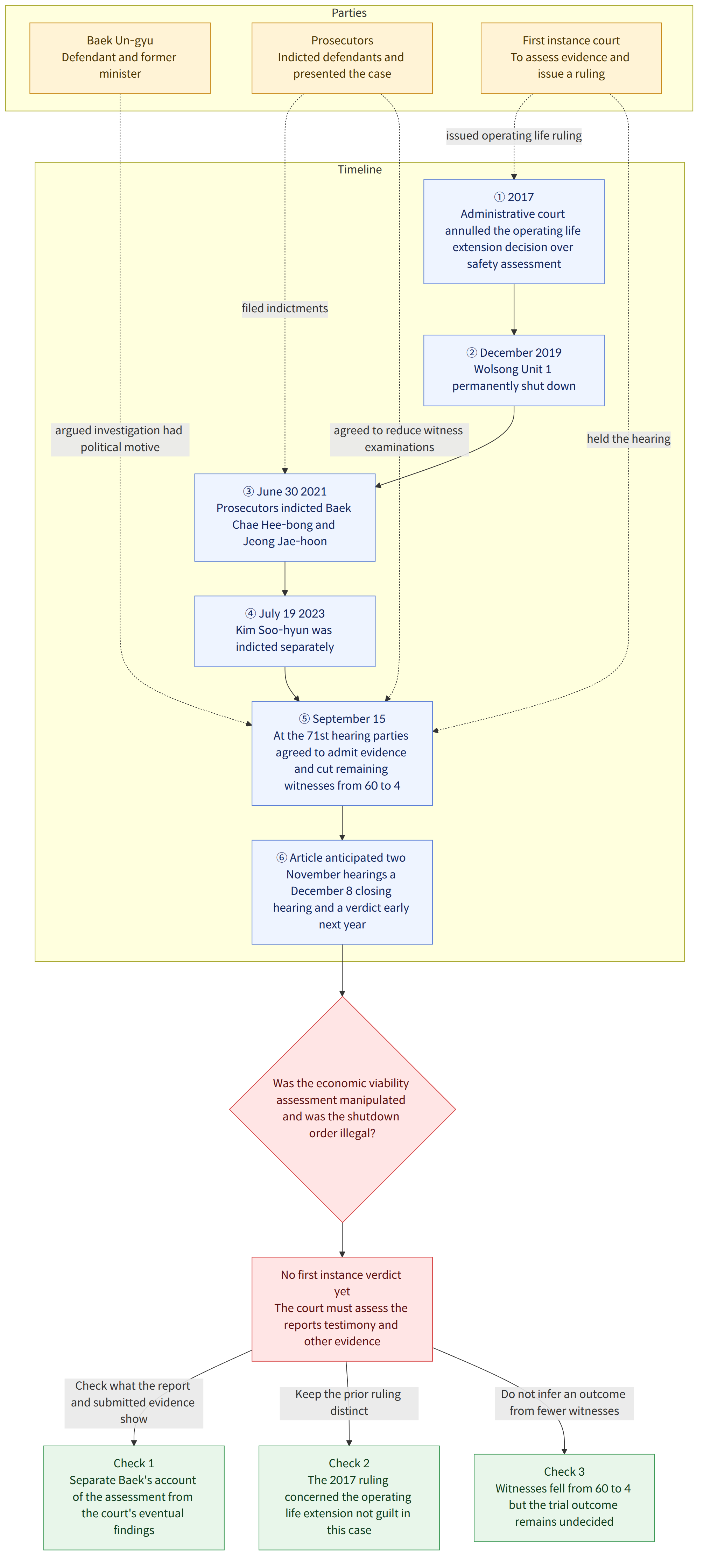
More than five years after charges were filed, the first-instance trial in the alleged economic viability manipulation case involving Wolsong Unit 1 has entered its final stage. At the 71st hearing on September 15, the defendants and prosecutors agreed to admit evidence and reduce witness examinations, cutting the number of remaining witnesses from 60 to 4. The original article anticipated two hearings in November, a closing-arguments hearing on December 8, and a first-instance verdict early next year.
In an interview near the end of the trial, former Minister of Trade, Industry and Energy (산업통상자원부) Baek Un-gyu argued that the investigation had a political motive. He said that sacrificing public officials for political purposes is an act of national self-harm. This is the position of the defendant’s side; it does not mean that the court has reached a final determination about the investigation’s motives or the charges.
Background and context
Prosecutors indicted Baek, former Blue House senior secretary for industrial policy Chae Hee-bong, and former Korea Hydro & Nuclear Power (한국수력원자력) president Jeong Jae-hoon on June 30, 2021. Former Blue House policy chief Kim Soo-hyun was indicted separately on July 19, 2023. Issues in the case include whether the economic viability assessment for Wolsong Unit 1 was manipulated and whether an order to shut down the reactor was illegally issued. Wolsong Unit 1 was permanently shut down in December 2019.
Baek countered that prosecutors cited the analytical method and use of forecast prices in the economic viability assessment report as evidence of manipulation, but that their claims did not match the report’s contents. According to his account, the report analyzed how economic viability would change under different scenarios by varying the capacity factor and forecast prices, and Korea Hydro & Nuclear Power had used forecast prices when making projections about the future. These are Baek’s claims; it is not yet known how the court will assess the report and related evidence.
He said the decision to shut down the reactor also took into account regional acceptance—whether local residents would accept it—and safety, in addition to economic viability. According to the article, the Seoul Administrative Court (서울행정법원) ruled in 2017 that the decision to extend Wolsong Unit 1’s operating life should be annulled because the safety assessment had not been properly conducted. That ruling concerned the operating-life extension decision and should be distinguished from the question of guilt or innocence in the current alleged economic viability manipulation case.
What this news means
A substantial reduction in the number of witnesses can bring the end of a trial closer, but it does not in itself imply a conclusion favorable or unfavorable to the defendants. Baek said prosecutors had requested more than 100 witnesses, prolonging the trial, and that questioning of key witnesses had already been completed. Even with fewer witness examinations, the remaining issues must be decided on the basis of materials submitted in court, including reports and testimony.
Baek argued that, since the investigation, public officials have become reluctant to mediate policy conflicts and implement policies. If concerns grow that policy decisions could later lead to criminal liability, civil servants may avoid risk by making fewer active decisions. However, the original article alone does not establish what actual impact this case has had on the civil service as a whole.
For example, if a public official has to choose one of several options while implementing a policy, they might watch this case and worry about how that decision could later be assessed in a criminal trial. This is a hypothetical illustration of a possible impact, not a confirmed fact that public officials actually had such concerns.
Baek also said the trial had disrupted his research. He said he had been named to Clarivate’s Highly Cited Researchers list for six consecutive years through last year and is editor-in-chief of EES Batteries, a journal published by the Royal Society of Chemistry (영국왕립화학회). He said that this year he launched an on-campus startup that produces materials and provides technical support for semiconductor planarization processes. This shows that the trial is taking place alongside the defendant’s research and business activities, but it is not, in itself, a basis for judging the validity of the charges.
Related legal and support information
According to an in-house legal guide, in criminal trials, factors such as the procedures used to collect or prepare evidence and whether there was an opportunity to challenge statements and their contents in court can affect its admissibility—whether it can be used as evidence at trial. Illegally obtained evidence and secondary evidence based on it generally cannot be used as evidence of guilt, but exceptions may be considered depending on circumstances, including whether the causal link between the illegal act and the collection of evidence has been broken.
However, whether evidence can be admitted and whether it can establish guilt are separate questions. Even after evidence is admitted, its credibility and probative value—how much it supports a fact—are assessed separately. Therefore, the fact that the defendants and prosecutors agreed on evidence at this hearing does not mean that the prosecution’s claims have been accepted or that the defense’s claims of innocence have been upheld.
The article states that Moon Shin-hak and others, who were indicted on charges of deleting Wolsong nuclear power plant records and obstructing an audit, were found not guilty by an appellate court in January 2024, and that the acquittal was upheld by the Supreme Court in May of the same year. This was the outcome of a separate case. The acquittal in that case, or findings concerning the audit process, cannot be applied as the conclusion of the current trial. (In-house material L1)
What is confirmed and what remains unknown
Confirmed facts
- At the 71st hearing on September 15, the parties agreed to admit evidence and reduce witness examinations, cutting the number of remaining witnesses from 60 to 4.
- Prosecutors indicted former officials Baek Un-gyu, Chae Hee-bong, and Jeong Jae-hoon on June 30, 2021, and former policy chief Kim Soo-hyun separately on July 19, 2023.
- The original article reported that a verdict was expected early next year, after two hearings in November and a closing-arguments hearing on December 8.
- Baek expressed views on the economic viability assessment and the investigation’s motives that differ from those of prosecutors.
- The Supreme Court upheld the acquittals in the records-deletion and audit-obstruction case involving Moon Shin-hak and others in 2024.
What remains unknown
- What will the final first-instance verdict be in the alleged economic viability manipulation case involving Wolsong Unit 1?
- How will the court rule on the claims of economic viability assessment manipulation and an illegal order to shut down the reactor?
- What effect will the evidence and the testimony of the four remaining witnesses have on each issue?
- Will Baek’s claims about the investigation’s political motives and its chilling effect on the civil service be reflected in the court’s ruling or in broader assessments of the civil service?
What readers should check
- It is worth checking how the remaining hearings, closing-arguments hearing, and verdict schedule actually proceed. The schedule given in the original article was an expectation at the time, and no verdict is provided.
- The procedural fact that the parties agreed on evidence can be considered separately from the court’s assessment of the evidence’s credibility and probative value.
- The acquittals in the records-deletion and audit-obstruction case and the current alleged economic viability manipulation case are separate matters. It is important not to confuse the outcomes of different trials.
If you are dealing with a similar issue, attorney Ji-sun Ahn of Ijun Law Firm can review the procedural history, the specific facts or evidence in dispute, and the relevant court or agency notices with you. These details can help clarify which options apply to your situation.