South Korea’s men’s football team beat Japan 1-0 in the final of the Aichi-Nagoya Asian Games on October 3 to win the gold medal. Head coach Lee Min-seong named Celtic FC winger Yang Hyeon-jun, who did not play in the final, his personal MVP. Yang played in only one match of the tournament, but the coach said his sacrifices off the field had helped the players who took part in matches.
This moment shows, apart from the on-field play that secured the gold medal, what kinds of contributions were recognized within the national team. Yang Hyeon-jun said that while he was unable to play because of an injury, he tried to help Yang Min-hyuk stay focused on the game. However, there is no basis for concluding that Yang’s support led to Yang Min-hyuk’s performance or a goal in the final.
Background and context
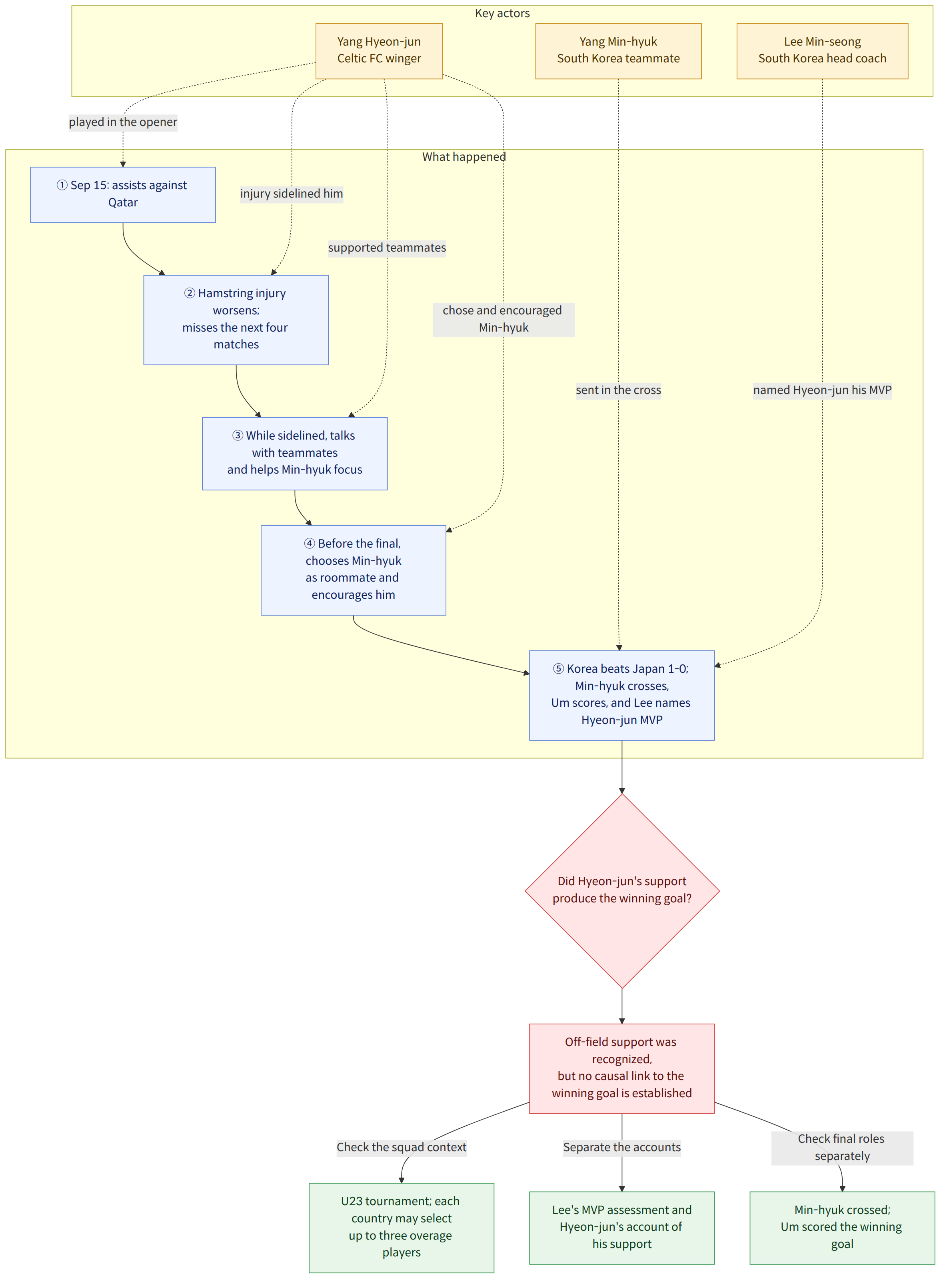
Yang Hyeon-jun recorded an assist in Qatar’s match on September 15, the opening game of the group stage. But his hamstring injury (an injury to the muscles at the back of the thigh) worsened, and he missed the next four matches. He reportedly judged after the opening game that he would not be fit enough to play in the rest of the tournament.
Yang’s selection by the coach cannot be explained by his playing record alone. Lee said Yang had made many sacrifices behind the scenes, while Yang said he thought the coach saw him as a mentor to his younger teammates. In particular, after Yang Min-hyuk was brought into the lineup following an injury, he was putting a lot of pressure on himself. Yang said he wanted to help him focus on the game and not worry about anything else for the time being.
Their relationship continued as the final approached. After the players traveled to Toyota and were allowed to choose new roommates, Yang Hyeon-jun chose Yang Min-hyuk. Yang said he had seen Min-hyuk blame himself too much for mistakes during matches, and encouraged him not to push himself so hard and to keep playing consistently.
What this news means
Yang Hyeon-jun’s case shows that a player with limited playing time may still have a role to play in a tournament. For this national team, that role took the form of conversations with teammates, advice to help them focus on the game, and connecting players. This is an interpretation based on accounts from the coach and players; it does not mean that his support directly produced the team’s results.
Yang Min-hyuk’s contribution in the final can be considered separately. He won the ball on the right flank and sent in a cross, which Um Ji-seong received before scoring the winning goal. Um recorded four goals and four assists in the tournament, putting him at the top of the combined goals-and-assists tally. Yang Hyeon-jun’s encouragement and Yang Min-hyuk’s play occurred during the same tournament, but the reported facts do not establish a causal link between the two.
For example, even if a player is unable to play because of an injury, they can use conversation to help a teammate feel less pressure and focus on the game. But unless separately confirmed, any claim about how that support affected the match result remains speculative.
The coach’s assessment that Yang Hyeon-jun contributed to the team and Yang Min-hyuk’s assist in the final are each confirmed facts. It is not possible to link the two and say that Yang Hyeon-jun’s support produced the winning goal.
Related rules and support information
The Asian Games men’s football tournament is for players under 23, and each country may select up to three players over the age of 23. Twenty-four-year-old Yang Hyeon-jun was selected as an overage player (a player who may be selected despite exceeding the age limit), while 20-year-old Yang Min-hyuk was the second-youngest player on the national team.
This age rule provides the context for players of different ages and levels of experience competing on the same team. In this case, Yang Hyeon-jun played in just one match of the tournament but took on a role supporting his teammates, while Yang Min-hyuk recorded an assist in the final. The rule itself does not define how players divide their roles, but the presence of players of different ages and experience levels in the national team helps explain the context of the two players’ relationship.
Confirmed facts and what remains unknown
Confirmed facts
- South Korea beat Japan 1-0 in the final and won the gold medal.
- Yang Hyeon-jun recorded an assist against Qatar, then missed the next four matches because of a hamstring injury.
- Head coach Lee Min-seong named Yang Hyeon-jun his personal MVP, and Yang said he had tried to help Yang Min-hyuk and connect players through conversation.
- Yang Min-hyuk crossed the ball in the final, and Um Ji-seong took on the play to score the winning goal.
What remains unknown
- Reports did not provide a recovery timeline for Yang Hyeon-jun’s hamstring injury.
- It has not been confirmed what role Yang Min-hyuk will have with his club after this tournament.
- It has not been established how much Yang Hyeon-jun’s role as a mentor affected the team’s performance or the result of the final.
What readers should check
- To determine when Yang Hyeon-jun might return, readers should check for subsequent announcements about his injury recovery. The current reports do not specify a return date.
- It is difficult to draw conclusions about Yang Min-hyuk’s future role based only on his performance in the final. Readers can distinguish that performance from subsequent news about his appearances or selection by his club.
- When assessing a player’s contribution to a team, it is worth considering not only playing records but also accounts from coaches and players. However, readers should separately consider whether a causal link between the support and the match result has been established.
References
- Other coverage consulted: hani.co.kr
- Other coverage consulted: hani.co.kr