
General Administrative Litigation: Guide to Subject Matter and Filing Deadlines
Based on 106 consultation cases · Updated · Translated from the Korean original.
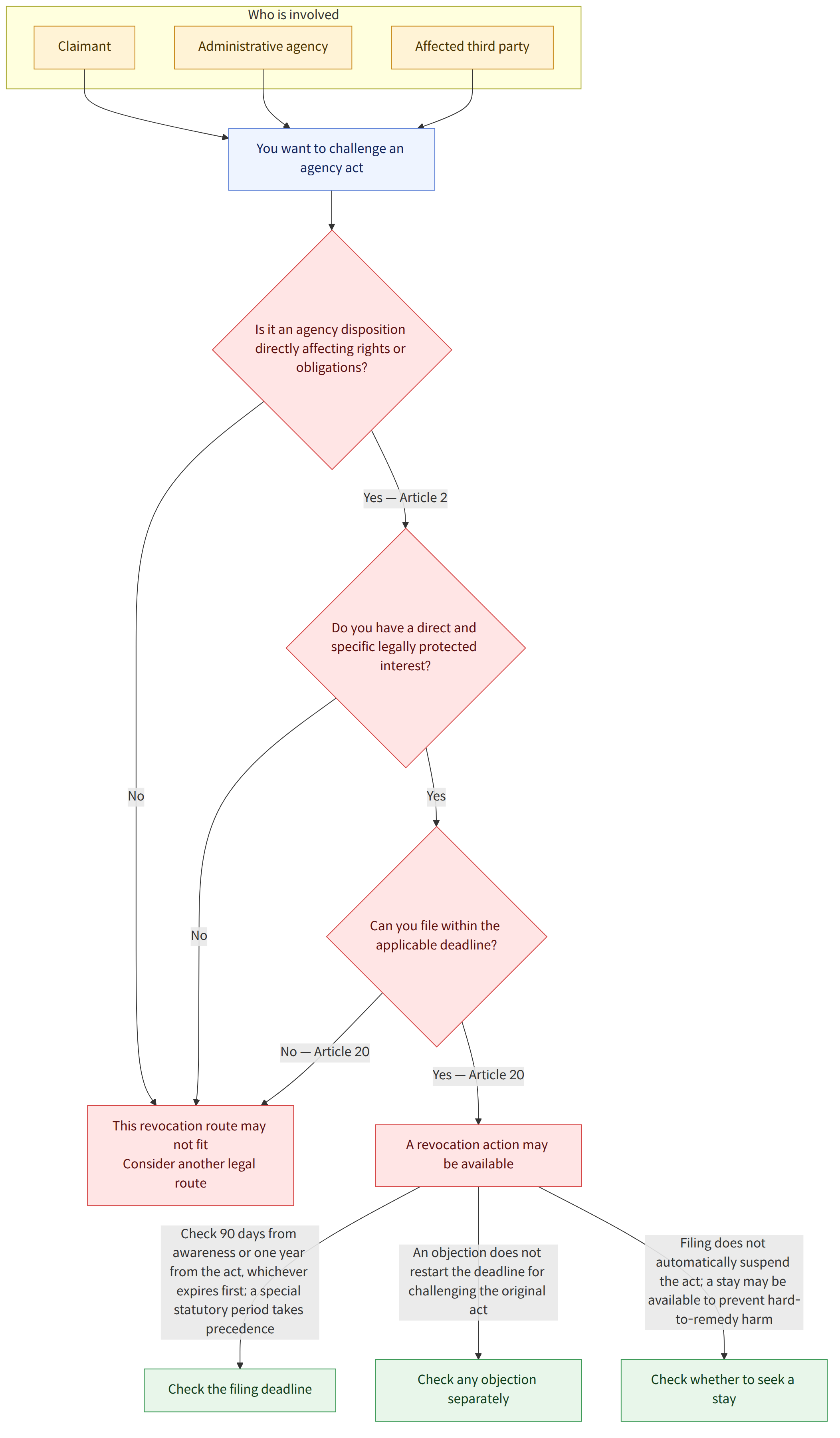
Before bringing an administrative lawsuit, you should first determine whether the act you wish to challenge is a disposition subject to appeal litigation and whether you have a legally protected interest. As a general rule, the filing periods are 90 days from the date you became aware of the disposition and one year from the date it was made. The available procedures and requirements vary depending on the circumstances, including a failure to act, a stay of execution, or a claim for damages.
At a glance
Key points
- A disposition subject to appeal litigation is an act by an administrative agency, such as the exercise of public authority, that directly affects people’s rights or obligations. Its specific character is determined by considering the relevant statutes and the act’s content and procedure, among other factors (Administrative Litigation Act, Article 2 (행정소송법 제2조), Examples 17, 20, and 25).
- A third party who is not the direct addressee of a disposition may also seek its revocation if they have a direct and specific interest protected by the statute on which the disposition is based. A merely factual or economic interest is not sufficient (Example 16).
- The general filing periods for an action to revoke a disposition are 90 days from the date you became aware of it and one year from the date it was made; you must observe whichever period expires first. If a specific statute prescribes a special period, that provision takes precedence (Administrative Litigation Act, Article 20 (행정소송법 제20조), Examples 2 and 18).
- A petition-based objection is different from an administrative appeal. Filing an objection does not restart the filing period for challenging the original disposition, and notice of the objection’s outcome may not constitute a separate disposition (Example 19).
- If an administrative agency does not respond to an application, consider whether it has a legal duty to respond and whether you have a right to apply. If the requirements are met, you may consider an administrative appeal seeking performance of an obligation or an action to confirm the illegality of the agency’s failure to act (Administrative Litigation Act, Article 4, subparagraph 3 (행정소송법 제4조 제3호), Example 3).
- Filing an action to revoke a disposition does not, as a general rule, automatically suspend its effect or execution. You may apply for a stay of execution if there is an urgent need to prevent harm that would be difficult to remedy, among other requirements (Administrative Litigation Act, Article 23 (행정소송법 제23조), Examples 8 and 21).
- Not every act by an administrative agency is subject to appeal litigation. Where the matter concerns a relationship under private law, such as a lease of general property or a claim for usage fees, it may need to be challenged through a civil action (Examples 13 and 15).
- A disposition partially reducing an assessment partially revokes the original disposition, so the subject matter and period for challenging it are determined by reference to the disposition that remains after the reduction. In some cases, a disposition increasing an assessment absorbs the prior disposition, making the new corrected disposition the subject of challenge (Example 6).
Frequently asked questions
Q. By when must I file an action seeking revocation of an administrative disposition?
Generally, the action must be filed within 90 days from the date you became aware of the disposition and within one year from the date the disposition was made. You must observe whichever of these two periods expires first. If a separate period is prescribed by a specific statute, you should check that provision.
Q. If I file a petition-based objection to a disposition, is the deadline for filing a lawsuit extended?
A petition-based objection is not an administrative appeal, so filing one does not, by itself, extend or restart the filing period for challenging the original disposition. Notice of the result of the objection may also not constitute a separate disposition subject to an appeal litigation. You should therefore keep track of the deadline for challenging the original disposition separately.
Q. What should I do if an administrative agency does not process my application and continues not to respond?
If you have a right under statute or general principles of law to apply to an administrative agency for a particular disposition, and the agency has a legal duty to respond but has not done so within a reasonable period, you may consider procedures for obtaining relief from the agency’s failure to act. The examples include an administrative appeal seeking performance of an obligation and an action to confirm the illegality of the agency’s failure to act.
Q. Does filing an action to revoke a disposition automatically stop its execution?
No. Filing an action to revoke a disposition does not, as a general rule, suspend the disposition’s effect or execution. You may apply to the court for a stay of execution if the requirements are met, including an urgent need to prevent harm that would be difficult to remedy and the absence of a serious adverse effect on the public welfare.
Q. Can I bring an administrative lawsuit if I suffer harm because an administrative agency’s recommendation or guidance was improper?
Administrative guidance is generally a non-authoritative factual act, so it is difficult to challenge through administrative litigation in its own right. However, the State may potentially be held liable for acts performed by a public official in the course of their duties in providing administrative guidance. Whether the guidance exceeded its limits, among other specific circumstances, must be examined.
Q. Can I challenge rent or usage fees for general state- or local-government property through administrative litigation?
A lease of general property may be regarded as a contract under private law entered into by the State or a local government acting as a private economic entity, and a notice demanding payment of rent for its use may likewise constitute a claim under private law. In such cases, the matter may need to be challenged through a civil action rather than an appeal litigation.
Q. Can I file an action to revoke a disposition even if I am not its direct addressee?
It may be possible. However, you must have a direct and specific interest protected by the statute on which the disposition is based. A generalized, abstract interest shared by the public, or merely a factual or economic interest, may not be sufficient to establish standing.
Q. If a tax assessment is reduced by a correction, is the period for challenging it recalculated from the reduced assessment?
According to the explanation in the example, a partial correction reducing the assessment constitutes a partial revocation of the original disposition. Accordingly, the procedures and deadlines for challenging it are assessed with reference to the original disposition as reduced. Take care not to recalculate the deadline from the date of the partial correction as if it were a new disposition.
Q. If an administrative disposition is defective, can I claim in a civil lawsuit that it is immediately void?
If the defect in a disposition is a ground for revocation only, the disposition may be treated as valid until it is duly revoked. It may therefore be difficult to deny the disposition’s effect directly in a civil action, such as a claim for restitution of unjust enrichment.
Relevant laws
- Administrative Litigation Act, Article 2 (행정소송법 제2조)
- Administrative Litigation Act, Article 4, subparagraph 3 (행정소송법 제4조 제3호)
- Administrative Litigation Act, Article 8 (행정소송법 제8조)
- Administrative Litigation Act, Article 20 (행정소송법 제20조)
- Administrative Litigation Act, Article 23 (행정소송법 제23조)
- Administrative Litigation Act, Article 28 (행정소송법 제28조)
- Administrative Litigation Act, Article 34 (행정소송법 제34조)
- Administrative Appeals Act, Article 5, subparagraph 3 (행정심판법 제5조 제3호)
- Administrative Appeals Act, Article 44(1) (행정심판법 제44조 제1항)
- Civil Procedure Act, Article 233(1) (민사소송법 제233조 제1항)
- State Compensation Act, Article 2(1) (국가배상법 제2조 제1항)
- Public Property and Commodity Management Act, Article 7 (공유재산 및 물품 관리법 제7조)
- Public Property and Commodity Management Act, Article 21(1) (공유재산 및 물품 관리법 제21조 제1항)
- Public Property and Commodity Management Act, Article 83 (공유재산 및 물품 관리법 제83조)
- Farmland Act, Article 8(1) (농지법 제8조 제1항)
Watch out for
- The filing periods must be assessed separately by reference to the date you became aware of the disposition and the date it was made. Check whether a specific statute prescribes a different period.
- Do not assume that filing a petition-based objection or making an inquiry to an administrative agency will suspend or extend the time for filing a lawsuit.
- A stay of execution must be applied for separately from the action on the merits, subject to the applicable requirements. The mere filing of a lawsuit does not stop execution of the disposition.
- Even an act by an administrative agency may be a contract or claim under private law. Before filing suit, first determine whether the matter being challenged is a disposition.
Related articles
Source cases
This guide was compiled by AI from the following Korea Legal Aid Corporation consultation cases (in Korean).
- 위법한 부관(附款)만의 취소를 구하는 취소소송이 가능한지
- 행정처분에 대한 취소소송의 제소기간
- 행정청이 증명발급을 지체한 경우 권리구제방법
- 잘못된 행정지도로 인한 손해배상청구 가능한지
- 공공기관에 대한 국민의 정보공개청구절차
- 양도소득세를 경정처분한 경우 불복절차 행사기간의 기산점
- 재외국민의 부동산소유권이전등기용 인감증명의 발급이 가능한지
- 산업기능요원편입취소처분 집행정지 시 처분자체의 효력정지 허용 여부
- 징계처분에 대한 재량권 남용여부의 판단기준
- 행정관청의 부작위로 피해발생 시 손해배상청구 가능한지
- 체납된 수도요금을 새로운 소유자에게 부과할 수 있는지
- 위법한 행정처분에 대한 행정소송 시 그 취소를 하지 않는 경우
- 공유재산 대부계약 해지 시 행정대집행으로 그 지상물철거 가능한지
- 행정소송 진행 중 원고 사망 시 상속인의 승계 가능 여부
- 국유잡종재산에 대한 대부사용료의 부과고지가 항고소송의 대상인지
- 사도(私道)폐지허가처분에 대해 제3자가 취소 등을 구할 수 있는지
- 잘못 산정된 통상임금을 기준으로 하여 육아휴직급여 중 일부만 지급된 경우 다툴 수 있는 방법
- 유족보상금지급부결처분에 대한 행정소송의 제소기간
- 민원 이의신청과 구제방법
- 구청장의 주민등록번호 변경신청 거부행위의 항고소송 대상성
- 행정청의 처분에 대해 그 집행을 임시적으로 정지하기 위한 요건
- 공정거래위원회의 신고인에 대한 통지행위가 행정처분인지
- 공정거래위원회의 과징금 부과처분과 감면신청기각결정에 대한 불복 시 소의 대상
- 과세처분에 취소사유의 하자가 존재하는 경우 민사소송에서 그 효력을 부인할 수 있는 지 여부
- 항고소송의 대상 및 증명책임
This guide is general legal information about Korean law, not legal advice for your situation. For a specific case, consult a lawyer or the Korea Legal Aid Corporation (call 132 in Korea).