
Guide to Remedies in Civil Enforcement
Based on 44 consultation cases · Updated · Translated from the Korean original.
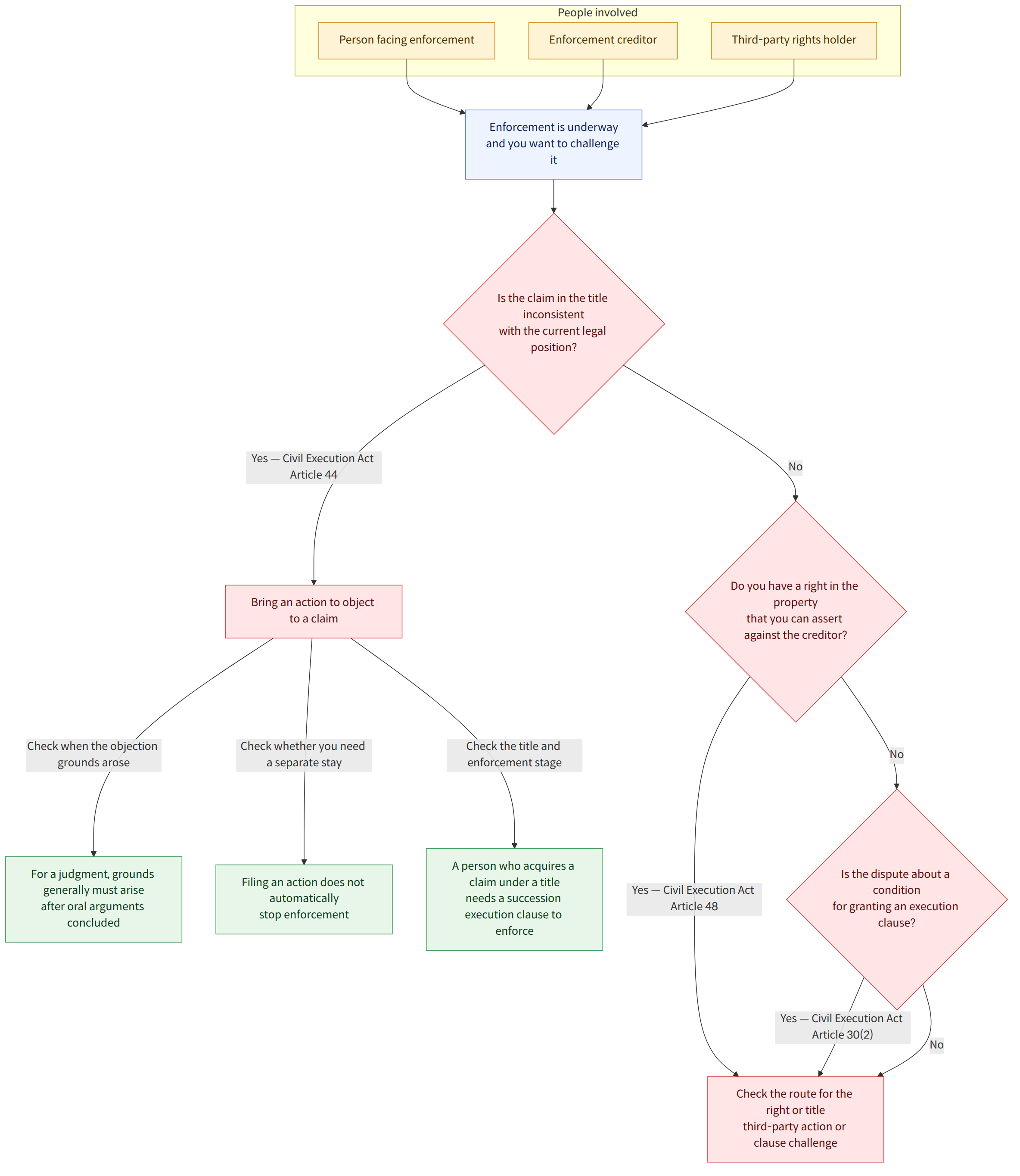
Even if you object to compulsory enforcement, the available remedy—such as an action to object to a claim, an action by a third party to object to enforcement, or a procedure concerning an execution clause—depends on the enforcement title and the right you are contesting. Filing an action does not automatically stay enforcement, and you should also check when the grounds for objection arose and what stage the enforcement has reached.
At a glance
Key points
- An action to object to a claim is a procedure for seeking to exclude all or part of the enforceability of an enforcement title on the ground that the claim stated in it does not accord with the current substantive legal position (Civil Execution Act, Article 44 (민사집행법 제44조)).
- As a general rule, an action to object to a claim based on a judgment must rely on grounds that arose after the conclusion of oral arguments. The cases explain that this timing restriction does not apply to final payment orders or recommendations to perform and similar titles (Civil Execution Act, Article 44(2) and Article 58(3) (민사집행법 제44조 제2항, 제58조 제3항); Trial of Small Claims Act, Article 5-8(3) (소액사건심판법 제5조의8 제3항)).
- Even if a person accepted an inheritance subject to limited liability before judgment but did not raise it in the lawsuit, the person may contest the scope of enforcement in an action to object to a claim if the judgment did not determine the scope of liability. Renunciation of inheritance, however, concerns the existence of the inheritance debt itself and cannot be contested in the same way (Cases 1, 3, and 15).
- A debt is not extinguished merely because the requirements for setoff are met; a declaration of setoff is required for it to take effect. Accordingly, a declaration of setoff made after the conclusion of oral arguments in the proceedings that resulted in the judgment may be a ground for an action to object to a claim (Civil Act, Articles 492 and 493 (민법 제492조·제493조); Case 4).
- A third party who has ownership or another right in property subject to enforcement that can be asserted against the enforcement creditor may seek to exclude enforcement by bringing an action by a third party to object to enforcement. This remedy may not be available, however, where the person cannot assert the relevant right against the enforcement creditor, as may be the case for an indirect possessor or a person who has entrusted title to another (Civil Execution Act, Article 48 (민사집행법 제48조); Cases 6, 9, 14, and 21).
- Whether a condition required for granting an execution clause has been fulfilled must be contested in an action for the grant of an execution clause or an action challenging the grant of an execution clause. This issue must be distinguished from those that may be contested in an action to object to a claim (Civil Execution Act, Article 30(2) (민사집행법 제30조 제2항); Case 18).
- Filing an action to object to a claim does not automatically stay enforcement. A separate application is required for the court to order a stay or other relief. One case held that filing only an action for confirmation of nonexistence of a debt does not satisfy the requirements for interim relief staying enforcement (Civil Execution Act, Article 46 (민사집행법 제46조); Cases 16 and 23).
- A person who acquires a claim under an enforcement title must also obtain a succession execution clause to continue enforcement based on the existing enforcement title (Civil Execution Act, Article 31(1) (민사집행법 제31조 제1항); Civil Execution Rules, Article 23 (민사집행규칙 제23조); Cases 2 and 20).
Frequently asked questions
Q. Can I stop enforcement based on the fact that I already paid after the judgment became final?
If payment was made after the conclusion of oral arguments in the proceedings that resulted in the judgment, you may seek to have the judgment’s enforceability excluded by bringing an action to object to a claim. However, filing the action does not automatically stop enforcement, so you must separately apply for a stay of enforcement.
Q. I accepted an inheritance subject to limited liability or renounced the inheritance before judgment, but did not raise it in the lawsuit. Can I contest it now?
If the judgment did not determine the scope of liability, a qualified acceptance of inheritance may later be raised in an action to object to a claim to contest the scope of enforcement. The cases explain, however, that renunciation of inheritance concerns the existence of the inheritance debt itself, so an action to object to a claim cannot be brought on that same basis after the judgment becomes final.
Q. I could have set off the claim before judgment, but notified the other party of the setoff afterward. Is that a ground for an action to object to a claim?
A setoff does not extinguish a debt merely because the requirements for setoff are met; a declaration of setoff is also required. The cases explain that a declaration of setoff made after the conclusion of oral arguments may constitute a valid ground for an action to object to a claim.
Q. What procedure can I use to contest the seizure of property or a claim owned by someone else?
If you have an ownership right or another right in the property subject to enforcement that you can assert against the enforcement creditor, you may seek to exclude enforcement by bringing an action by a third party to object to enforcement. You must, however, consider whether the right can be asserted against the enforcement creditor and whether it was acquired at or after the time of enforcement.
Q. An amount was imposed for indirect compulsion. Can I argue in an action to object to a claim that I did not actually breach the obligation?
The cases treat whether an obligation to refrain from an act was breached as a condition for granting an execution clause for an order of indirect compulsion. They explain that this issue must therefore be contested in an action for the grant of an execution clause or an action challenging the grant of an execution clause, and cannot be contested in an action to object to a claim.
Q. Does filing an action to object to a claim immediately stop enforcement proceedings that are already underway?
No. Filing an action to object to a claim does not suspend enforcement, so you must separately apply to the court for interim relief, such as a stay of enforcement. One case also held that filing only an action for confirmation of nonexistence of a debt does not satisfy the requirements for such an application.
Q. Can someone who acquires a claim stated in an enforcement title immediately collect a seized claim?
The cases explain that even if a person has acquired a claim stated in an enforcement title, the person cannot collect the seized claim as an enforcement creditor without first obtaining a succession execution clause. To continue existing enforcement proceedings, the person must also submit an authenticated copy of the enforcement title bearing a succession execution clause.
Q. Can I claim compensation from the State if I suffered loss because a property statement for an auction sale was prepared incorrectly?
The State may be held liable to compensate for loss if a court or its official, in breach of an official duty, provides incorrect or unclear information about legal relationships and a purchaser consequently suffers loss that could not have been anticipated. However, if the purchaser was also negligent in failing to properly check the relevant materials, that negligence may be taken into account in determining the amount of damages.
Relevant laws
- Civil Execution Act, Article 22 (민사집행법 제22조)
- Civil Execution Act, Article 30(2) (민사집행법 제30조 제2항)
- Civil Execution Act, Article 31(1) (민사집행법 제31조 제1항)
- Civil Execution Act, Article 44 (민사집행법 제44조)
- Civil Execution Act, Article 46 (민사집행법 제46조)
- Civil Execution Act, Article 48 (민사집행법 제48조)
- Civil Execution Act, Article 52(1) and (2) (민사집행법 제52조 제1항·제2항)
- Civil Execution Act, Article 57 (민사집행법 제57조)
- Civil Execution Act, Article 58(3) (민사집행법 제58조 제3항)
- Civil Execution Act, Article 59(3) (민사집행법 제59조 제3항)
- Civil Execution Act, Article 105 (민사집행법 제105조)
- Civil Execution Act, Article 154(2) (민사집행법 제154조 제2항)
- Civil Execution Act, Article 227(4) (민사집행법 제227조 제4항)
- Civil Execution Act, Article 229(6) (민사집행법 제229조 제6항)
- Civil Execution Act, Article 288 (민사집행법 제288조)
Watch out for
- For an action to object to a claim based on a judgment, when the ground for objection arose is important. As a general rule, grounds that already existed before the conclusion of oral arguments cannot be asserted in such an action. The cases explain that separate timing rules apply to payment orders and certain other titles.
- Filing an action to object to a claim or an action by a third party to object to enforcement does not, by itself, stay enforcement. Check whether a separate application, such as an application for a stay of enforcement, is needed.
- An action by a third party to object to enforcement requires that the right in question be assertable against the enforcement creditor. Consider both whether the right—such as ownership or an assignment of a claim—was established and whether it can be asserted against the enforcement.
- An action to object to a claim, an action by a third party to object to enforcement, litigation concerning an execution clause, and an objection to a seizure order have different subject matters and requirements. Take care not to bring an action to object to a claim when the issue actually concerns the requirements for an execution clause or the property subject to enforcement.
Related articles
Source cases
This guide was compiled by AI from the following Korea Legal Aid Corporation consultation cases (in Korean).
- 한정승인한 사실을 주장하지 않은 경우 청구이의 소 제기 가능한지
- 중첩적 채무인수의 경우 민사집행법 제31조 제1항 의 승계집행문을 부여할 수 있는지 여부 및 면책적 채무인수인이 위 조항에서 ...
- 상속포기사실을 주장하지 않은 경우 청구이의의 소 제기 가능한지 여부
- 변론종결 전 상계적상채권을 변론종결 후 상계표시한 경우 청구이의 사유인지
- 법원이 매각물건명세서작성을 잘못한 경우 국가의 배상책임
- 점유이전금지가처분에 대한 간접점유자의 제3자 이의의 소가 가능한지
- 채무불이행자명부등재신청이 소멸시효의 중단사유인지 여부
- 청구에 관한 이의의 소에서 소송목적의 값(소가)
- 집행 후 취득한 권리와 제3자 이의의 소
- 이미 소멸된 채권에 대하여 얻은 집행권원에 기한 강제집행과 청구이의
- 소액사건심판법의 소액사건의 범위 내의 지급명령에 기초한 청구이의의 소의 관할
- 상속채무의 이행을 구하는 소송에서 피고의 한정승인 항변이 받아들여졌음에도 불구하고 상속인 고유재산에 대하여 압류 및 전부명령이...
- 가압류채무자가 사망하고, 제1순위 상속인이 상속을 포기한 경우가 승소판결에 기한 본집행을 하지 못할 장애에 해당하는지
- 종중이 명의신탁된 부동산에 관하여 제3자이의의 소를 제기할 수 있는지
- 사실심변론종결시까지 상속포기 사실을 주장하지 않은 경우 청구이의의 소를 제기할 수 있는지
- 청구이의의 소의 요건
- 동시이행관계에 있는 채무임에도 단순 이행 채무를 내용으로 한 공정증서가 작성된 경우 청구이의의 소를 제기할 수 있는지
- 부작위채무에 대한 간접강제결정의 집행력 배제를 구하는 청구이의의 소에서 채무자에게 부작위의무위반이 없었다는 주장을 청구이의 사...
- 채무자 이외의 자가 소유한 동산에 대한 경매에서 소유권자의 구제방법
- 채권자가 집행권원에 기하여 압류 및 추심명령을 받은 후 그 집행권원상의 채권을 양도하였으나 양수인이 기존 집행권원에 대하여 승...
- 제3자에 귀속하는 채권이 압류된 경우의 구제방법
- 불법말소된 저당권의 권리자와 배당이의의 소
- 채무부존재확인의 소를 제기한 것만으로 민사집행법 제46조 제2항에 따른 잠정처분을 할 요건이 갖추어졌다고 할 수 있는지 여부
- 청구이의가 일부 받아들여지는 경우 지급명령 발령으로 인한 소촉법상 이율이 여전히 적용되는지
- 공정증서의 작성원인이 된 채무에 관하여 채무부존재확인의 소를 제기할 수 있는지
This guide is general legal information about Korean law, not legal advice for your situation. For a specific case, consult a lawyer or the Korea Legal Aid Corporation (call 132 in Korea).