
Guide to Company-Related Liability and Shareholder Rights
Based on 134 consultation cases · Updated · Translated from the Korean original.
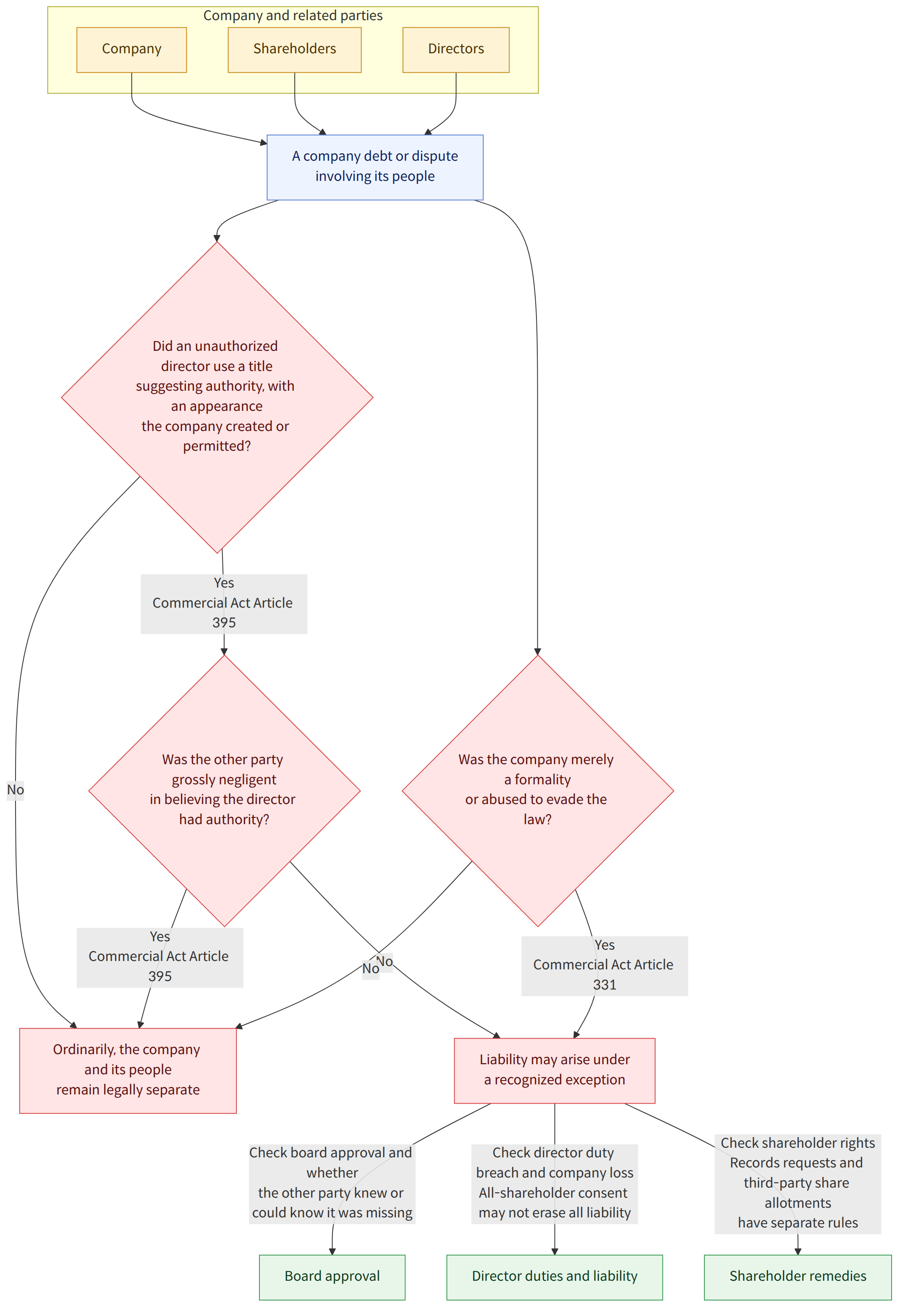
As a rule, a company and its shareholders, directors, and representative directors are separate legal persons, so a company’s debts cannot be claimed directly from an individual. However, liability and remedies may vary depending on the specific circumstances, including the appearance of authority to represent the company, a director’s breach of duty, abuse of the corporate form, or infringement of shareholder rights.
At a glance
Key points
- A company may be liable when a director without authority to represent it uses a title suggesting that they have such authority. However, the company must have created or permitted that appearance, and the other party may not be protected if they were grossly negligent (Commercial Act, Article 395 (상법 제395조), Cases 1, 7, and 10).
- Even if the representative director entered into a transaction requiring a board resolution without one, the transaction may be valid unless the other party knew or could have known that the resolution was absent. As a rule, the company must assert and prove those circumstances (Commercial Act, Article 393 and Article 389(3) (상법 제393조·제389조 제3항), Cases 19 and 20).
- A director who neglects their duties and causes loss to the company may be liable to compensate the company. A release based on the consent of all shareholders may not extinguish a director’s liability under the Commercial Act and tort liability to the same extent (Commercial Act, Articles 399 and 400 (상법 제399조·제400조), Cases 2 and 3).
- The company’s assets are, as a rule, separate from the personal assets of its shareholders and directors. However, in specific legal relationships, the company’s separate legal personality may be disregarded if the company is merely a formality or has been abused as a means of evading the application of the law (Commercial Act, Article 331 (상법 제331조), Cases 9, 14, and 24).
- Allotting new shares to a third party is an exception and requires not only a basis in the articles of incorporation but also necessity to achieve a business purpose, such as introducing new technology or improving the company’s financial structure. An allotment to a third party made solely to defend management control may infringe shareholders’ preemptive rights (Commercial Act, Articles 418 and 429 (상법 제418조·제429조), Case 6).
- Shareholders may request to inspect and copy board minutes, accounting books, and other records, but the company may refuse if it proves that the request is improper, taking into account its purpose and circumstances. An attempt to carry out a hostile takeover does not, by itself, make the request improper (Commercial Act, Article 391-3 and Article 466 (상법 제391조의3·제466조), Cases 16 and 21).
- For a company division, the divided company and the newly established company are, as a rule, jointly and severally liable for debts incurred before the division. A special resolution and creditor-protection procedures are relevant if liability is to be divided as an exception. A reduction in the principal debt under a rehabilitation plan does not, as a rule, affect the guarantor’s liability (Commercial Act, Article 530-9 (상법 제530조의9); Debtor Rehabilitation and Bankruptcy Act, Article 250 (채무자 회생 및 파산에 관한 법률 제250조), Cases 4 and 11).
Frequently asked questions
Q. Can I claim money the company has not repaid from its representative director personally?
If a company is a party to the loan document or contract, a claim should, as a rule, be brought against the company’s assets, and cannot be brought directly against the representative director personally. However, the representative director may potentially be held separately liable if they personally agreed to assume the debt or if circumstances establish that they abused the company’s separate legal personality.
Q. I ordered goods from a managing director who did not have authority to represent the company. Can I claim the price from the company?
A company may be liable for a transaction entered into by a director using a title, such as managing director, that could give the appearance of authority to represent the company. However, the company must have created or permitted that appearance, and the company may not be liable if the other party to the transaction was grossly negligent in believing that the director had authority to represent it.
Q. If the representative director borrowed money in the company’s name without board approval, does the company have to repay it?
Even if a transaction requires a board resolution, it is not necessarily invalid simply because no resolution was adopted. The transaction may be valid unless the company asserts and proves that the other party knew or could have known that the resolution was absent or invalid.
Q. Can all shareholders’ consent eliminate all of a director’s liability for harm to the company?
Consent from all shareholders may be grounds for releasing a director from liability to the company under the Commercial Act. However, the case explains that such a release does not automatically extinguish a claim for damages arising from a tort.
Q. Can existing shareholders challenge a company’s issuance of new shares to outsiders during a control dispute?
Even if the articles of incorporation provide a basis for allotting shares to a third party, the allotment must be necessary to achieve a business purpose, such as introducing new technology or improving the company’s financial structure. If new shares were allotted to a third party solely to protect management’s control, the allotment may be challenged on the grounds that it infringes existing shareholders’ preemptive rights.
Q. Can a shareholder attempting a hostile takeover inspect the minutes of board meetings?
The fact that a shareholder is attempting a hostile takeover does not, by itself, make a request to inspect and copy records improper. Such a request may be permitted if it is made to protect the interests of the company and its shareholders, and there are no special circumstances—such as a risk that the information obtained will be used in a competing business or that the timing would be excessively detrimental to the company.
Q. If a company’s debt is reduced under a rehabilitation plan, is the joint and several guarantor’s debt reduced too?
According to the explanation in the case, a reduction in the principal debt or a change to its repayment date under a rehabilitation plan does not, as a rule, affect the scope of the guarantor’s liability. Accordingly, the guarantor may remain liable for the original claim independently of the rehabilitation plan.
Q. If a company is divided, must a pre-division debt be claimed only from the newly established company?
When a company is divided, the divided company and the newly established company are, as a rule, jointly and severally liable to repay the debts of the company before the division. However, if an exception dividing liability is established by a special resolution, creditor-protection procedures become relevant. Whether a debt is assumed should therefore not be determined solely from the division plan.
Relevant laws
- Commercial Act, Article 37(1) (상법 제37조 제1항)
- Commercial Act, Article 209 (상법 제209조)
- Commercial Act, Article 232 (상법 제232조)
- Commercial Act, Article 288 (상법 제288조)
- Commercial Act, Article 331 (상법 제331조)
- Commercial Act, Article 335 (상법 제335조)
- Commercial Act, Article 337(1) (상법 제337조 제1항)
- Commercial Act, Article 341 (상법 제341조)
- Commercial Act, Article 341-2 (상법 제341조의2)
- Commercial Act, Article 342-2 (상법 제342조의2)
- Commercial Act, Article 360 (상법 제360조)
- Commercial Act, Article 362 (상법 제362조)
- Commercial Act, Article 368(1) (상법 제368조 제1항)
- Commercial Act, Article 371 (상법 제371조)
- Commercial Act, Article 374(1), subparagraph 1 (상법 제374조 제1항 제1호)
Watch out for
- If you entered into a transaction with someone who lacked authority to represent the company, do not rely only on their title. You should also consider whether the company approved or permitted the use of that title and whether the other party to the transaction was grossly negligent.
- A claim for damages should distinguish whether it is based on breach of contract or on a tort. The cases explain that the burden of proof and limitation period may differ depending on the type of claim.
- The case guidance states that an action to invalidate an issuance of new shares must be brought within six months from the date the shares were issued under Commercial Act, Article 429 (상법 제429조).
- The case explains that even where the company’s separate legal personality may be disregarded, the enforceability of a final judgment against the existing company does not automatically extend to the newly established company.
Related articles
Source cases
This guide was compiled by AI from the following Korea Legal Aid Corporation consultation cases (in Korean).
- 대표권 없는 이사의 월권행위에 대한 회사의 책임
- 총주주의 동의로 이사의 회사에 대한 책임을 면제할 수 있는지
- 이사 또는 감사의 임무해태로 인한 손해배상채권의 소멸시효기간
- 회사의 분할과 채권자보호절차
- 주식회사 감사 선임 시 3% 초과 주식이 상법 제368조 제1항의 ‘발행주식총수’에 산입 여부
- 신기술의 도입, 재무구조의 개선 등의 목적 없이 대표이사등이 자신의 경영권을 주주로부터 방어하기 위하여 제3자에게 한 신주발행...
- 경리담당 상무이사가 대표이사 명의의 어음 발행 시 회사의 책임
- 상법상 주식회사의 자기주식 취득금지와 가장납입의 효력
- 회사에 대한 채권으로 대표이사 개인재산을 강제집행할 수 있는지
- 이사자격 없는 자에게도 상법상 표현대표이사 규정이 적용되는지
- 회생계획으로 회생채권의 내용 변경 시 보증인의 책임범위
- 명의개서를 부당하게 거절당한 주식양수인의 구제수단
- 미등기된 대표이사의 직무대행자선임 가처분의 효력
- 기존주식회사의 채무를 신설주식회사에 청구할 수 있는지
- 종류주주총회결의를 흠결한 정관변경의 효력
- 적대적 인수합병 계획회사의 이사회 회의록 열람 등사청구
- 회사의 중요사업부분 양도와 상법상 1인회사의 주주총회 운영
- 제권판결로 재발행된 주권의 제권판결 취소시 효력
- 대표이사가 이사회 결의 없이 행한 대외적 거래행위의 효력
- 甲, 乙회사 대표이사 겸직자가 甲회사 명의로 乙회사 채무를 연대보증한 경우
- 적대적 인수를 시도하는 주주의 열람ㆍ등사 청구가 가능한지
- 회생절차에서의 회생채권 신고방법
- 설립중 회사의 개념과 발기인의 권한범위
- 채무면탈 목적으로 회사 설립 시 원래의 회사에 대한 판결의 효력 범위
- 합병비율의 불공정으로 인한 합병무효의 소
This guide is general legal information about Korean law, not legal advice for your situation. For a specific case, consult a lawyer or the Korea Legal Aid Corporation (call 132 in Korea).