
Guide to Other Constitutional Issues and Constitutional Court Proceedings
Based on 10 consultation cases · Updated · Translated from the Korean original.
This guide outlines the basics of retrials and criminal compensation following rulings of unconstitutionality, the parties and deadlines for jurisdictional dispute proceedings, and constitutional court procedures such as party dissolution and impeachment. Because each procedure has different eligible petitioners and requirements, the relevant issues must be considered separately.
At a glance
Key points
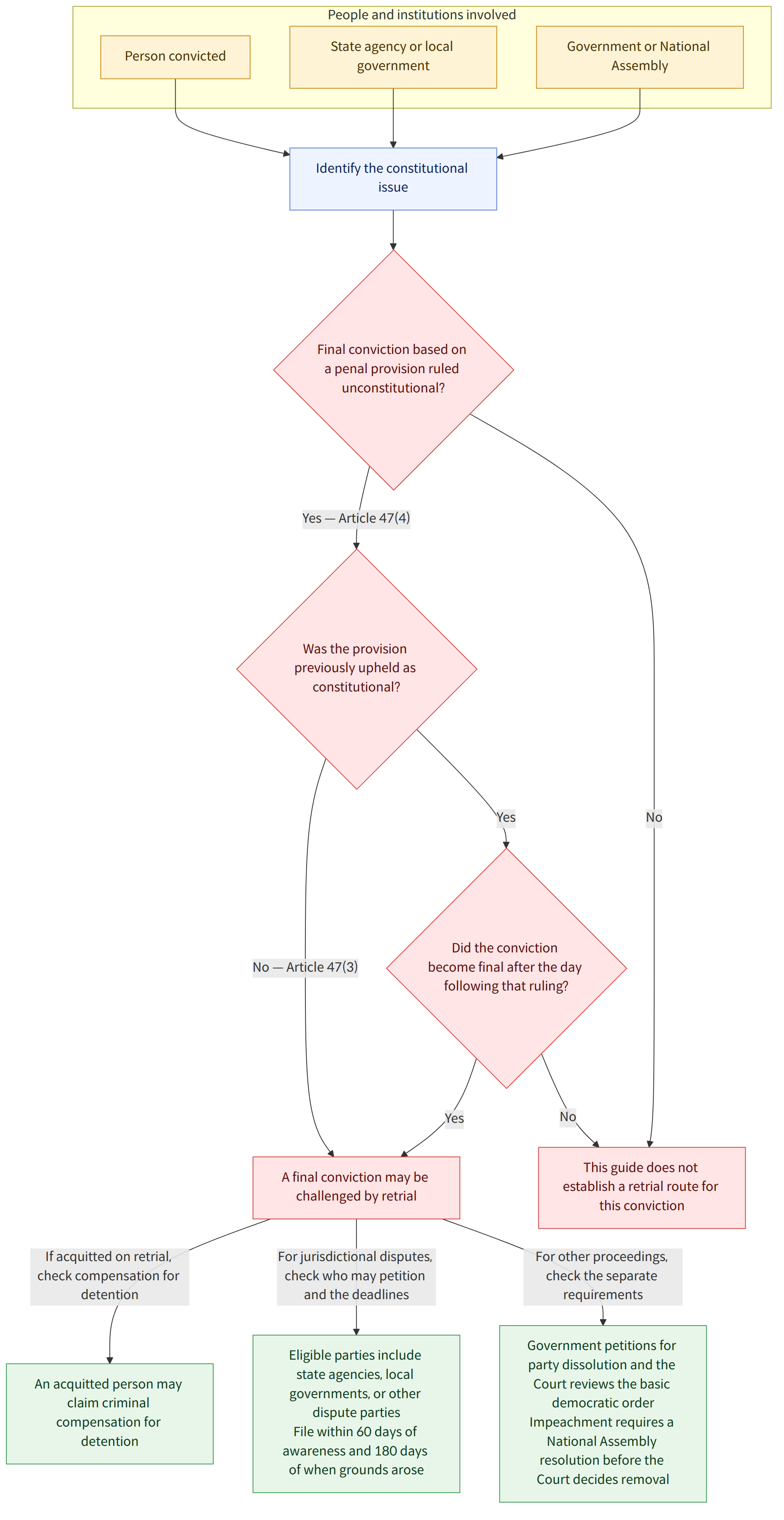
- As a general rule, a penal provision ruled unconstitutional loses effect retroactively. If there was an earlier ruling upholding it as constitutional, it loses effect retroactively from the day after that ruling (Constitutional Court Act, Article 47(3) (헌법재판소법 제47조 제3항)).
- A final judgment of conviction based on a penal provision ruled unconstitutional may be challenged by seeking a retrial (Constitutional Court Act, Article 47(4) (헌법재판소법 제47조 제4항)).
- If the conviction became final after the day following the earlier ruling upholding the provision as constitutional, the case may be eligible for retrial even if the criminal act occurred before that ruling (Supreme Court, Nov. 10, 2016, 2015Mo1475).
- If a person is acquitted in a retrial, they may claim criminal compensation for the period of detention (Criminal Compensation and Restoration of Honor Act, Article 5(1) (형사보상 및 명예회복에 관한 법률 제5조 제1항)).
- A jurisdictional dispute proceeding is for a state agency or local government, or another party to a jurisdictional dispute, to claim that its authority has been infringed or is at risk of infringement. Individuals may not bring such a proceeding.
- A jurisdictional dispute petition must be filed within 60 days from the date the petitioner became aware of the grounds and within 180 days from the date those grounds arose (Constitutional Court Act, Article 63(1) and (2) (헌법재판소법 제63조 제1항·제2항)).
- The Government petitions for a judgment dissolving a political party, and the Constitutional Court examines whether the party’s purpose or activities violate the basic democratic order (Constitution, Article 8(4) (헌법 제8조 제4항)).
- A retrial may also be sought against a judgment dissolving a political party. An impeachment proceeding, by contrast, requires a resolution by the National Assembly to impeach, after which the Constitutional Court decides whether to remove the public official from office.
Frequently asked questions
Q. Can I seek a retrial if I was convicted under a law that was ruled unconstitutional?
A final judgment of conviction based on a penal provision that has been ruled unconstitutional may be challenged by seeking a retrial. However, if the provision was previously ruled constitutional, it loses effect retroactively from the day after that ruling, so the date on which the conviction became final may affect whether a retrial is available.
Q. Can I seek a retrial even if the criminal act occurred before the ruling that upheld the law as constitutional?
According to the Supreme Court’s ruling in the case, a retrial may be sought even if the criminal act occurred before the earlier ruling that upheld the provision as constitutional, provided that the conviction became final after the day of that ruling. Whether a case is eligible for retrial depends not only on when the criminal act occurred, but also on whether the judgment applied a provision whose effect was retroactively nullified by the ruling of unconstitutionality.
Q. Can I receive compensation for time spent in detention if I am acquitted in a retrial?
If you were detained under a conviction and later acquitted in a retrial, you may claim criminal compensation. The case explains that compensation may be awarded at a prescribed rate for the period of detention, but it does not specify the amount.
Q. Can an individual bring a jurisdictional dispute against a state agency or local government?
An individual cannot bring a jurisdictional dispute because individuals are not state agencies or local governments that may be parties to such proceedings. The procedure is for a state agency or local government to claim that its authority has been infringed or is at risk of infringement.
Q. Can a dispute over authority between a superintendent of education and the relevant local government also be resolved through a jurisdictional dispute proceeding?
In the case, the Constitutional Court treated the superintendent of education as an agency that administers educational and academic affairs for a City/Do. It ruled that an internal dispute between the superintendent and the relevant local government does not constitute a jurisdictional dispute within the Constitutional Court’s jurisdiction. A petition of this kind may therefore be dismissed as procedurally improper.
Q. By when must a jurisdictional dispute petition be filed?
A petition must be filed within 60 days from the date the petitioner became aware of the grounds for the proceeding and within 180 days from the date those grounds arose. The case explains that a petition filed after these time limits will be dismissed.
Q. Who may petition for the dissolution of a political party, and what happens if the party is dissolved?
The Government may petition the Constitutional Court for a judgment dissolving a political party if the party’s purpose or activities violate the basic democratic order. If the Court orders dissolution, the party’s registration is canceled. According to the case, the dissolved party’s representatives and officers may not form a party with the same or similar platform or basic policies, and the party’s property becomes state property.
Q. Can a retrial be sought against a judgment dissolving a political party?
In the case, the Constitutional Court ruled that retrial must also be available for a judgment dissolving a political party. It therefore cannot be assumed that such a judgment is not subject to retrial.
Q. If I lose a constitutional complaint, will the State pay my attorney’s fees?
According to the Constitutional Court’s decision in the case, the adjudication costs borne by the State do not include a party’s own expenses, such as attorney’s fees. Accordingly, the State cannot be required to bear the cost of retaining counsel to file a constitutional complaint.
Relevant laws
- Constitution, Article 8(4) (헌법 제8조 제4항)
- Constitution, Article 65(1), (3), and (4) (헌법 제65조 제1항·제3항·제4항)
- Constitution, Article 111(1)(4) (헌법 제111조 제1항 제4호)
- Constitution, Article 113(1) (헌법 제113조 제1항)
- Constitution, Article 117(2) (헌법 제117조 제2항)
- Constitutional Court Act, Article 23(2) (헌법재판소법 제23조 제2항)
- Constitutional Court Act, Article 47(3) and (4) (헌법재판소법 제47조 제3항·제4항)
- Constitutional Court Act, Article 54(2) (헌법재판소법 제54조 제2항)
- Constitutional Court Act, Article 55 (헌법재판소법 제55조)
- Constitutional Court Act, Article 62(1)(3) (헌법재판소법 제62조 제1항 제3호)
- Constitutional Court Act, Article 63(1) and (2) (헌법재판소법 제63조 제1항·제2항)
- Constitutional Court Act, Article 66(2) (헌법재판소법 제66조 제2항)
- Constitutional Court Act, Article 67(2) (헌법재판소법 제67조 제2항)
- Criminal Compensation and Restoration of Honor Act, Article 5(1) (형사보상 및 명예회복에 관한 법률 제5조 제1항)
- Local Education Autonomy Act (지방교육자치에 관한 법률)
Watch out for
- When assessing whether a retrial is available following a ruling of unconstitutionality, check both whether there was an earlier ruling upholding the provision as constitutional and whether the conviction became final after the day of that ruling.
- The parties eligible to bring a jurisdictional dispute are limited. Both deadlines must be met: 60 days from the date the petitioner became aware of the grounds and 180 days from the date those grounds arose.
- Petitions for dissolution of a political party and impeachment proceedings have different petitioners and procedures. A party-dissolution proceeding begins with a petition by the Government, while an impeachment proceeding begins with the National Assembly’s resolution to impeach.
- The outcomes and requirements described in the cases are based on the rulings in those particular consultation cases. The facts and procedures applicable to a specific matter should be checked separately.
Related articles
- After the Law Falls: Can a Former Prisoner Undo an Adultery Conviction?
- Convicted After the Law Changed: When a Past Crime Can Be Reopened
- When Trust in an Investigation Breaks: How Korea’s Special Prosecutor System Works
- When a Minister Crosses the Line: How Impeachment Works in South Korea
- When a Party Challenges Democracy: Korea’s Constitutional Dissolution Process
- When City Hall and the State Clash, Who Has the Final Say?
Source cases
This guide was compiled by AI from the following Korea Legal Aid Corporation consultation cases (in Korean).
This guide is general legal information about Korean law, not legal advice for your situation. For a specific case, consult a lawyer or the Korea Legal Aid Corporation (call 132 in Korea).