
Guide to Construction Payment and Defect Disputes under Contracts for Work
Based on 74 consultation cases · Updated · Translated from the Korean original.
In disputes under contracts for work, it is important to determine whether construction was completed, what the contract and any agreements provide, and when a claim was exercised. Construction costs, contract termination, rights of retention, liability for defects, and delay damages each have different requirements and effects, so the facts and contract documents must be considered together.
At a glance
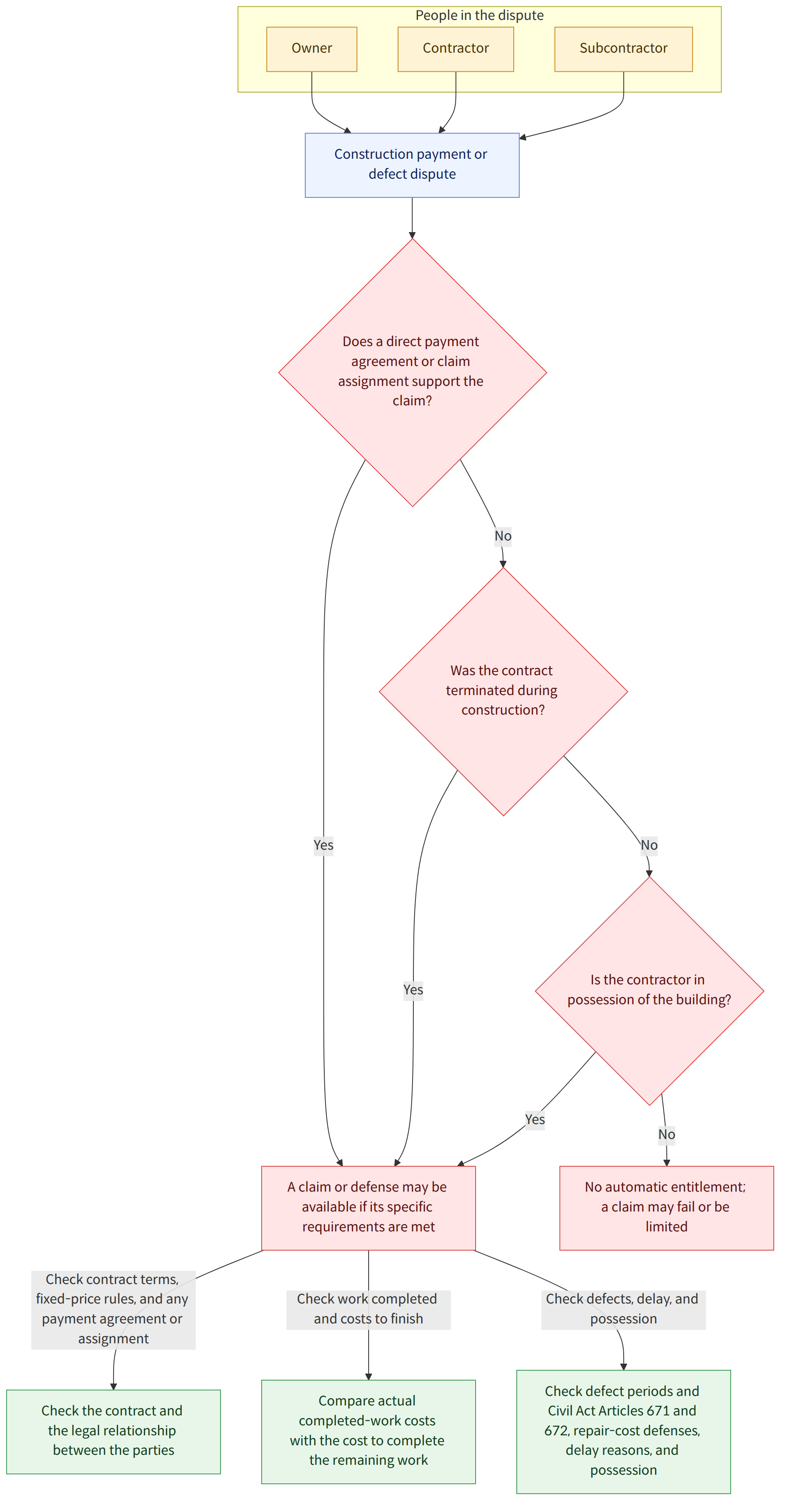
Key points
- If construction of a building has reached the final scheduled stage and is complete in the ordinary sense, the contract generally cannot be terminated if the remaining issues are merely defects. If the construction is incomplete, the requirements for termination must be considered (Case 1).
- If the contract is terminated during construction, the costs attributable to the work completed may be settled. The percentage of work completed is calculated based on the actual cost of the completed portion and the cost that would be required to complete the unperformed portion (Cases 1 and 22).
- Even if the contractor has not been paid for the construction work, the contractor must be in possession of the building to exercise a right of retention. The contractor may refuse to deliver the building to a purchaser at auction by exercising that right, but cannot claim the construction costs themselves from the purchaser (Cases 2 and 10).
- The contractor’s duty to repair defects and the owner’s duty to pay construction costs may be subject to simultaneous performance. However, the scope of the defense may be limited depending on the circumstances—for example, where the unpaid construction costs are markedly greater than the repair costs or the defense appears to be a means of avoiding performance (Cases 13 and 23).
- The period of liability for defects in a building may vary depending on the type of subject matter and when it was delivered. The cases address periods of five or ten years after delivery for buildings and other property. A contractor may remain liable for defects it knew about but did not disclose, even where the parties agreed to limit liability (Civil Act, Articles 671 and 672 (민법 제671조·제672조); Cases 9 and 18).
- Under a fixed-price contract, it is difficult to claim an increase in the construction price solely because actual construction or material costs exceeded expectations. Whether an increase is available must be determined according to the contract terms (Case 15).
- Delay damages for late construction must be assessed in light of the contract terms and the reasons for the delay. Ordinary rain or difficulty obtaining materials is generally unlikely to be considered grounds for exemption. However, the agreement on delay damages may be limited if the owner required a shortened construction period that was physically impossible or effectively forced the contractor to perform defective work (Cases 12 and 20).
- Whether a subcontractor may claim construction costs directly from the owner depends on the specific legal relationship, such as a direct payment agreement or an assignment of the claim. The fact that the contractor and owner reached an agreement does not, by itself, always allow a direct claim (Cases 8 and 14).
Frequently asked questions
Q. If a construction contract is terminated midway through the work, can I be paid for the work already done?
If construction has progressed substantially when the contract is terminated, the construction costs attributable to the work completed may be settled. The percentage of work completed is calculated by considering both the costs of the portion already completed and the costs required to complete the remaining work.
Q. If I have not been paid for the construction work, can I refuse to hand over the keys to the building?
If the contractor is in possession of the building and the claim for construction costs relating to that building is due, the contractor may assert a right of retention and refuse to hand over the building. However, it is necessary to check whether ownership of the building belongs to the owner and whether the contractor is actually in possession of it.
Q. If I have a right of retention, can I demand payment of construction costs directly from someone who bought the building at auction?
According to the court decision described in the case, a person exercising a right of retention cannot demand payment of construction costs from a purchaser at auction. However, that person may refuse to deliver the property retained until the secured claim is paid.
Q. If defects are discovered, can I refuse to pay the construction costs?
A claim for repair of defects or for damages in lieu of repair may be subject to simultaneous performance with the claim for construction costs. A defense may be available even if the payment for the defective portion has already been made, but its scope may be limited in light of the cost of repairing the defects and the purpose of the defense.
Q. If the period for liability for defects specified in the contract has expired, can I no longer make a claim?
The fact that the period has elapsed does not necessarily mean that a claim can no longer be made. The period of liability for defects in a building and when that period begins may be at issue. A contractor may also remain liable for facts it knew about but did not disclose, even if the parties agreed to limit liability.
Q. If material and labor costs have risen, can I ask for the agreed construction price to be increased?
If the construction price is a fixed lump sum, it is difficult to claim an increase solely because actual costs have risen. The contract terms, including any agreement to adjust the price due to a change in design or economic conditions, should be checked.
Q. If I agreed to a request to shorten the construction period but completed the work late, do I have to pay delay damages?
The answer depends on the agreed construction period and the reasons for the delay. If, at the owner’s unilateral request, it was physically impossible to complete the work within the shortened period, or the request effectively forced the contractor to perform defective work, the full amount of delay damages calculated on the basis of that period may not be awarded.
Q. Can a subcontractor claim construction costs directly from the owner?
As a rule, whether a subcontractor may claim payment from the owner depends on the contract and the relationships among the claims. A direct payment agreement among the owner, contractor, and subcontractor may allow a direct claim if it is construed as an assignment of the claim and the owner’s consent to that assignment. The amount payable may also be limited when the system for direct payment of subcontracting fees applies.
Q. If we end a contract for work by mutual agreement, can I separately claim damages?
If the parties made no special agreement on damages or reserved a right to claim damages when they mutually agreed to terminate the contract for work, it is generally difficult to claim damages for breach of contract. The party asserting that such an agreement or reservation existed must prove it.
Relevant laws
- Civil Act, Article 320(1) (민법 제320조 제1항)
- Civil Act, Article 321 (민법 제321조)
- Civil Act, Article 396 (민법 제396조)
- Civil Act, Article 398(2) (민법 제398조 제2항)
- Civil Act, Article 450 (민법 제450조)
- Civil Act, Article 536 (민법 제536조)
- Civil Act, Article 548(2) (민법 제548조 제2항)
- Civil Act, Article 667 (민법 제667조)
- Civil Act, Article 668 (민법 제668조)
- Civil Act, Article 670 (민법 제670조)
- Civil Act, Article 671 (민법 제671조)
- Civil Act, Article 672 (민법 제672조)
- Civil Act, Article 448 (민법 제448조)
- Civil Execution Act, Article 56(3) and (4) (민사집행법 제56조 제3호·제4호)
- Civil Execution Act, Article 91(5) (민사집행법 제91조 제5항)
Watch out for
- It is necessary to distinguish between work that is incomplete and work where the final scheduled stage has been completed but defects remain. The availability of contract termination may differ depending on this distinction.
- The period of liability for defects may vary depending on the subject matter and when it was delivered. In a case involving conversion to a sale after a lease, the period was calculated from the initial delivery, not from the date of conversion to a sale.
- Possession of the property is important to a right of retention. If possession was transferred after the seizure arising from a decision to commence auction proceedings took effect, the right of retention may not be enforceable against others.
- The terms of the contract and the agreements between the parties should be checked in detail regarding direct payment agreements, reservations of claims for damages, extensions or reductions of the construction period, and settlement of advance payments.
Related articles
Source cases
This guide was compiled by AI from the following Korea Legal Aid Corporation consultation cases (in Korean).
- 공사진행 중 도급계약이 해제될 경우 공사대금 산정방법
- 공사대금채권에 기한 건물유치권자의 경락인에 대한 대항력
- 토지매수인이 자기비용으로 건축한 건물소유권을 매도인으로 한 경우
- 여러 차례의 단계적 도급에 있어서 직상수급인의 임금지급책임
- 하자보수보증금 중 실제 소요비용을 공제한 잔액의 반환 여부
- 수급인이 파산선고를 받은 경우 하자보수채권이 재단채권인지
- 제작물공급계약의 법적 성질 및 그에 따른 대금지급의무에 대한 소멸시효기간
- 도급인의 하수급인에 대한 공사대금 직접지급약정의 효력
- 수급인이 알고 고지하지 아니한 하자의 경우 담보책임
- 수급인이 공사대금확보 위해 신축건물에 유치권 행사 가능한지
- 손해배상액예정 없이 계약 합의해제할 경우 손해배상청구 가능한지
- 도급계약에서 지체상금의 면책사유
- 수급인 하자보수의무와 동시이행 할 도급인 공사대금 지급채무의 범위
- 하수급인의 하수급대금 직접지급과 선급금의 공제
- 사정변경을 이유로 도급공사대금을 증액하여 청구할 수 있는지
- 하도급거래 공정화에 관한 법률에 위반된 하도급약정의 사법상 효력
- 공동이행방식의 공동수급체(2)
- 분양전환과 하자보수청구권의 제척기간
- 하자보수에 갈음한 손해배상청구권 행사와 제척기간
- 공기 단축 요구에 따른 지체상금 부담 여부
- 하자보수보증금청구권과 하자담보추급권의 관계
- 자기의 비용과 재료로 건물을 신축한 수급인의 권리
- 하자확대손해로 인한 수급인의 손해배상채무와 도급인의 공사대금채무는 동시이행관계에 있는 것인지
- 민간공사 도급계약에서 수급인의 보증인이 계약해제에 따른 선급금 반환의무에 대하여도 보증책임을 지는지 여부
- 수급인의 하자담보책임청구의 경우 도급인 과실을 참작할 수 있는지
This guide is general legal information about Korean law, not legal advice for your situation. For a specific case, consult a lawyer or the Korea Legal Aid Corporation (call 132 in Korea).