
General Guide to Contracts: Contract Formation and Principles of Performance
Based on 84 consultation cases · Updated · Translated from the Korean original.
The parties and terms of a contract are determined not only from the written contract but also by considering the circumstances in which it was entered into, the parties’ intentions, and the actual course of performance. The duty to explain standard terms and conditions, the defense of simultaneous performance, and the consequences of breach are not determined uniformly in every case; the specific agreement and circumstances must be examined.
At a glance
Key points
- A term in standard terms and conditions is not automatically invalid merely because it is unfavorable to the customer. The overall determination considers whether it involves abuse of a superior bargaining position or unfairness that runs counter to legitimate interests or reasonable expectations (Act on the Regulation of Terms and Conditions, Article 6 (약관규제법 제6조), Case 1).
- Important terms in standard terms and conditions that directly affect the conclusion of a contract must be explained in a way the customer can understand. However, the duty to explain may not apply to matters that are customary in the relevant transaction and could be anticipated without a separate explanation (Act on the Regulation of Terms and Conditions, Article 3 (약관규제법 제3조), Cases 1 and 11).
- If a contract is entered into in another person’s name, the contracting party is determined according to the parties’ shared intent if their intentions match. If they do not match, the determination is made by examining the specific circumstances, including the contract’s terms and the circumstances in which it was entered into (Case 22).
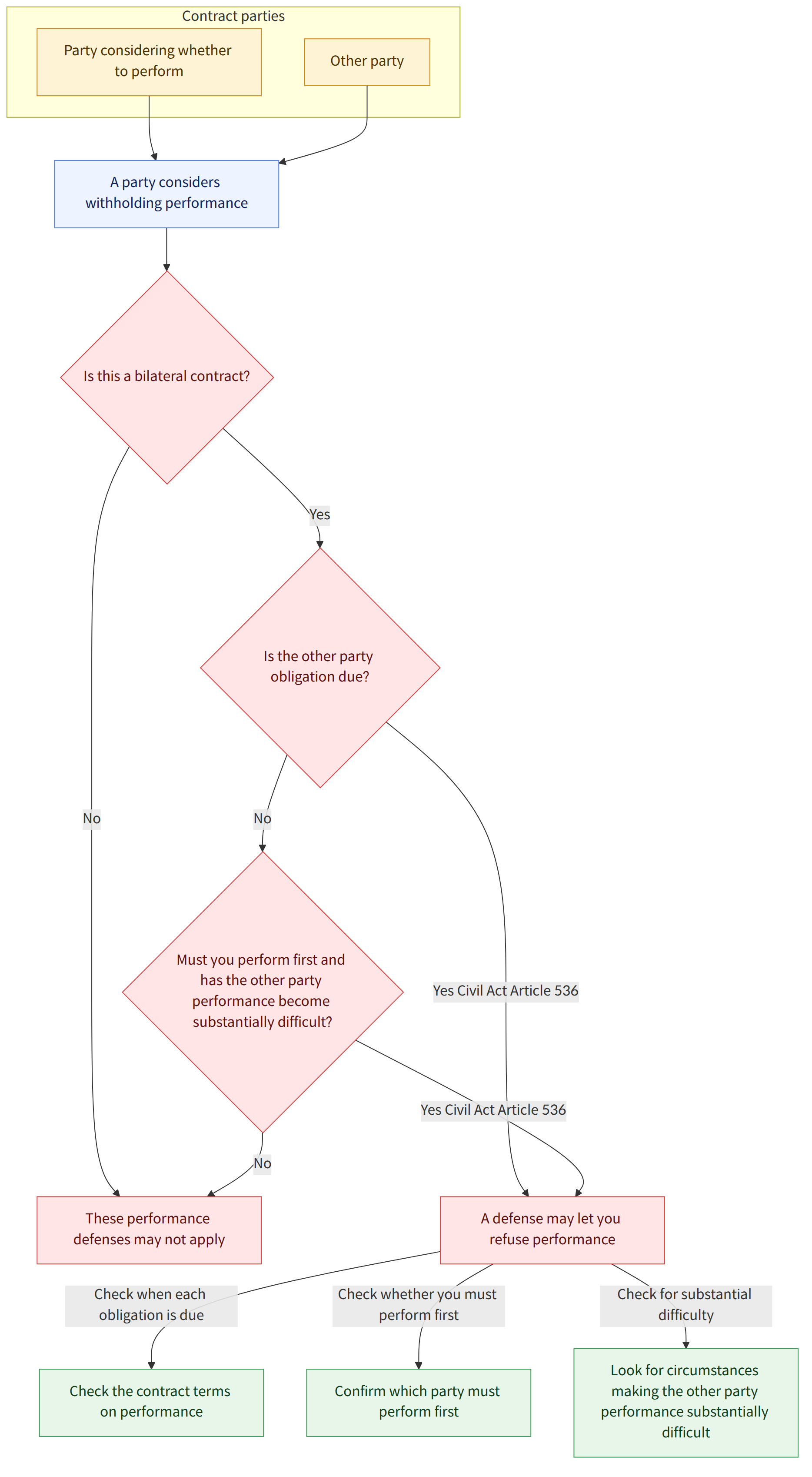
- In a bilateral contract, the defense of simultaneous performance may be available when the other party’s obligation falls due, allowing a party to refuse to perform its own obligation. Even a party required to perform first may be entitled to the defense of insecurity if circumstances arise that make the other party’s performance substantially difficult (Civil Act, Article 536 (민법 제536조), Cases 6 and 12).
- Even if the offeror states, “If you do not object within the specified period, you will be deemed to have accepted,” the offeror cannot compel acceptance on that basis alone if the other party has no duty to reply (Civil Act, Articles 527 and 528 (민법 제527조·제528조); Commercial Act, Article 53 (상법 제53조), Case 13).
- Where a written contract is a requirement for formation, as with a local-government contract, the main contract may not be formed merely by the award of the bid. However, after the award has established the main terms, adding major terms that differ from the published terms may not be permitted (Act on Contracts to Which the State Is a Party, Article 11 (국가계약법 제11조), Case 21).
- If a contract provides for performance for the benefit of a third party, that third party may, if the requirements are met, demand performance directly from the obligor. However, who qualifies as a third party is determined by examining the contract’s purpose and the scope of protection, among other factors (Civil Act, Article 539 (민법 제539조), Case 15).
- As a general rule, the validity of a contract is governed by the law in force when it was entered into. The fact that the law is later amended does not, by itself, mean that the new provisions automatically apply to contracts already entered into (Case 25).
Frequently asked questions
Q. Are unfavorable terms written in standard terms and conditions automatically invalid?
Not necessarily. A term is not invalid merely because it is somewhat unfavorable to the customer. Whether it is unfair is determined by considering the disadvantage caused by the term and the likelihood of that disadvantage occurring, its effect on the transaction, relevant laws and regulations, and other factors as a whole.
Q. What happens if a business operator does not explain important terms in its standard terms and conditions?
A business operator must explain important terms in a way the customer can understand. If the operator fails to do so, it may not assert that those terms form part of the contract. However, the duty to explain may not apply to matters that are customary in the relevant transaction or that the customer could reasonably anticipate without a separate explanation.
Q. If I entered into a contract using someone else’s name, who can be held liable?
If the person who entered into the contract and the other party share the same intent, the parties to the contract are determined according to that intent. If their intents do not match, the determination is made by considering the circumstances before and after the contract, including its terms, purpose, and the circumstances in which it was entered into, to establish whom the other party understood to be the contracting party.
Q. Can I stop performing even though I agreed to perform first if the other party does not pay?
In an ongoing business relationship, there may be circumstances in which a party may refuse to perform its next obligation if it has already supplied goods or services but has not received payment that is past due, or if there are substantial grounds to doubt that the other party will make a subsequent payment. The matter is determined by considering the circumstances of the parties as a whole, including whether payment is overdue and whether there are means of securing payment.
Q. If the other party does not pay by the contractual due date, can I refuse to perform too?
A party may exercise the defense of simultaneous performance if the parties’ obligations are reciprocal and the other party’s obligation has fallen due. The obligations do not have to have been due at the same time from the outset; the issue may also arise if the other party’s obligation falls due while the party who must perform first is still under that obligation.
Q. If an offer says, “If you do not object within the specified period, you will be deemed to have agreed,” will I be treated as having agreed?
If the other party has no duty to reply, the offeror cannot bind that party merely by stating that they must do so. However, the specific circumstances should be examined where a separate rule may apply, such as to a contract falling within the ordinary course of business in an ongoing commercial relationship.
Q. Is a contract formed immediately when a bid for a local-government contract is awarded?
For the local-government contract discussed in the case, a written contract was a requirement for formation, so the main contract was not formed merely by the award of the bid. However, after the award has established the main terms, adding important terms that differ from the invitation to bid may not be permitted in the absence of special circumstances.
Q. Can visitors who are not among those protected by the contract receive protection under a contract for the benefit of a third party?
Even if a contract is recognized as a contract for the benefit of a third party, the scope of those protected is determined by examining the contract’s purpose, the nature of the work, and how the subject matter is used. In the case, family members living with and routinely using the building under security protection were included, but people who visited temporarily were not.
Q. If the law changes after I enter into a contract, does the new law apply to my existing contract?
As a general rule, the validity of a contract is governed by the law in force when the contract was entered into. Unless an amended law contains a special provision making it applicable to existing contracts, the new law cannot be considered automatically applicable to contracts already entered into.
Relevant laws
- Act on the Regulation of Terms and Conditions, Articles 3 and 6 (약관의 규제에 관한 법률 제3조·제6조)
- Civil Act, Articles 103, 527, 528, 534, 536, and 539 (민법 제103조·제527조·제528조·제534조·제536조·제539조)
- Commercial Act, Articles 52 and 53 (상법 제52조·제53조)
- Act on Real Name Financial Transactions and Confidentiality, Article 3 (금융실명거래 및 비밀보장에 관한 법률 제3조)
- Private School Act, Articles 28 and 51 (사립학교법 제28조·제51조)
- Enforcement Decree of the Private School Act, Article 12 (사립학교법 시행령 제12조)
- Act on the Ownership and Management of Aggregate Buildings, Articles 18, 23, 28, 29, 41, and 42 (집합건물의 소유 및 관리에 관한 법률 제18조·제23조·제28조·제29조·제41조·제42조)
- Housing Act, Article 44 (주택법 제44조)
- Mutual Savings Banks Act, Article 37 (상호저축은행법 제37조)
- Enforcement Decree of the Mutual Savings Banks Act, Article 30 (상호저축은행법 시행령 제30조)
- former Labor Standards Act, Article 34 (구 근로기준법 제34조)
- Small and Medium Enterprise Cooperatives Act, Articles 35, 40, and 88 (중소기업협동조합법 제35조·제40조·제88조)
- Local Finance Act, Article 63 (지방재정법 제63조)
- Act on Contracts to Which the State Is a Party, Article 11 (국가를 당사자로 하는 계약에 관한 법률 제11조)
- Housing Lease Protection Act, Article 3 (주택임대차보호법 제3조)
Watch out for
- Even for the same type of contract, the parties, scope of obligations, and time for performance may vary depending on the wording of the agreement, the circumstances in which it was entered into, and the actual performance.
- Before exercising the defense of simultaneous performance or the defense of insecurity, the specific requirements must be checked, including when the other party’s obligation falls due and the grounds for uncertainty about performance. Mere dissatisfaction is not enough to exercise either defense.
- The effect of failing to reply to an offer may vary depending on the business relationship and applicable rules. The formation of a contract should not be assumed merely because the offer says “no response means acceptance.”
- The laws cited in the cases include provisions of former laws. In an actual matter, check when the contract was entered into and whether the relevant laws are currently in force.
Related articles
Source cases
This guide was compiled by AI from the following Korea Legal Aid Corporation consultation cases (in Korean).
- 약관에 정하여진 사항이 별도의 설명 없이도 고객이 충분히 예상할 수 있었거나 이미 법령에 의하여 정해진 것을 되풀이하거나 부연...
- 학교교지로 출연된 학교경영자 명의 부동산에 대한 근저당권의 효력
- 상가번영회의 상가관리규약상 ‘업종제한규정’의 효력
- 전소유자가 연체한 아파트관리비를 경락인이 부담해야 하는지
- 상가분양회사가 업종제한약정을 위반한 경우 손해배상책임
- 임가공료는 안주면서 추가납품만 요구할 때 선이행의무를 거절할 수 있는지
- 명의신탁 해지로 인한 예금채권 양도를 청구할 수 있는지
- 공동명의예금을 다른 명의자의 동의 없이 단독으로 인출 할 수 있는지
- 사용자가 근로자의 퇴직금 중간정산 요구기간 중 일부 기간에 대하여만 일방적으로 중간정산을 실행하였는데 근로자가 그 중간정산퇴직...
- 상호저축은행법상 임원 대출금지 규정에 위반된 대출의 효력
- 甲 은행이 항공사와 제휴하여 마일리지가 적립되는 신용카드를 발급하던 중 약관을 변경하여 ‘신용카드에 부가된 제휴서비스의 제공 ...
- 선이행의무 지체 중 후이행의무 변제기 도래한 경우 동시이행항변권
- 청약자가 미리 정한 기간 내에 이의를 하지 아니하면 승낙한 것으로 간주한다는 뜻을 청약시 표시한 경우 그 효력
- 부동산의 매도인이 매수인을 이행지체에 빠뜨리기 위한 이행제공의 방법과 그 정도
- 제3자를 위한 계약의 성질을 가지는 용역경비계약에서 제3자의 범위
- 부가세를 포함한 매매대금지급의무와 소유권이전등기의무가 동시이행관계인지
- 영업비밀침해에 대한 손해배상약정이 직업선택의 자유에 위반되는지
- 중소기업협동조합이 체결한 단체적 계약의 당사자 및 효력 범위
- 매매대금 지급에 갈음하여 대출원리금 채무를 인수키로 하였으나, 아직 소유권이전등기나 점유이전이 이루어지지 않은 상태에서 동시이...
- 주택임차인이 그 임차권의 대항력을 취득한 후에 경료된 근저당권의 실행으로 소유권을 취득한 자에 대하여 위 주택의 전차인이 위 ...
- 지방자치단체가 계약의 주요한 내용 내지 조건을 입찰공고와 달리 변경하거나 새로운 조건을 추가하는 것이 허용되는지 여부
- 타인의 이름으로 계약을 체결한 경우 계약당사자 확정방법
- 약관의 유효성
- 원인채무의 이행의무와 어음 반환의무가 상호 동시이행의 관계에 있는 경우, 원인채무의 채무자는 어음을 반환받을 때까지는 이행지체...
- 개정된 하도급거래공정화에관한법률 제14조의 규정이 그 개정 전 체결된 하도급계약의 하도급거래에 관하여도 적용되는지 여부
This guide is general legal information about Korean law, not legal advice for your situation. For a specific case, consult a lawyer or the Korea Legal Aid Corporation (call 132 in Korea).