
Guide to Compulsory Execution Against Real Estate: Procedures and Precautions
Based on 179 consultation cases · Updated · Translated from the Korean original.
In a real estate auction, you must check not only the bidding procedure but also what is being sold, the rights affecting the property, the order of priority for distribution, and the rights of occupants. The requirements for enforcing against an unregistered building and the ways to challenge auction proceedings vary by case, so carefully review the relevant documents and deadlines.
At a glance
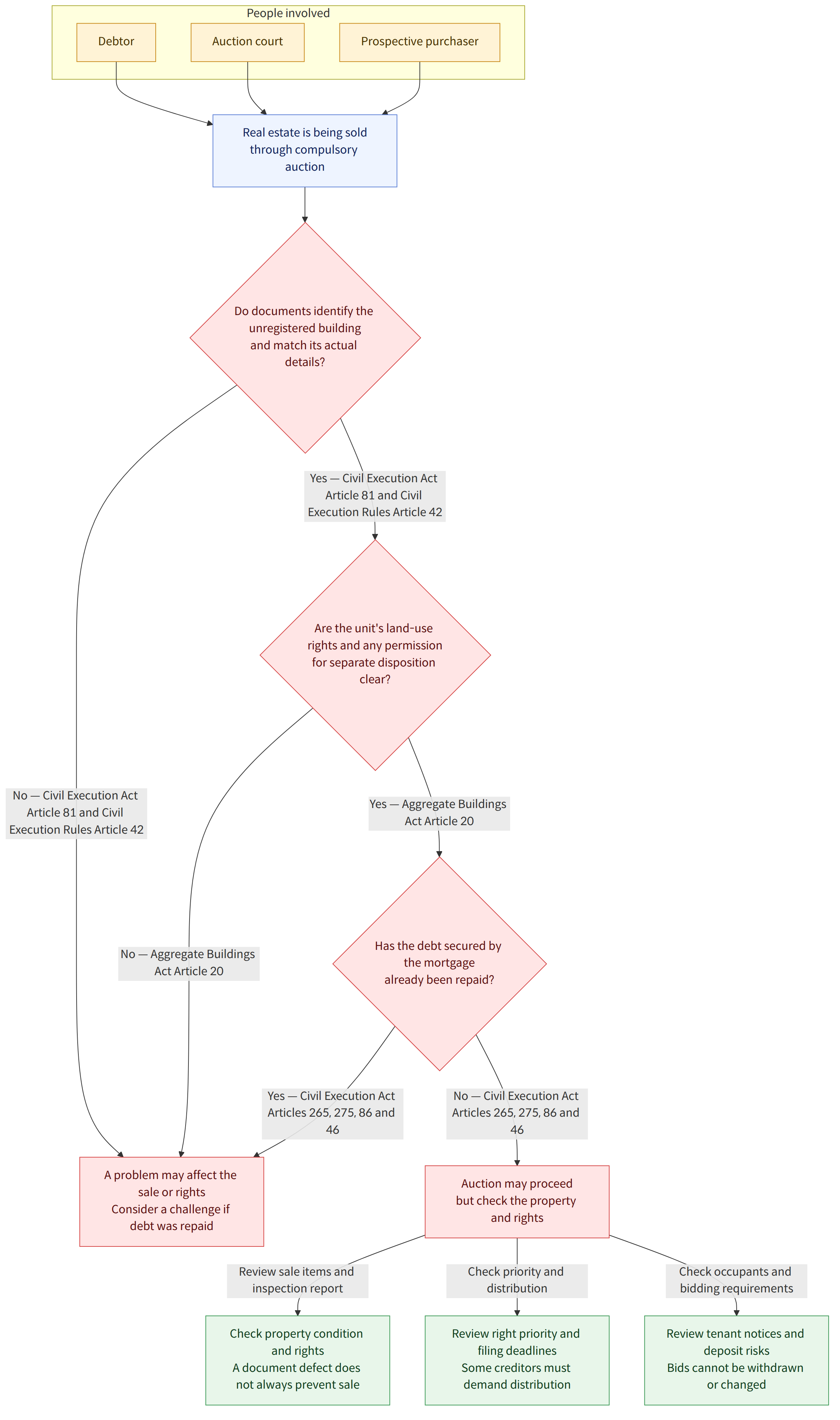
Key points
- In a date-of-sale bidding procedure, bidders submit the prescribed bid form and a deposit for the purchase offer. Once submitted, the bid form cannot be withdrawn, changed, or exchanged (Civil Execution Rules, Articles 62, 63, and 64 (민사집행규칙 제62조·제63조·제64조)).
- A compulsory auction may be applied for in respect of an unregistered building if certain documents can establish that the building belongs to the debtor and identify its lot number, structure, and area. The application may be dismissed if the building is not found to match the details in the building permit or building notification documents (Civil Execution Act, Article 81 (민사집행법 제81조); Civil Execution Rules, Article 42 (민사집행규칙 제42조)).
- As a general rule, the right to use the land appurtenant to a unit in a condominium building is disposed of together with the unit, unless special circumstances apply, such as a governing agreement or notarized deed allowing separate disposition. The auction court must examine whether the right to use the land exists and whether separate disposition is permitted (Act on the Ownership and Management of Aggregate Buildings, Article 20 (집합건물의 소유 및 관리에 관한 법률 제20조)).
- The statement of sale items and the on-site inspection report are important materials that prospective purchasers use to understand the property's condition and the rights affecting it. A defect in preparing these materials does not always prevent the sale; the issue is assessed primarily by considering the effect it may have had on the decision to purchase or the price (Civil Execution Act, Articles 105, 121, and 123 (민사집행법 제105조·제121조·제123조)).
- Even if a residential tenant has signed a confirmation of rent-free occupancy for a senior mortgagee, it may be contrary to the principle of good faith for the tenant to assert their rights against the purchaser if the purchaser relied on the notice in the statement of sale items and bought the property on the understanding that they would not assume the obligation to return the tenant's deposit.
- If an auction begins even though the debt secured by a mortgage has been repaid, consider challenging the commencement order or filing an action disputing the debt. Filing an objection or an action does not, by itself, stay the auction, so check whether a separate stay order is needed (Civil Execution Act, Articles 265, 275, 86, and 46 (민사집행법 제265조·제275조·제86조·제46조)).
- Whether rights are extinguished or assumed in an auction, and how proceeds are distributed, depend on factors such as the priority of the rights, when the auction was applied for, and whether a demand for distribution was filed. In particular, a creditor whose claim requires a demand for distribution must complete the procedure by the prescribed deadline to receive a distribution (Civil Execution Act, Article 88 (민사집행법 제88조)).
Frequently asked questions
Q. What should I be careful about when bidding in a court real estate auction?
Accurately enter the case number, property description, bidder information, and bid amount on the bid form. Unless the special conditions of sale provide otherwise, you must also submit a deposit for the purchase offer. Because a bid cannot be withdrawn, changed, or exchanged, it is important to review the relevant materials, including the statement of sale items, before deciding on your bid.
Q. Can an unregistered building be sold at a compulsory auction?
You may apply for a compulsory auction of an unregistered building if you can establish that it belongs to the debtor and provide the building's lot number, structure, and area, as well as documents relating to the building permit or building notification. The application may be dismissed if the building's actual condition is not found to match the details in the permit or notification documents.
Q. If only the unit in an apartment building is being auctioned, can I also acquire the right to use the land?
Even if the land-right has not yet been registered, the right to use the land may be included in the auction of the unit if circumstances support its existence—for example, where the unit and a share of the land were purchased together and paid for in full—and there are no special circumstances, such as a governing agreement, permitting separate disposition. You should check the specific rights affecting the property and whether separate disposition is permitted.
Q. If a residential tenant has signed a confirmation of rent-free occupancy, can the tenant assert their rights against the purchaser at auction?
The fact that a tenant signed a confirmation of rent-free occupancy for a mortgagee does not, by itself, mean that the tenant can always assert their rights against the purchaser. If the purchaser relied on the tenant's rights and priority for distribution as stated in the statement of sale items, and bought the property on the understanding that they would not assume the obligation to return the tenant's deposit, the tenant's assertion of rights against the purchaser may violate the principle of good faith.
Q. What should I do if a mortgage auction begins even though I have repaid the secured debt in full?
You may consider challenging the commencement order on the grounds that the security right does not exist or has been extinguished, or filing an action disputing the debt. However, filing an objection or an action does not, by itself, stop the auction proceedings. You may need to apply separately for an auction stay order or similar relief.
Q. Will a leasehold right that ranks behind a mortgage be assumed by the purchaser after the auction?
According to the ruling in the case, if the leasehold right ranks behind a senior mortgage and that mortgage is extinguished through the auction, the leasehold right is also extinguished by the sale and cannot be asserted against the purchaser. In practice, however, you should check the priority of each right and the conditions of sale.
Q. Can a mortgagee receive a distribution on a claim exceeding the maximum secured amount?
The portion exceeding the maximum secured amount is not entitled to priority payment under the mortgage. To receive a distribution on that excess portion at the same priority as other provisional attachment creditors, the mortgagee must meet separate requirements, such as making a valid demand for distribution in respect of the excess.
Q. I bought property at auction and resold it to the former owner. Can I apply for an order to deliver possession?
If the purchaser resells the property to the former owner after paying the purchase price, the seller is obliged to transfer possession to the purchaser, making it difficult to apply for an order to deliver possession while the sale contract remains in effect. The applicant must establish that the basis for the occupant's possession has ceased, for example, because the contract was rescinded.
Relevant laws
- Civil Execution Act, Article 16 (민사집행법 제16조)
- Civil Execution Act, Article 34 (민사집행법 제34조)
- Civil Execution Act, Article 44 (민사집행법 제44조)
- Civil Execution Act, Article 46 (민사집행법 제46조)
- Civil Execution Act, Article 78 (민사집행법 제78조)
- Civil Execution Act, Article 81 (민사집행법 제81조)
- Civil Execution Act, Article 84 (민사집행법 제84조)
- Civil Execution Act, Article 85 (민사집행법 제85조)
- Civil Execution Act, Article 86 (민사집행법 제86조)
- Civil Execution Act, Article 87 (민사집행법 제87조)
- Civil Execution Act, Article 88 (민사집행법 제88조)
- Civil Execution Act, Article 90 (민사집행법 제90조)
- Civil Execution Act, Article 91 (민사집행법 제91조)
- Civil Execution Act, Article 96 (민사집행법 제96조)
- Civil Execution Act, Article 98 (민사집행법 제98조)
Watch out for
- A bid form cannot be withdrawn, changed, or exchanged after submission. Check the bid amount, deposit for the purchase offer, documents proving authority to act as a representative, and other materials before submitting them.
- For an unregistered building, check the ownership and the building's lot number, structure, and area, and confirm that these match the details in the building permit or building notification documents.
- A creditor whose claim requires a demand for distribution must complete the procedure by the deadline for demands for distribution. According to the case, even national tax claims attached after registration of the auction commencement order require a request for payment by that deadline.
- An objection or lawsuit concerning an auction does not automatically stay the proceedings. Separately check whether an auction stay order is required and what the application requirements are.
Related articles
Source cases
This guide was compiled by AI from the following Korea Legal Aid Corporation consultation cases (in Korean).
- 부동산의 기일입찰절차 및 주의사항
- 구분건물의 전유부분만 경매로 매각된 경우 그 대지지분도 포함되는지
- 미등기 부동산에 대한 강제집행절차
- 구분건물의 경매 시 그 대지사용권을 반드시 일괄경매하여야 하는지
- 배당 전 가등기에 기한 본등기로 소유권을 상실한 경락인의 구제방법
- 부동산현황조사를 하는 집행관의 주의의무의 정도
- 1순위 근저당권자에게 무상거주확인서를 작성해 주어 임차보증금을 배당받지 못한 주택임차인이 매수인에게 주택임대차보호법상 대항력을...
- 신축중인 미등기건물에 대하여 강제집행이 가능한지
- 소유권이전등기청구권 압류 후 타인에게 이전된 경우 말소청구 여부
- 이중경매개시결정된 경우 남을 가망이 없는지 여부를 정하는 기준
- 배당이의에서 피고 패소 시 원고배당액에 추가하고 남은 잉여금 처리방법
- 주유소건물에 대한 근저당권의 효력이 주유기에도 미치는지
- 근저당권자가 채권최고액을 초과하는 채권도 배당받을 수 있는지
- 주택임차인과 부자관계임을 기재하지 않은 것이 매각불허가 사유인지
- 경매부동산의 매수인이 소유자에게 양도 후 인도명령을 신청할 수 있는지
- 토지에 저당권이 설정된 후 축조된 건물에도 경매를 청구할 수 있는지
- 입찰기일공고에 있어서 최저입찰가격을 누락하거나 착오로 잘못 기재한 경우, 그 입찰기일공고의 적부 및 재입찰하는 경우의 최저입찰...
- 매각기일과 매각결정기일의 통지 누락과 채무자의 손해발생 여부
- 담보권실행경매절차 개시 후 채무변제를 이유로 한 이의제기 방법
- 공동저당부동산의 일부만 경매 시 동시배당보다 불이익 받은 저당권자의 구제
- 부동산이 경매로 매각될 경우 근저당권보다 후순위인 전세권도 소멸하는지
- 경매기입등기 후 압류등기 한 국세채권은 교부청구 없이도 배당되는지
- 배당종기 이후에 이중경매신청을 한 자가 이해관계인에 해당하는지 여부
- 국세기본법상의 공시송달절차에 의해 공매된 부동산의 소유권 회복방법
- 채무자나 소유자가 제기한 배당이의의 소에서의 심리대상 및 채무자나 소유자의 증명책임의 정도
This guide is general legal information about Korean law, not legal advice for your situation. For a specific case, consult a lawyer or the Korea Legal Aid Corporation (call 132 in Korea).