
Essential Guide to Changes in Real Rights and Real Estate Registration
Based on 94 consultation cases · Updated · Translated from the Korean original.
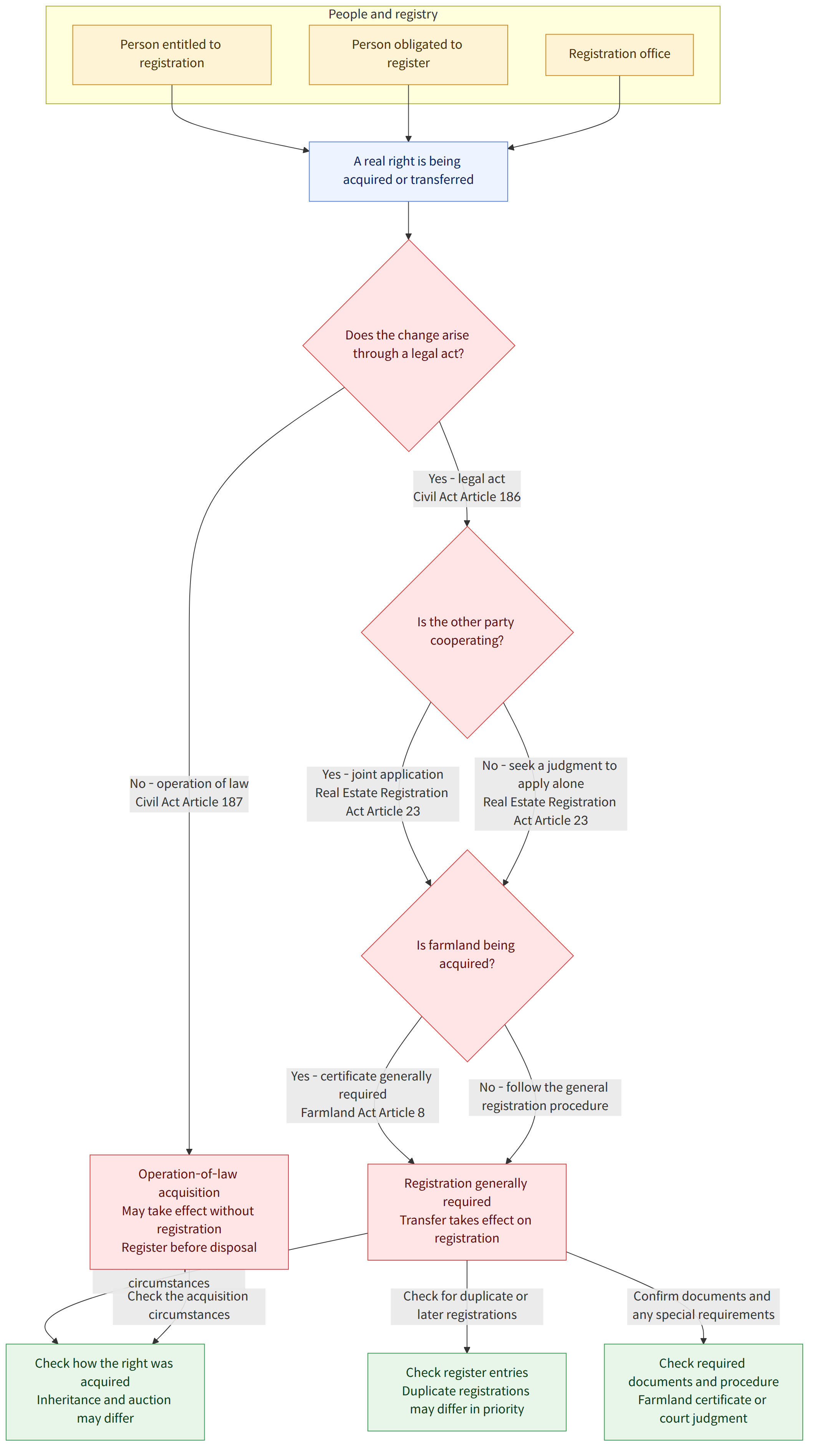
Registration is generally required to acquire or transfer real rights through a legal act, such as a real estate sale, and applications for registration are usually made jointly by the person entitled to registration and the person obligated to register. The acquisition of farmland, duplicate registrations, provisional registrations, and restoration of canceled registrations are subject to separate requirements and procedures, so you should check the register, the circumstances of acquisition, and the relevant documents.
At a glance
Key points
- Changes in the acquisition or loss of real rights through a legal act, such as a real estate sale, take effect upon registration. There are exceptions for acquisitions by operation of law, such as inheritance or auction, but the property cannot be disposed of without registration (Civil Act, Articles 186 and 187 (민법 제186조·제187조)).
- Registration is generally applied for jointly by the person entitled to registration and the person obligated to register. If the other party does not cooperate, the applicant may obtain a judgment ordering performance of the registration procedure and apply alone. If the requirements are met, a seller may also demand that the buyer accept registration (Real Estate Registration Act, Article 23 (부동산등기법 제23조); Example 5).
- A certificate of qualification for acquisition of farmland is generally required when applying to register the acquisition of farmland. However, exceptions prescribed by law, such as inheritance, apply. An action for registration of transfer of ownership may be filed without the certificate, but the certificate may be required for the actual application for registration (Farmland Act, Article 8 (농지법 제8조); Examples 12 and 23).
- A clan generally cannot newly acquire farmland for use as ancestral burial-ground land. Check whether the circumstances fall within an exception described in the examples, such as existing ancestral burial-ground land listed in the ancestral burial-ground register at the time of the Farmland Reform, and whether the applicable requirements are met (Farmland Act, Article 6 and Addenda Article 5 (농지법 제6조·부칙 제5조); Example 1).
- The effect of duplicate registrations of the same real estate may vary depending on the registered owner, the cause of registration, the underlying registration of preservation, and the timing of each registration. You cannot assume that one registration takes priority solely because the registrations are duplicates (Real Estate Registration Act, Articles 15 and 21 (부동산등기법 제15조·제21조); Examples 4 and 18).
- A registration completed under a Special Measures Act is presumed to have been lawfully made and to conform to the substantive rights. To challenge it, evidence is needed of circumstances showing that the registration was not lawfully made, such as a false or forged guaranty or confirmation certificate. The presumption is not immediately rebutted merely because the stated cause of acquisition differs from what actually happened (Examples 6, 19, and 21).
- Even if a registration in a third party’s name has been made after a provisional registration, the right to seek a principal registration based on the provisional registration does not automatically cease through merger. If the principal registration is made, subsequent registrations may be affected according to their priority (Civil Act, Articles 191 and 507 (민법 제191조·제507조); Real Estate Registration Act, Articles 91 and 92 (부동산등기법 제91조·제92조); Examples 2, 8, and 16).
- The name on a building permit or an unauthorized-building register is not, by itself, equivalent to a registration proving ownership of the building. Separate requirements and the legal interest in bringing an action must be considered for registration of preservation of ownership of an unregistered building or a change of the name on the relevant register (Real Estate Registration Act, Article 65 (부동산등기법 제65조); Examples 7, 10, 15, and 17).
Frequently asked questions
Q. Do I need a certificate of qualification for acquisition of farmland when I inherit farmland?
In the situation described, acquiring farmland by inheritance under the Farmland Act falls within an exception to the requirement for a certificate of qualification for acquisition of farmland. However, if the acquisition is based on a different cause or the registration circumstances differ, the applicable requirements must be checked separately.
Q. Can I file an action for registration of transfer of ownership even if I do not yet have a certificate of qualification for acquisition of farmland?
The precedent discussed in the example explains that a certificate of qualification for acquisition of farmland is not a requirement for filing an action for registration of transfer of ownership itself. However, after obtaining a judgment, the certificate must generally be issued and attached when applying to register the transfer of ownership.
Q. Can a clan newly purchase a rice paddy or field to use as ancestral burial-ground land?
According to the example, a clan generally cannot newly acquire farmland, and the fact that it will be used as ancestral burial-ground land does not, by itself, establish an exception. You should check whether the farmland falls within a limited exception, such as existing ancestral burial-ground land listed in the ancestral burial-ground register at the time of the Farmland Reform.
Q. Can the seller register the property directly if the buyer keeps delaying registration of the transfer of ownership?
Registration is generally applied for jointly by the parties, so it is difficult for the seller to apply unilaterally to register the property in the buyer’s name. However, if the requirements are met, the seller may seek a judgment ordering the buyer to accept registration and may then apply alone on the basis of that judgment.
Q. If I lose the certificate of registration, can I no longer sell or register the transfer of real estate?
Losing the certificate does not make an application for registration impossible. The example explains that this may be addressed by having the person obligated to register appear at the registry office for verification, having a lawyer or judicial scrivener verify the fact of authorization, or notarizing the portion of the application that must be completed by the applicant.
Q. Does a registration under the Special Measures Act become invalid if its stated cause of acquisition differs from what actually happened?
The fact that the cause of acquisition differs from what is stated in a guaranty or confirmation certificate does not, by itself, immediately rebut the presumption of validity of the registration. However, the presumption may be rebutted if it is proved that the newly asserted cause of acquisition is fictitious, or that other evidence gives reason to doubt the truth of that cause as well.
Q. If there are two registrations of preservation of ownership for the same land, which one takes priority?
Where there are duplicate registrations of preservation of ownership in the names of different registered owners, the later registration may generally be invalid unless the earlier registration is invalid for lack of a valid cause. However, the criteria may differ for registrations restoring a registration after its loss, depending on the basis for each registration and when it was restored, so the history of the registrations must also be examined.
Q. Can a registration canceled unlawfully be restored without the consent of an interested third party?
If a third party has a registered interest affected by an application to restore a canceled registration, the third party’s consent or a copy of a judgment that can be asserted against that third party may be required. If consent cannot be obtained, it may be necessary to bring a separate action against the third party seeking consent.
Relevant laws
- Civil Act, Articles 186, 187, 191, 245, 507, 548, and 766 (민법 제186조·제187조·제191조·제245조·제507조·제548조·제766조)
- Farmland Act, Articles 6, 8, and 13, and Addenda Article 5 (농지법 제6조·제8조·제13조·부칙 제5조)
- Enforcement Decree of the Farmland Act, Article 6 (농지법 시행령 제6조)
- Real Estate Registration Act, Article 2, subparagraph 4; Articles 3, 15(1), 21, 23, 29, 50, 51, 59, 60, 65, 88, 91, 92, and 100 (부동산등기법 제2조 제4호·제3조·제15조 제1항·제21조·제23조·제29조·제50조·제51조·제59조·제60조·제65조·제88조·제91조·제92조·제100조)
- Special Measures Act for the Registration of Real Estate, Articles 2 and 8 (부동산등기특별조치법 제2조·제8조)
- Act on the Registration of Real Estate under Actual Titleholder’s Name, Article 8, subparagraph 1 (부동산 실권리자명의 등기에 관한 법률 제8조 제1호)
- Act on the Ownership and Management of Aggregate Buildings, Article 2, subparagraph 6 (집합건물의 소유 및 관리에 관한 법률 제2조 제6호)
- Trust Act, Article 3(5) (신탁법 제3조 제5항)
- Local Tax Act, Article 20-2 (지방세법 제20조의2)
- Act on Acquisition of and Compensation for Land, etc. for Public Works Projects, Article 91 (공익사업을 위한 토지 등의 취득 및 보상에 관한 법률 제91조)
- Act on the Improvement of Rural Communities, Articles 16, 25, 43, 82, and 100 (농어촌정비법 제16조·제25조·제43조·제82조·제100조)
- Special Measures Act on the Settlement of Requisitioned Property, Article 20 (징발재산정리에 관한 특별조치법 제20조)
- Special Measures Act for National Security, Article 5(4) (국가보위에 관한 특별조치법 제5조 제4항)
- Special Measures Act on the Settlement of Land Expropriated or Used, Articles 2 and 3 (수용·사용된 토지의 정리에 관한 특별조치법 제2조·제3조)
- Farmland Reform Act (농지개혁법)
Watch out for
- The point at which a certificate of qualification for acquisition of farmland is required may differ between filing an action and actually applying for registration. Even after obtaining a judgment, check which documents are required before applying for registration.
- It can be difficult to reach a conclusion based only on the entries in the register in cases involving duplicate registrations or registrations under a Special Measures Act. Check the underlying registration of preservation, the circumstances of restoration, and relevant materials such as guaranty and confirmation certificates.
- Even if a cancellation of registration is invalid, restoration of the canceled registration may not be permitted where the parties voluntarily canceled it. The consent of an interested third party, or a judgment that can be asserted against that third party, may be required.
Related articles
Source cases
This guide was compiled by AI from the following Korea Legal Aid Corporation consultation cases (in Korean).
- 분묘수호를 위하여 종중 명의로 농지를 구입할 수 있는지
- 다른 이유로 소유권이전 받은 후 가등기에 기초한 본등기이행청구 가능한지
- 대지권 미등기 집합건물 취득자의 대지권등기방법
- 동일부동산에 명의인을 달리하여 중복등재 된 회복등기 사이의 우열기준
- 매수인이 부동산소유권을 이전해 가지 않을 경우 매도인의 등기인수청구권
- 특별조치법에 따른 등기명의자가 그 취득원인을 달리 한 경우 등기추정력
- 소유권보존등기 된 건물, 건축주명의변경이행청구 가능한 경우
- 당사자가 자발적으로 말소등기를 한 경우 무효인 말소등기의 회복등기가 가능한지
- 잘못된 등기신청서 기재사항으로 등기가 마쳐진 경우 정정방법
- 미등기 건물에 대하여 국가를 상대로 소유권확인을 구할 이익이 있는지
- 위자료조로 국민주택입주자 지위를 받은 처에게 바로 이전등기 가능한지
- 상속을 원인으로 농지를 취득할 경우에도 농지취득자격증명이 필요한지
- 부동산 등기필정보를 분실한 경우의 부동산 소유권이전등기 신청방법
- 채무자의 비용으로 신축한 건물의 건축허가명의를 채권자로 한 경우
- 무허가건물 매수인이 그 건물대장의 소유자 명의변경청구가 가능한지
- 원상회복의 방법으로 소유권이전등기청구권 보전이 가등기가 가능한지
- 이중양도의 선매수인이 건물대장상 명의 이전된 후 매수인에 대한 명의변경 청구
- 이중으로 마쳐진 부동산 소유권보존등기의 효력
- 특별조치법으로 부동산 소유권보존등기 된 때 그 소유권회복절차
- 이미 경료된 중간생략등기의 유효성
- 특별조치법에 의한 이전등기의 추정력
- 중간생략등기 합의 후 최초 매도인과 중간 매수인간의 매매대금 변경의 효력
- 농지취득자격증명 없이 농지소유권이전등기청구소송이 가능한지
- 가등기상의 권리이전등기를 가등기에 대한 부기등기 형식으로 할 수 있는지
- 이해관계 있는 제3자가 있는 경우 말소회복등기 신청
This guide is general legal information about Korean law, not legal advice for your situation. For a specific case, consult a lawyer or the Korea Legal Aid Corporation (call 132 in Korea).