
Guide to Work-Related Accident Eligibility and Compensation
Based on 121 consultation cases · Updated · Translated from the Korean original.
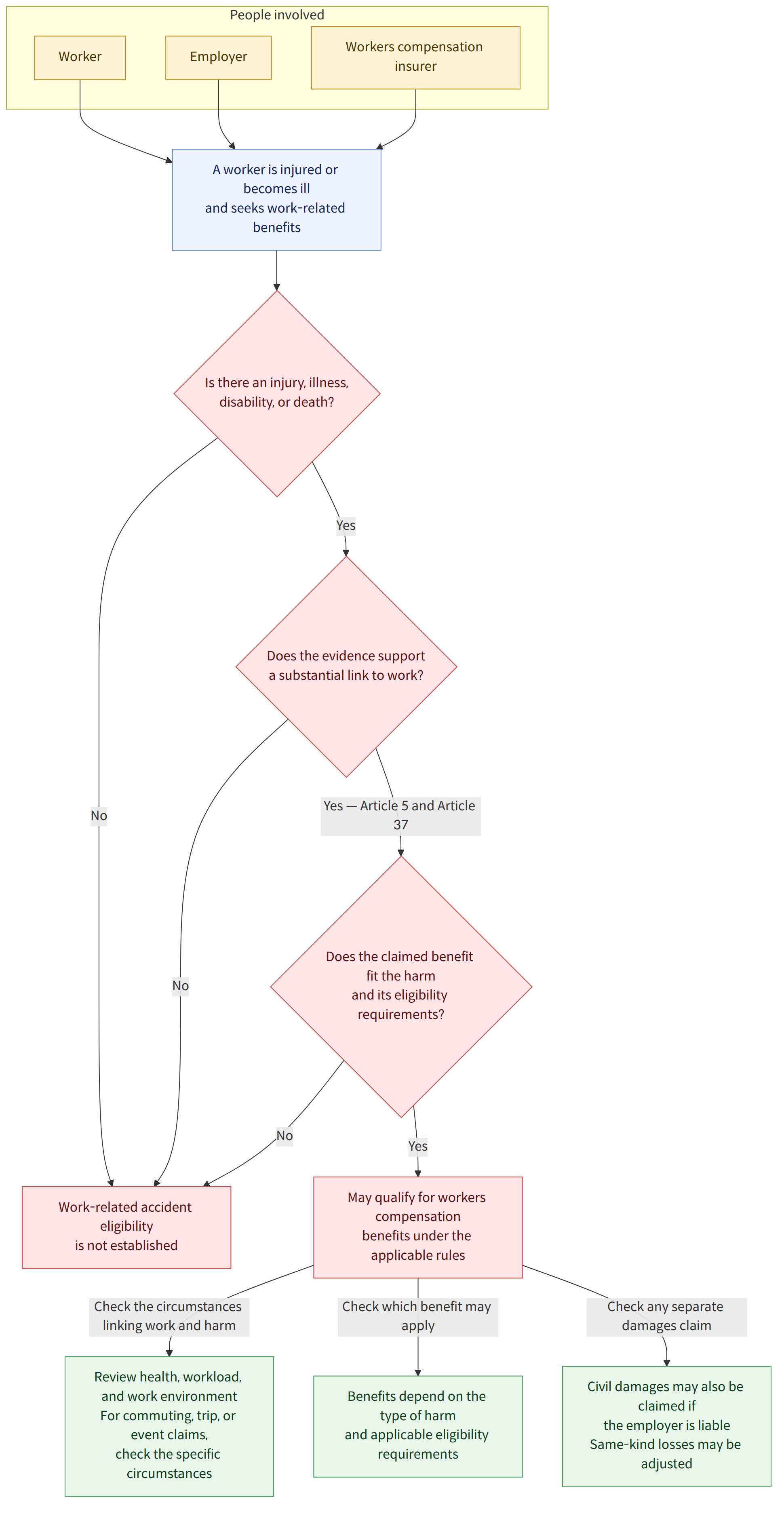
The key issue in determining whether an accident is work-related is whether there is a substantial causal connection between the work and the injury, illness, disability, or death. The connection to work is assessed by considering various circumstances, including the work environment and the worker’s health. Even if workers’ compensation benefits are paid, a separate claim for damages may be brought if the employer is found liable, although amounts covering the same kind of loss may be adjusted.
At a glance
Key points
- A work-related accident includes an injury, illness, disability, or death arising from work-related causes, and requires a substantial causal connection between the work and the accident (Industrial Accident Compensation Insurance Act, Article 5, subparagraph 1 (산업재해보상보험법 제5조 제1호), and Article 37 (산업재해보상보험법 제37조)).
- The causal connection between work and an illness does not always have to be proved conclusively through medical or natural-science evidence. It may be inferred from indirect facts, including the worker’s health, workload, work environment, and length of service (Examples 5, 6, 22, and 24).
- Workers’ compensation insurance benefits include medical care benefits, temporary disability benefits, disability benefits, nursing care benefits, survivors’ benefits, injury and disease compensation annuities, funeral expenses, and vocational rehabilitation benefits, among others (Industrial Accident Compensation Insurance Act, Article 36 (산업재해보상보험법 제36조), etc.).
- Whether a commuting accident is covered must be assessed under the law in force at the time of the accident and based on the commuting route and method. The examples address both the use of transportation provided by the employer and commuting by an ordinary route and method (Industrial Accident Compensation Insurance Act, Article 37 (산업재해보상보험법 제37조); Enforcement Decree of the Industrial Accident Compensation Insurance Act, Article 29 (산업재해보상보험법 시행령 제29조); Examples 2 and 21).
- During a business trip, work-relatedness may be recognized throughout the trip in the absence of special circumstances. An accident during a personal activity not ordinarily associated with the trip may be assessed differently (Example 20).
- If a worker is injured at an event outside work, such as a company dinner or club activity, whether the event was under the employer’s control and management is assessed by considering factors such as who organized it, its purpose, whether attendance was compulsory, and who paid the expenses (Examples 12 and 25).
- Workers’ compensation insurance benefits and civil damages may both be at issue. However, duplicate payment may be adjusted where compensation has already been received for the same kind of loss. An amount of a different kind, such as benefits under personal accident insurance, may not be deducted depending on the circumstances of the case (Industrial Accident Compensation Insurance Act, Article 80 (산업재해보상보험법 제80조); Examples 7, 15, and 18).
Frequently asked questions
Q. What compensation can I receive under workers’ compensation insurance?
The examples describe medical care benefits, temporary disability benefits, disability benefits, nursing care benefits, survivors’ benefits, injury and disease compensation annuities, funeral expenses, and vocational rehabilitation benefits. Which benefits you may receive depends on the type of accident and on the applicable eligibility requirements, including whether you need medical care and whether you have a disability or have died.
Q. If I am in a traffic accident while commuting, will it be recognized as work-related?
Whether an accident while commuting is covered must be assessed under the law in force at the time of the accident and in light of the specific circumstances. The examples explain that a commuting accident may be treated as a work-related accident not only when a worker is using transportation provided by the employer, but also, under the amended law that took effect in 2018, when the accident occurs while commuting by an ordinary route and method.
Q. Are injuries sustained during a business trip or while traveling after a company dinner covered?
During a business trip, work-relatedness may be recognized throughout the trip in the absence of special circumstances. However, an accident during a personal activity unrelated to the trip may not be recognized as work-related. If employees continue to a separate gathering of their own accord after a company dinner, whether the event was under the employer’s control and management may also be at issue.
Q. Can my illness be recognized as work-related if my job aggravated a pre-existing condition?
Even if you had a pre-existing condition, your illness may qualify as a work-related accident if it was aggravated or its symptoms were brought on by a work-related accident, overwork, stress, or similar factors. The connection between work and the illness is assessed by considering the circumstances as a whole, including your pre-existing health, job duties, how the illness developed, and the course of treatment.
Q. Do I have to prove the causal connection between my work and illness conclusively through medical evidence?
According to the examples, the causal connection does not always have to be proved conclusively through medical or natural-science evidence. It may be inferred from indirect facts, such as whether the substance that caused the illness was present in the workplace, the duration of exposure, the nature of the work, and the worker’s health before starting the job.
Q. What can I do if the Korea Workers’ Compensation and Welfare Service denies my workers’ compensation benefits?
Under the procedure described in the examples, an appeal against a decision on insurance benefits must be filed within 90 days from the date the decision became known to you. The Korea Workers’ Compensation and Welfare Service generally makes a decision within 60 days of receiving the appeal. If necessary, it may extend the period once, for no more than 20 days.
Q. Can I claim damages from my employer even after receiving workers’ compensation benefits?
If an accident occurred through the employer’s intent or negligence, you may claim civil damages separately from workers’ compensation insurance benefits. However, in a damages claim, you must prove the employer’s liability. If you were also at fault, the amount of damages may be reduced, and damages of the same kind as benefits already received may be adjusted.
Q. Can dispatched workers or people registered as company representative directors receive workers’ compensation protection?
The examples explain that a dispatched worker may also claim damages from the user company for a breach of its duty to ensure safety if it directed and supervised the work and provided the equipment. Whether a person is a company’s registered representative director or an owner-operator of a truck is not determined by title alone; the actual circumstances must be examined, including whether the person worked in a subordinate relationship for wages.
Relevant laws
- Industrial Accident Compensation Insurance Act, Article 5 (산업재해보상보험법 제5조)
- Industrial Accident Compensation Insurance Act, Article 6 (산업재해보상보험법 제6조)
- Industrial Accident Compensation Insurance Act, Article 36 (산업재해보상보험법 제36조)
- Industrial Accident Compensation Insurance Act, Article 37 (산업재해보상보험법 제37조)
- Industrial Accident Compensation Insurance Act, Article 40 (산업재해보상보험법 제40조)
- Industrial Accident Compensation Insurance Act, Article 52 (산업재해보상보험법 제52조)
- Industrial Accident Compensation Insurance Act, Article 57 (산업재해보상보험법 제57조)
- Industrial Accident Compensation Insurance Act, Article 63 (산업재해보상보험법 제63조)
- Industrial Accident Compensation Insurance Act, Article 80 (산업재해보상보험법 제80조)
- Industrial Accident Compensation Insurance Act, Article 84 (산업재해보상보험법 제84조)
- Industrial Accident Compensation Insurance Act, Article 87 (산업재해보상보험법 제87조)
- Industrial Accident Compensation Insurance Act, Article 103 (산업재해보상보험법 제103조)
- Industrial Accident Compensation Insurance Act, Article 105 (산업재해보상보험법 제105조)
- Enforcement Decree of the Industrial Accident Compensation Insurance Act, Article 29 (산업재해보상보험법 시행령 제29조)
- Enforcement Decree of the Industrial Accident Compensation Insurance Act, Article 76 (산업재해보상보험법 시행령 제76조)
Watch out for
- The criteria for recognizing commuting accidents may differ depending on when the law was amended, so you should check the rules in force at the time of the accident.
- Under the criteria described in the examples, an appeal against a decision denying benefits must be filed within 90 days from the date you learned of the decision. Check the decision notice and applicable laws for the specific appeal procedure and deadline.
- The examples refer to a three-year limitation period for claims to insurance benefits and to periods for civil damages claims. For an actual claim, check the applicable period separately based on the date of the accident and the type of claim.
Related articles
Source cases
This guide was compiled by AI from the following Korea Legal Aid Corporation consultation cases (in Korean).
- 산업재해보상보험법상의 보험급여의 종류
- 출·퇴근 중 발생한 재해에 대하여도 산재보험이 적용되는지
- 일실수입에서 장해보상일시금을 공제한 경우 장해보상연금의 지급정지 여부
- 적용제외사업을 규정한 산업재해보상보험법 시행령 제2조 제1항 제3호 가항에서 정한 ‘총공사금액’에 부가가치세가 포함되는지 여부...
- 산재보험급여의 부지급결정에 불복하는 절차
- 간접사실에 의해서도 업무상 재해를 인정 받을 수 있는지 여부
- 산재보험수급권과 자기신체사고보험금청구권과의 관계에 있어 이중전보금지원칙 저촉 여부
- 근로복지공단에 대해 스스로 사업주로 행세하며 허위로 재해발생 경위를 확인해 준 자에게 보험급여를 받은 자와 연대하여 징수의무를...
- 지입차주가 고용한 운전자가 재해 당한 때 지입회사의 책임
- 우울증을 앓다가 업무상 과로가 원인이 되어 자살한 경우 업무상 재해성 인정 여부
- 세대별 발코니 공사의 산업재해보상보험의 적용 여부
- 정례회식 후 개별모임 중 당한 재해도 산재보험이 적용되는지
- 파견 근로관계에서 실제 사용 사업주가 산업재해로 인한 손해배상 책임을 부담하는지 여부
- 산재사고 후 후유증으로 비관자살한 경우 산재처리 되는지
- 사업주가 가입한 ‘자손사고’ 보험금의 유족보상금 공제 여부
- 지입차주 겸 운전자가 재해를 입은 경우 산재처리 되는지
- 산업재해보상보험과 자동차보험과의 관계
- 산재보상금 수령 후에도 손해배상청구소송이 가능한지
- 산재보험법상 유족급여수급권자에 이성동복 형제도 포함되는지
- 출장중의 재해에 대하여도 산재처리될 수 있는지
- 甲이 퇴근하기 위하여 자전거를 타고 회사 내 도로를 지나던 중 급정거로 자전거와 함께 넘어지는 사고를 당한 경우, 업무상 재해...
- 업무상의 과로나 스트레스로 질병을 유발 또는 악화시킨 경우 업무상 재해에 해당하는지 여부
- 등기부상 대표이사이나 실제로는 근로자인 경우 산재보험 적용 여부
- 기왕증이 악화된 경우 업무상 재해에 해당하는지
- 회사내 축구 동호회 도중 입은 골절 부상의 산업재해 해당 여부
This guide is general legal information about Korean law, not legal advice for your situation. For a specific case, consult a lawyer or the Korea Legal Aid Corporation (call 132 in Korea).