
1. A Human Story
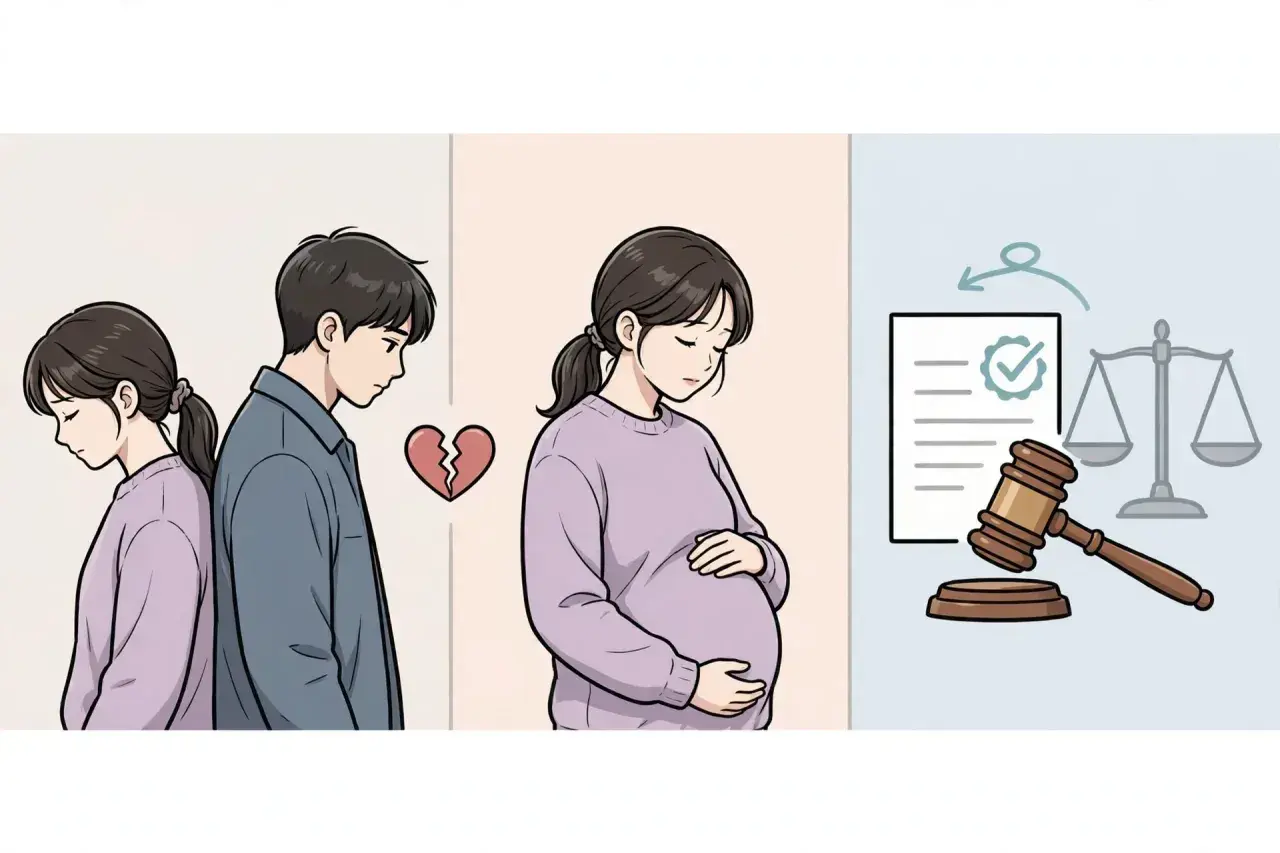
When Emily Park began her first year at university, she and her older classmate, Daniel Lee, spoke about having a child as a promise of a future together. The pregnancy was not part of a plan they had carefully made, but at first they welcomed it. Emily imagined the three of them building a life around the small, hopeful idea they had shared.
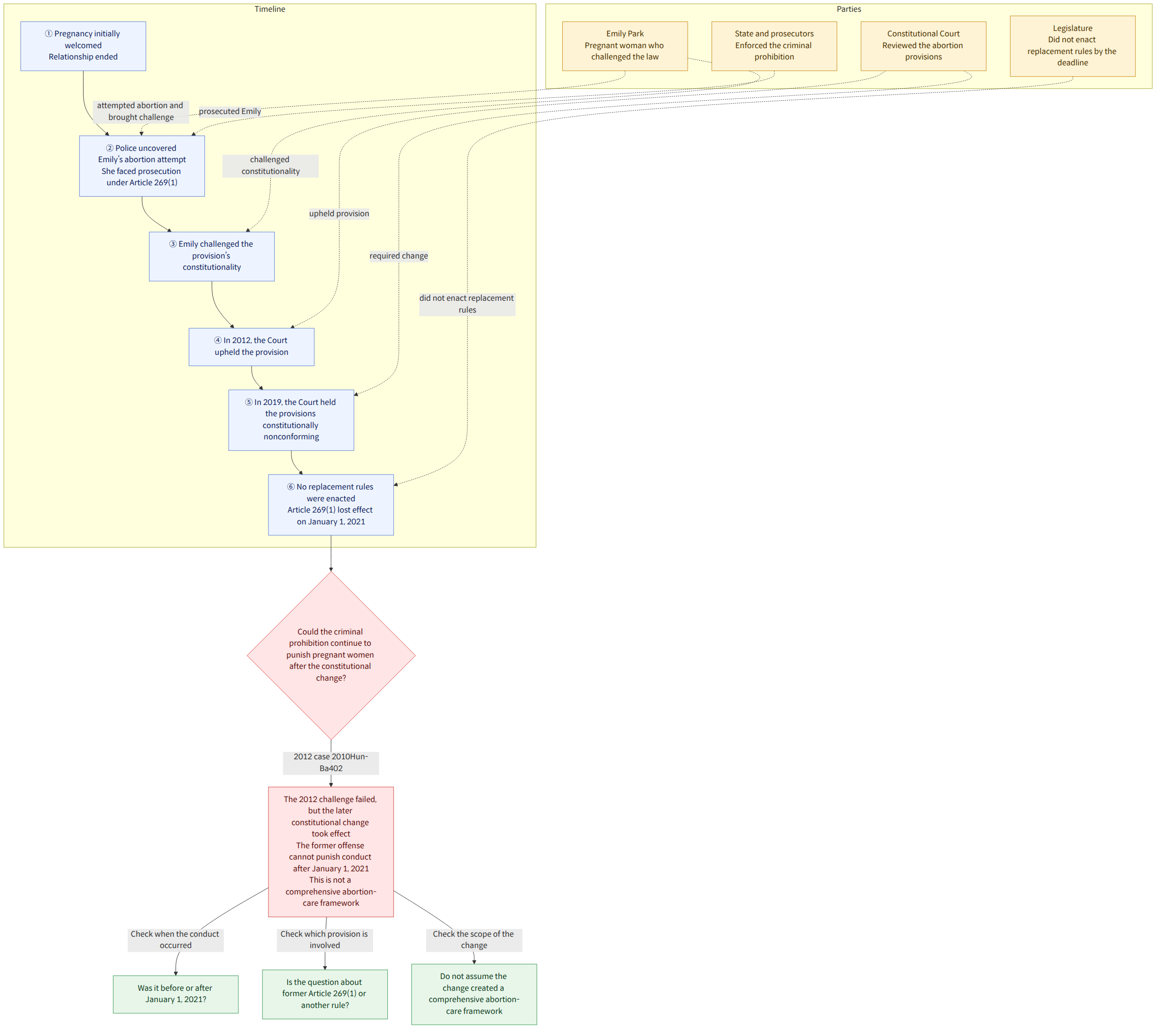
Then she learned that Daniel had been seeing someone else. Their relationship ended, and the pregnancy that had once seemed like a bond between them became a source of fear and regret. Emily tried to obtain an abortion. A police operation uncovered the attempt, and she faced prosecution under the Criminal Act. She believed the law was forcing her to continue a pregnancy against her will, and challenged its constitutionality.
2. The Legal Question
Could Korea constitutionally punish a pregnant woman for ending her pregnancy under Article 269(1) of the Criminal Act, or did that punishment violate her right to make decisions about her own body and life?
The answer depends in part on when the question is asked. In 2012, the Constitutional Court upheld the provision. In 2019, it reconsidered the constitutional balance and required change. The former criminal prohibition ceased to have effect on January 1, 2021.
3. What Korean Law Says
The 2012 ruling
On August 23, 2012, in case 2010Hun-Ba402, the Constitutional Court rejected a constitutional challenge to Article 269(1). The provision punished a pregnant woman who ended her own pregnancy, subject to statutory exceptions.
The Court recognized that the woman’s choice about pregnancy was protected by her constitutional right to self-determination. But it concluded that the restriction was justified by the state’s duty to protect life, including the life of the fetus.
In the Court’s 2012 view, protecting fetal life was a legitimate constitutional purpose, and the criminal prohibition did not impose an unreasonable restriction on a pregnant woman’s right to decide.
The Court pointed to several considerations:
- Fetal life deserved legal protection. The Court treated the state as having a responsibility to protect unborn life.
- Education and contraception were not enough. Wider access to sex education and contraceptive methods, and support for pregnant women, were not considered effective substitutes for criminal penalties in preventing unlawful abortions.
- The law contained exceptions. Article 14 of the Mother and Child Health Act permitted abortion in specified circumstances, including certain health, genetic, and sexual-crime-related situations, subject to statutory requirements.
Four justices disagreed. They reasoned that imposing criminal punishment across the board—even in early pregnancy—burdened a woman’s self-determination too severely. Their position highlighted the significance of pregnancy’s early stages and the real social, economic, and personal circumstances in which a woman might make her decision.
The later constitutional change
The 2012 decision is not the end of the story. In 2019, the Constitutional Court reviewed the abortion-related criminal provisions again and held them constitutionally nonconforming: they could not remain in force indefinitely in their existing form, but the legislature was given time to enact a replacement framework. The Court concluded that the law failed to strike a fair balance because it did not adequately account for women’s choices, circumstances, and the different stages of pregnancy.
The legislature did not enact replacement rules by the Court’s deadline. As a result, the relevant criminal provisions—including the former offense of self-induced abortion in Article 269(1)—lost effect on January 1, 2021. That change means the former criminal prohibition can no longer be used to punish a pregnant woman under that provision for conduct after it ceased to have effect. It should not be confused with a comprehensive statutory framework governing every aspect of abortion care.
4. How Korean Courts Approach This
In constitutional review, Korean courts weigh the rights and interests on both sides rather than treating one as automatically decisive. In this setting, the competing considerations include a pregnant woman’s bodily autonomy, privacy, health, and ability to shape her life, and the state’s interest in protecting fetal life.
A restriction on a constitutional right must pursue a legitimate aim and must not impose a burden that is excessive in relation to that aim.
The 2012 majority accepted the criminal ban as a proportionate way to protect fetal life, taking account of the statutory exceptions and the limits of non-criminal measures. The four dissenting justices saw the rule as too sweeping, particularly because it punished abortion without distinguishing adequately between early and later pregnancy.
By 2019, the Court reached a different constitutional conclusion. It emphasized that a law cannot fairly balance the interests at stake if it leaves women without meaningful room to make decisions in the early stages of pregnancy and fails to take account of their individual circumstances. The Court’s change of direction illustrates an important point: constitutional judgments can evolve as the Court re-examines how a law works in practice and whether it burdens a right too broadly.
5. Applying the Law to the Case
Emily’s situation has to be assessed against the law at the time of the events, as well as the later change in constitutional law.
- Her choice implicated a protected interest. Emily was deciding whether to continue a pregnancy after her relationship had ended. The 2012 Court recognized that such decisions fall within a woman’s sphere of self-determination, even though it did not find the criminal restriction unconstitutional.
- Under the 2012 ruling, her constitutional challenge would have failed. If Emily’s prosecution and challenge arose in the legal setting addressed by the 2012 decision, the controlling ruling was that Article 269(1) was constitutional. The majority’s reasoning was that the state could protect fetal life through a criminal prohibition, while specified statutory exceptions and other forms of support did not make that prohibition unreasonable.
- The dissent reflected the argument Emily was making. Four justices agreed that a blanket criminal penalty, including for abortions early in pregnancy, intruded too far into a woman’s decision-making. That view did not control the Court in 2012, but it anticipated the constitutional concerns that became central in the later review.
- The law subsequently changed. In 2019, the Constitutional Court found the existing criminal framework constitutionally deficient and set a deadline for legislative action. Because no replacement provisions were enacted by that deadline, Article 269(1) ceased to have effect on January 1, 2021. Emily’s case, if it arose after that date, could not be punished under the former self-induced-abortion offense.
The important distinction is between saying that the provision was upheld in 2012 and recognizing that it did not remain in force indefinitely. The earlier ruling explains the answer Emily would have received at that time; the later ruling determines the status of the former criminal prohibition after the deadline.
If you are dealing with a similar issue, attorney Ji-sun Ahn of Ijun Law Firm can review the provision applied in your case, the ruling or notice you received, and the dates relevant to challenging it with you. These details can help clarify which options apply to your situation.
6. Conclusion: What Happened, and What Should You Do?
In Emily’s 2012 case, her constitutional challenge would have been rejected under the Constitutional Court’s then-controlling decision. The Court considered the state’s interest in fetal life sufficient to justify the criminal restriction, although four justices believed the law went too far. Years later, the Court adopted a different constitutional balance. Since January 1, 2021, the former Article 269(1) offense has no longer been in effect.
For anyone facing a similar situation:
- Check the date and the specific law involved. The legal position before and after January 1, 2021 is materially different; do not rely on an old account of the law.
- Get prompt, confidential medical advice. A qualified healthcare professional can explain available care, health considerations, and applicable requirements.
- If contacted by police or facing a legal dispute, consult a Korean lawyer. Bring any notices, records, and dates of relevant events so the lawyer can assess which rules apply.

















