1. A Human Story
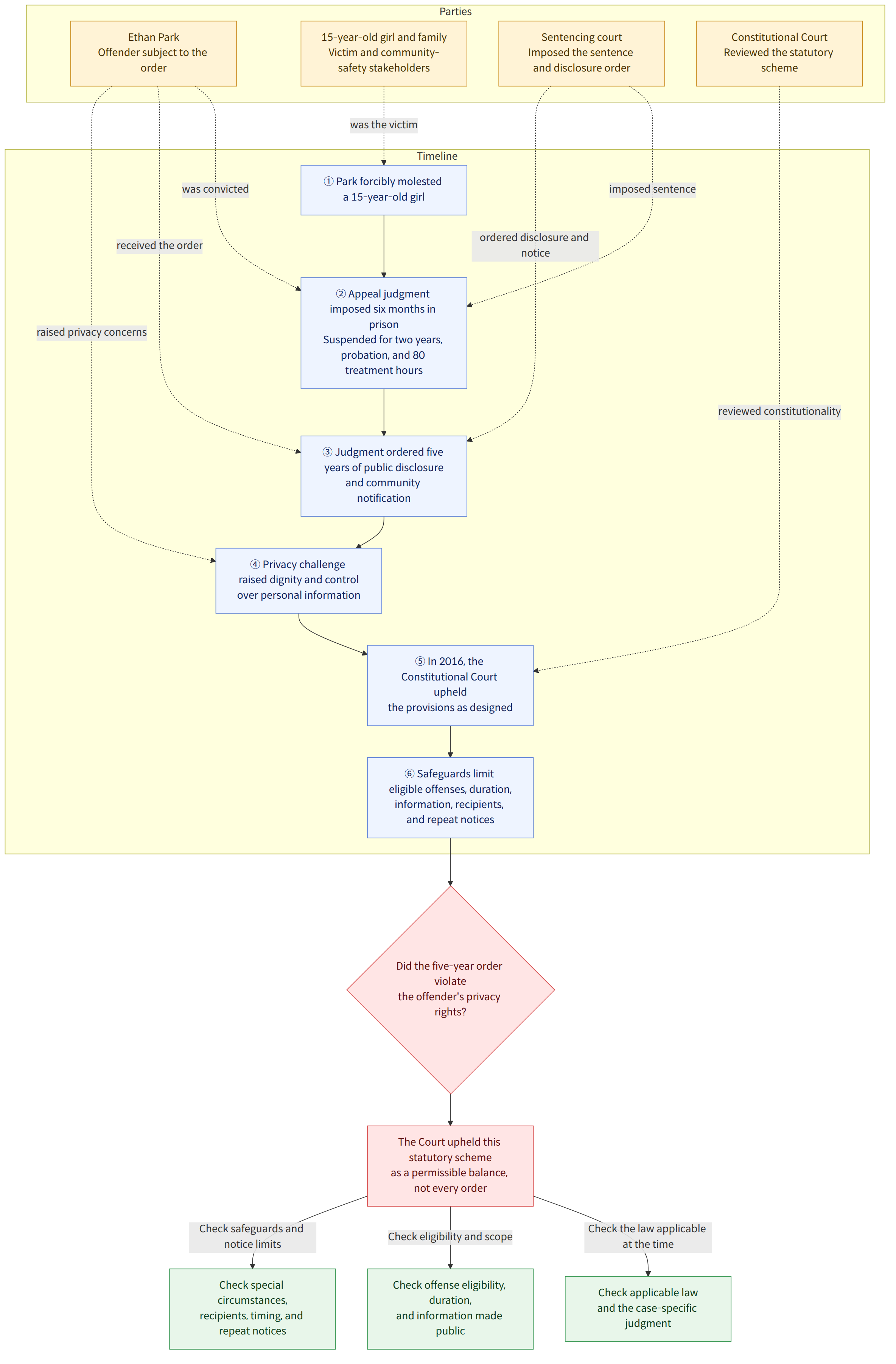
When Ethan Park learned the outcome of his appeal, the sentence seemed almost unreal: six months in prison, suspended for two years, for forcibly molesting a 15-year-old girl. He would be placed on probation and required to complete 80 hours of sexual-violence treatment.
Then came another part of the judgment. For five years, his personal information would be subject to public disclosure and notification to people responsible for children’s safety in the area where he lived. Ethan worried that a conviction would follow him into every conversation, job application, and encounter with a neighbor. The girl and her family, meanwhile, had their own concern: whether children in the community would be safer if those responsible for their care were warned.
2. The Legal Question
Can a five-year order to disclose an offender’s personal information publicly and notify people in the community violate the offender’s right to personal dignity or right to control personal information, even when the conviction involves a sexual offense against a minor?
3. What Korean Law Says
The Act on the Protection of Children and Youth Against Sex Offenses provides for public-disclosure and notification orders for people convicted of specified sex offenses against children or adolescents. The relevant provisions identified in this case are Articles 49(1) and 50(1). The order is made by a court in connection with the criminal judgment, and the statutory scheme includes limits and exceptions.
The Constitutional Court considered whether these provisions were unconstitutional in a 2016 decision. It rejected the claim that the disclosure and notification measures, as designed, violated the complainants’ dignity or control over personal information.
The constitutional balance takes account both of the serious intrusion on an offender’s privacy and of the public interest in protecting children and adolescents from sexual violence.
The Court’s reasoning focused on safeguards and the way each measure works:
- Public disclosure is limited by the eligible offenses, the period of disclosure, and the information that may be made public. A judge may also consider whether special circumstances weigh against disclosure, and the scheme contains measures intended to reduce resulting harm.
- Community notification is directed at protecting children and adolescents in the area where an offender resides. It is limited to qualifying offenses and may be withheld where special circumstances make notification inappropriate.
- Under the system considered by the Court, notification was generally sent once—within the prescribed period after initial registration or moving into the area where the person would live. If the person did not move away after that first notice, further notices were not sent merely because time passed.
These limits matter. The constitutional decision did not say that privacy is unimportant, or that any form of publication would be lawful. It held that the particular statutory scheme struck a permissible balance.
4. How Korean Courts Approach This
Korean courts and the Constitutional Court generally assess restrictions on constitutional rights by asking whether the state is pursuing a legitimate goal, whether the measure can help achieve it, whether it goes further than necessary, and whether the public benefit is reasonably balanced against the individual burden.
Protecting children and adolescents from sexual violence is a weighty public interest. But the court must also consider the scope, duration, and safeguards of the disclosure or notification measure.
In its 2016 ruling, the Constitutional Court found that public disclosure was limited in scope and time, subject to judicial consideration of special circumstances, and accompanied by safeguards intended to reduce harm. It also found that direct notification could effectively alert people responsible for children’s safety, while the limits on who receives notice, when it is sent, and when it may be withheld made the measure sufficiently restrained.
The ruling therefore rejected a broad constitutional challenge to these statutory provisions. It does not mean that every order is automatically immune from challenge: the case-specific judgment and the law applicable at the time still matter.
5. Applying the Law to the Case
Ethan’s situation closely matches the kind of challenge addressed by the Constitutional Court.
- The offense falls within the relevant category. The judgment concerns the forcible molestation of a 15-year-old. The statutory scheme at issue applies to qualifying sex offenses against children or adolescents.
- The order has a defined duration. Ethan’s disclosure and notification order lasts five years, rather than continuing without a stated limit. The Constitutional Court treated limits on duration and scope as important safeguards.
- A judge imposed the order as part of the judgment. The question is not simply whether the information will be private in every circumstance. It is whether the court’s order under the statutory scheme is constitutionally permissible. The framework allows consideration of special circumstances, including circumstances that may justify withholding disclosure or notice.
- The public purpose is substantial. Notification is intended to alert people responsible for children’s safety in the relevant community. Public disclosure also serves the statutory goal of protecting children and adolescents and promoting public safety.
- The constitutional balance favors the scheme on these facts. Ethan faces a serious intrusion into his privacy and reputation. But the Constitutional Court has concluded that the limited, safeguarded measures in this scheme do not impose an unconstitutional burden when weighed against the protection of children.
The suspended prison sentence does not, by itself, answer the constitutional question. Nor does the requirement to complete treatment. The key issue is whether the disclosure and notification order falls within the law and is subject to the safeguards the courts have recognized.
If you are dealing with a similar issue, attorney Ji-sun Ahn of Ijun Law Firm can review the provision applied in your case, the ruling or notice you received, and the dates relevant to challenging it with you. These details can help clarify which options apply to your situation.
6. Conclusion: What Happened, and What Should You Do?
Ethan’s constitutional challenge to the five-year disclosure and notification order would be unlikely to succeed on the argument that these measures inherently violate his dignity or right to control personal information. The Constitutional Court has upheld the relevant statutory provisions against that kind of challenge, reasoning that the child-protection purpose is compelling and that the system contains limits and exceptions. The outcome could still depend on the precise terms of the judgment and whether the statutory requirements were properly applied in his case.
For readers facing a similar situation:
- Read the full judgment carefully. Check the offense covered, the duration and scope of the order, and whether the court addressed any special circumstances.
- Get prompt, case-specific legal advice. Deadlines and procedures for challenging a judgment or a constitutional issue can be strict; do not assume a general constitutional ruling resolves every individual case.
- Follow the order while seeking advice. Ask counsel or the relevant authority what information must be registered, disclosed, or notified, and when. Do not ignore reporting or compliance obligations.