
1. A Human Story
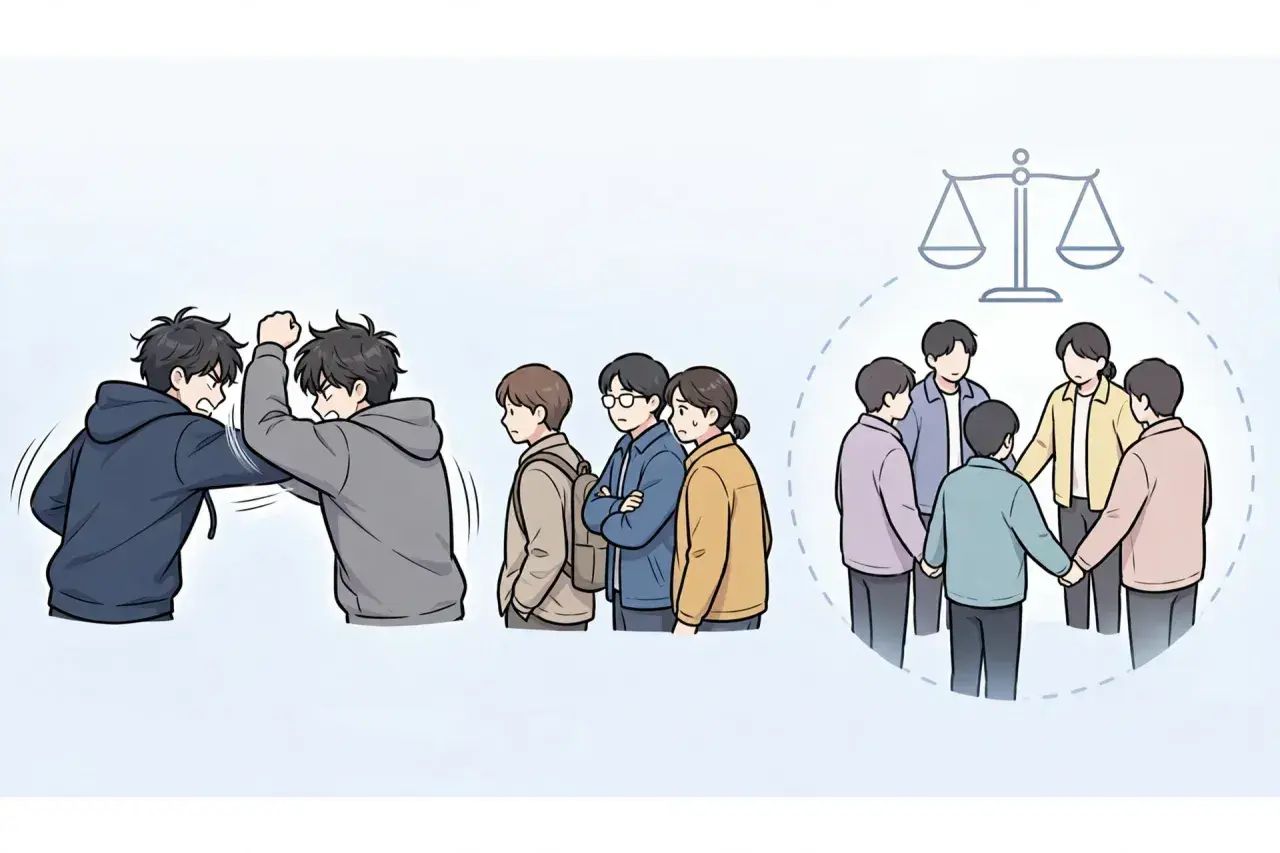
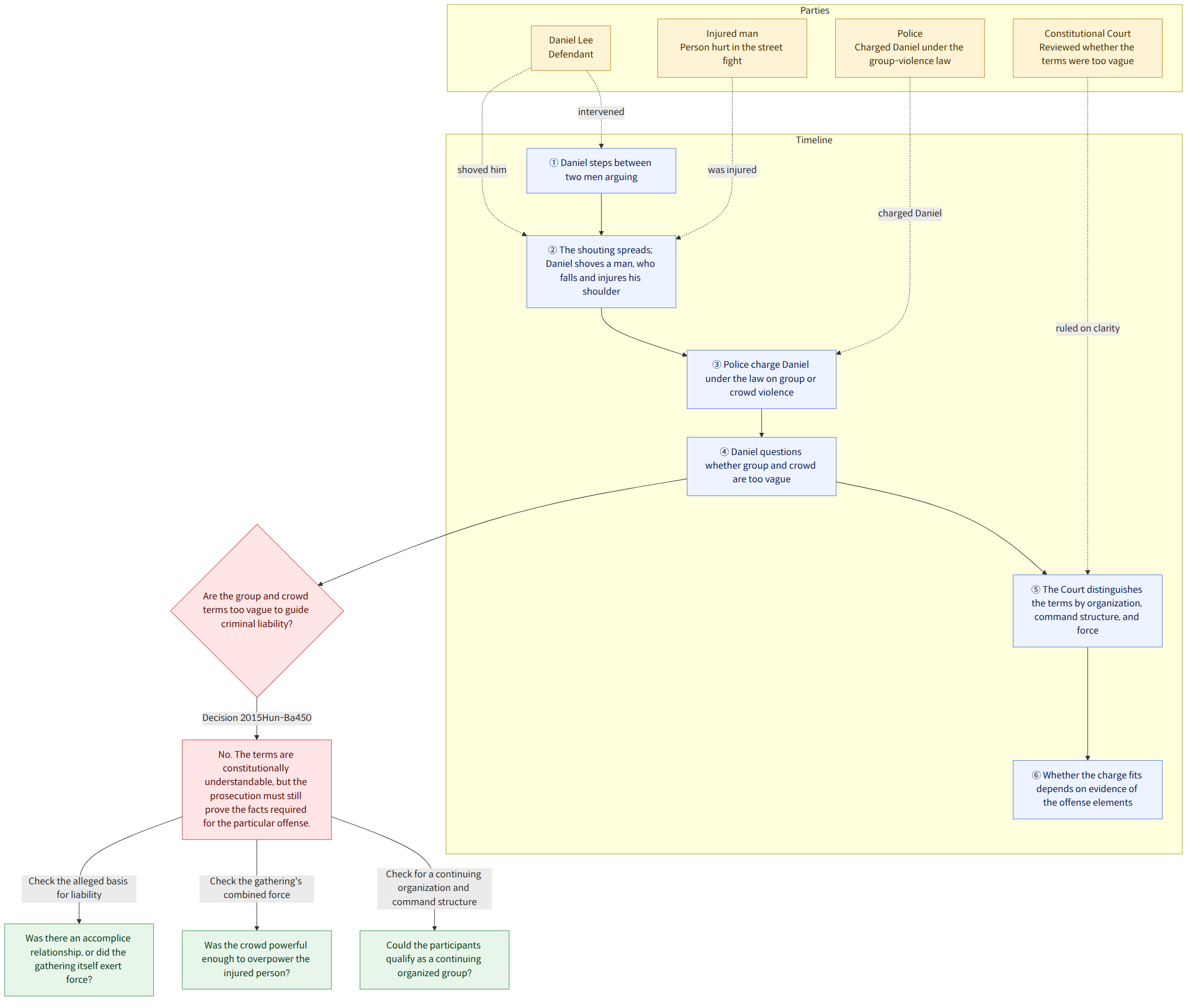
On a wet Friday night in Seoul, Daniel Lee stepped between two men arguing outside a late-night restaurant. Within seconds, the shouting spread to their friends. Daniel shoved one man as the crowd surged, and the man fell, injuring his shoulder. Daniel says he never arrived with a group and had no plan to fight anyone. The police, however, later charged him under Korea’s law addressing violence committed by a group or crowd.
The words in the charge troubled Daniel more than the courtroom itself. What made the people outside the restaurant a “group”? Was it enough that several people were there? And if the law uses terms that ordinary people might understand differently, could it be too vague to support a criminal charge? His lawyer explained that Korean constitutional law has addressed precisely that concern.
2. The Legal Question
The central question is whether the statutory terms describing violence by a group or crowd are so unclear that people cannot reasonably understand what conduct the law covers—or whether they have sufficiently distinct meanings, leaving the case to turn on the evidence.
3. What Korean Law Says
Korea’s Act on the Punishment of Violent Acts provides enhanced treatment for certain violence involving a group or crowd. The constitutional issue is whether those categories are clear enough to satisfy the principle of legality: crimes and punishments must be defined with sufficient clarity in advance.
The Constitutional Court, in decision 2015Hun-Ba450, held that the terms can be distinguished by their structure and character:
“Group” and “crowd” are distinguished by whether there is a continuing organization with a system of command. “Crowd” and “gathering” are distinguished by whether there is an organization with a system of command. “Group” and “gathering” are distinguished by whether the organization is continuing.
The Court also drew a separate line between collective force and joint offending:
“Acting jointly by two or more persons” requires an accomplice relationship among multiple participants. Acting “by the force of a group or crowd” applies when the gathering itself forms a force sufficient to overpower the other person.
In practical terms, the law asks different questions depending on the alleged basis for the charge:
- Group: Is there a continuing organization, with a command structure?
- Crowd: Is the gathering itself powerful enough to intimidate or overpower someone, even without a continuing organization?
- Joint action by two or more: Did the participants have the required relationship as accomplices?
- Gathering: Is there an organized body, but not one that is continuing?
These are not interchangeable labels for “several people were present.” The presence of multiple people may matter, but it does not by itself establish every element of every category.
4. How Korean Courts Approach This
The Constitutional Court concluded that a person with ordinary common sense and a normal understanding of legal language can grasp the distinctions. It therefore rejected the argument that the relevant provision was unconstitutionally vague.
The Court also addressed a related complaint: prosecutors may charge different participants in a multi-person incident under different provisions. It treated that concern as one about prosecutorial discretion and how the law is applied to particular facts—not proof that the statutory language itself is unclear.
The constitutional question is whether the law gives people an understandable standard. Whether that standard has been properly applied in a particular case is a separate question for the courts reviewing the evidence.
Accordingly, the ruling does not mean that every group-related charge is correct. It means that the terms are constitutionally understandable; the prosecution must still establish the facts required for the particular offense charged.
5. Applying the Law to the Case
Daniel’s situation has to be assessed in steps, not by counting the people in the street.
- Was there a continuing organization? Daniel says he did not arrive with an established group and had no prior plan. If the evidence supports that account, it may weigh against treating the participants as a continuing, organized “group.” But the court would examine the full circumstances, not simply accept his description.
- Did the gathering itself exert overpowering force? Even without an ongoing organization, a crowd may fall within the law if its combined presence was enough to overpower the injured person. The number of people, how they acted, and the effect on the person facing them could all matter. The question is not merely whether Daniel personally intended to intimidate someone; it is whether the gathering met the legal standard described by the Court.
- Did Daniel act jointly with others as an accomplice? The prosecution may also rely on the separate theory that two or more people acted together. That requires an accomplice relationship, not simply several people participating in the same chaotic episode. Evidence about coordination, shared conduct, and the circumstances of the incident would be relevant.
- Does the constitutional challenge answer the factual dispute? No. Daniel’s argument that “group” and “crowd” are too vague is unlikely to succeed under the Constitutional Court’s ruling. But that does not decide whether the prosecution can prove the elements of the offense against him. The distinction between a valid statute and a properly supported charge is crucial.
Daniel therefore cannot win simply by arguing that the words are unclear. His stronger defense, if supported by the evidence, would be to contest whether the gathering had the force required by the law, whether any continuing organization existed, or whether he shared an accomplice relationship with others.
If you are dealing with a similar issue, attorney Ji-sun Ahn of Ijun Law Firm can review the dates, the underlying agreement or decision, and records that show the circumstances of this case with you. These details can help clarify which options apply to your situation.
6. Conclusion: What Happened, and What Should You Do?
Daniel’s constitutional challenge was rejected: the statutory categories were held sufficiently clear. His case did not end there. The prosecution still had to prove the facts that made the particular charge applicable. The charge alone did not establish that the people outside the restaurant formed a continuing group, that their gathering exerted overpowering force, or that Daniel acted as an accomplice with others.
For someone facing a similar accusation:
- Preserve the evidence—including video, messages, witness details, and a careful timeline of how the incident began and who did what.
- Ask which legal theory is being alleged. A continuing organized group, a forceful crowd, and joint action by accomplices involve different requirements.
- Get advice from a Korean criminal defense lawyer promptly. The key issue may be the prosecution’s proof about organization, collective force, and your own role—not a general claim that the law is vague.

















