
1. A Human Story
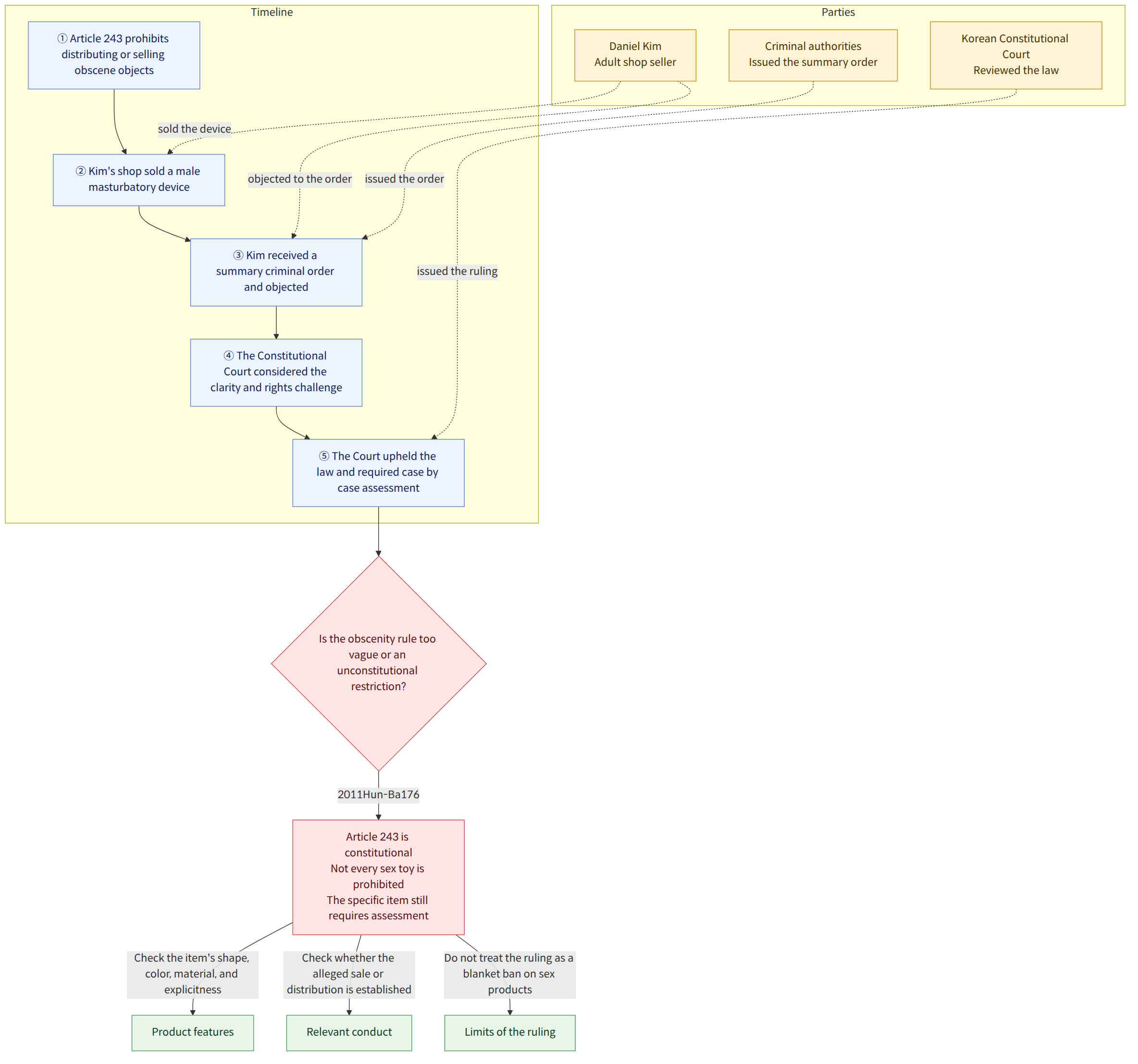
On a gray Tuesday morning, Daniel Kim found a court notice waiting at the counter of the adult shop he had run for years. It said he had received a summary order over the sale of a male masturbatory device. Daniel had thought of the item as ordinary merchandise: a product for adult customers, displayed among other goods in a small, discreet shop.
He objected to the order. His concern was not only the charge itself. The criminal law punished the distribution of “obscene” objects, but Daniel wondered what that word meant in practice. If even an adult product could cross the line, he feared, the rule might be too vague—and might leave shop owners and customers with no reliable way to know what was permitted.
2. The Legal Question
The central question is whether Korea’s criminal prohibition on distributing obscene objects is unconstitutional because “obscene” is too unclear, or because applying it to sex-related products improperly restricts a seller’s freedom to work and a customer’s privacy.
3. What Korean Law Says
Article 243 of the Korean Criminal Act makes it a crime to distribute, sell, lease, or publicly display obscene writings, pictures, films, or other objects. The law does not provide a checklist naming every item that is allowed or forbidden. Instead, the character of the particular object must be assessed under the legal meaning of obscenity.
The prohibition is not a blanket ban on sexual products. The question is whether the particular object is obscene, judged by its features and the way its sexual content is expressed.
In considering a sexual device, the relevant inquiry may include:
- Its physical features, including its shape, color, and material.
- How directly and explicitly it depicts or imitates sexual anatomy or conduct.
- Whether its form and expression seriously undermine or distort human dignity and worth.
- Whether the accused person distributed, sold, leased, or publicly displayed the item in circumstances covered by the statute.
The constitutional question is related but distinct. A law can use a word that requires judgment without necessarily being unconstitutional. The issue is whether people, courts, and enforcement authorities can understand the word’s meaning through ordinary interpretation and established legal standards.
4. How Korean Courts Approach This
Korea’s Constitutional Court upheld Article 243 in its decision of August 29, 2013, in case 2011Hun-Ba176. It concluded that the law did not violate the constitutional requirement of clarity and did not unconstitutionally infringe a seller’s freedom to pursue a profession or a user’s privacy and personal freedom.
The Court’s reasoning was deliberately narrower than a general condemnation of sex-related goods. It said that sex devices are not prohibited indiscriminately. Only exceptional products may qualify as obscene—those whose form and explicitness are considered to seriously harm or distort human dignity and worth.
Because it is difficult to sort every possible sex device into a general list of permitted and prohibited products, the assessment must be made case by case. That need for judgment does not, by itself, make the law unconstitutional.
The Court also treated the seller’s and customer’s interests as important, but not absolute. It found that the limited prohibition on objects meeting the legal standard for obscenity did not amount to an unconstitutional restriction on occupational freedom or private life.
5. Applying the Law to Daniel’s Case
First, Daniel’s constitutional argument faces a clear obstacle. The Constitutional Court has already ruled that Article 243 is constitutional. The fact that the statute uses the word “obscene,” rather than attempting to catalogue every prohibited object, is not enough on its own to invalidate it.
Second, the ruling does not automatically establish that Daniel’s product was obscene. The Court did not say that every male masturbatory device—or every sexual aid—is criminal to sell. A decision about a particular item requires attention to its actual features, including its shape, color, and material, and to whether its explicit form crosses the demanding threshold described by the Court.
Third, the alleged sale matters, but so does the object itself. Article 243 concerns specified conduct such as selling or distributing an obscene object. The authorities must still establish the relevant conduct and show that the item falls within the legal meaning of “obscene.” A constitutional ruling that the statute is valid does not substitute for that factual and legal assessment.
Finally, Daniel’s professional and his customers’ privacy interests remain part of the constitutional picture. But under the 2013 decision, those interests do not create a general exemption for adult shops or make the statute invalid. They support a careful, individualized assessment—not an automatic right to sell every item marketed for adult use.
If you are dealing with a similar issue, attorney Ji-sun Ahn of Ijun Law Firm can review the sequence of events, records showing what each person knew or did, and the grounds stated in any formal notice with you. These details can help clarify which options apply to your situation.
6. Conclusion: What Happened, and What Should You Do?
Daniel’s challenge to the law itself does not succeed: Korea’s Constitutional Court has upheld Article 243. But that does not settle whether the particular device he sold was obscene. That question must be decided by examining the product and the circumstances of the alleged sale under the Court’s case-by-case approach. In Daniel’s fictional situation, the constitutional challenge is rejected; the separate question of guilt still depends on the evidence about the item and the transaction.
If you sell or are charged over a sexual product, keep these practical points in mind:
- Do not assume that all sex toys are banned—or that every adult product is automatically lawful. The product’s actual design and presentation matter.
- Preserve the item and its product materials, including photographs, packaging, specifications, and sales records, so its features and the circumstances of sale can be assessed accurately.
- Get Korean legal advice promptly if charged. A constitutional challenge to Article 243 is unlikely to succeed on the same grounds rejected by the Constitutional Court; the product-specific facts and the evidence may be more important.

















