1. A Human Story
For years, Daniel Lee had watched his father, Mr. Lee, beat his mother. Daniel had tried to intervene before, pleading with his father to stop and helping his mother recover afterward. Each episode left him angrier and more afraid of what might happen the next time.
One evening, Daniel heard shouting from the next room and found his father striking his mother again. He rushed in to pull him away. In the struggle, Daniel acted impulsively and fatally injured his father. The violence stopped, but the family was left with a death, a criminal investigation, and a question Daniel could not shake: would the law treat him more harshly simply because the person who died was his father?
2. The Legal Question
The central question is whether South Korea may constitutionally impose a more severe sentencing range when a person kills a direct ascendant—such as a parent—than when the victim is not a relative. Put another way, does the special offense of parricide violate the constitutional principle of equality?
3. What Korean Law Says
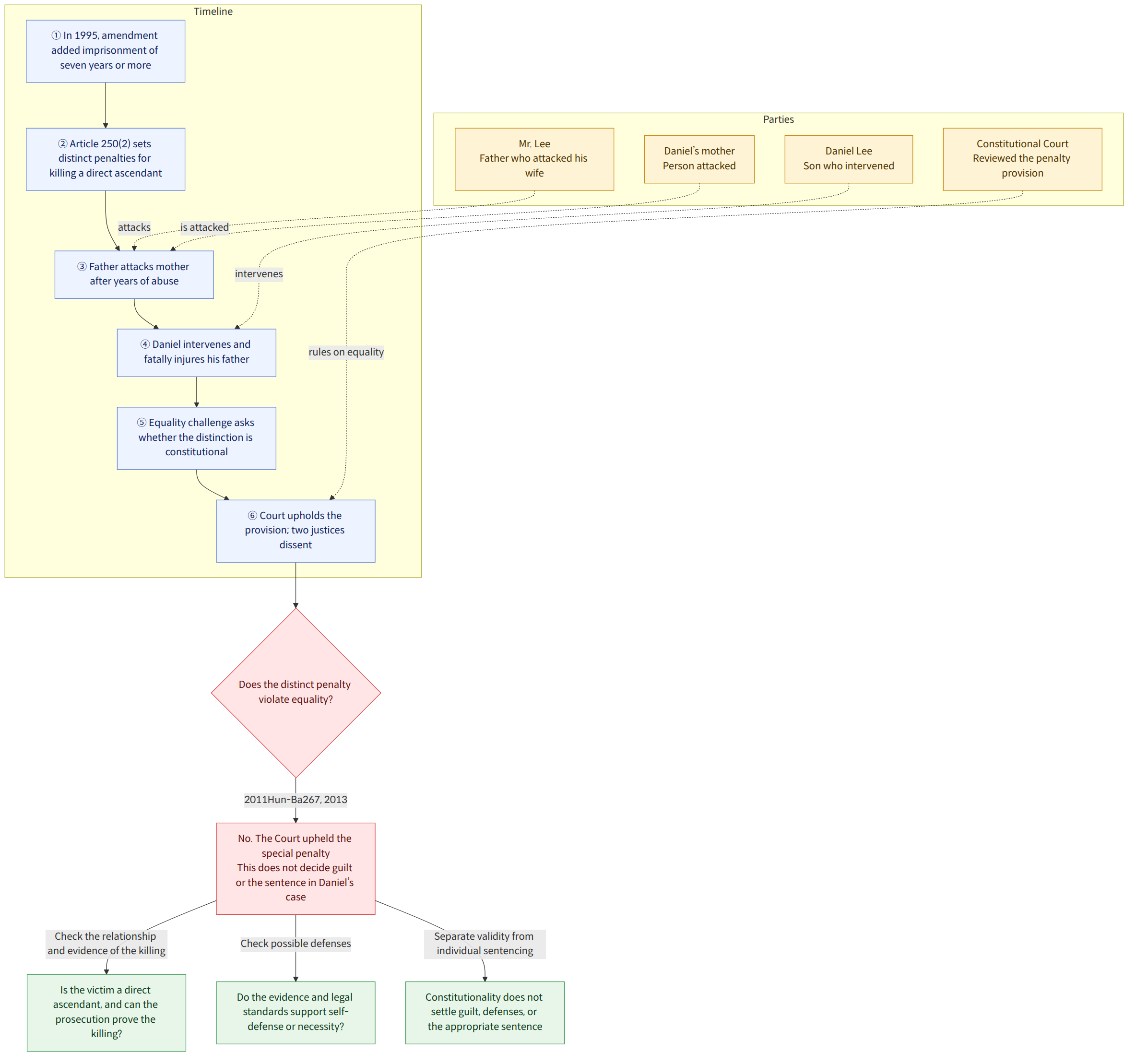
Article 250 of the Korean Criminal Act distinguishes ordinary murder from the killing of a direct ascendant. Under paragraph 2, a person who kills a direct ascendant may be punished by death, life imprisonment, or imprisonment for at least seven years. The general murder provision carries a different sentencing range.
Criminal Act Article 250(2): A person who kills a direct ascendant may be punished by death, imprisonment for life, or imprisonment for not less than seven years.
The constitutional issue is not whether every person who kills a parent deserves a harsher sentence. It is whether the legislature may treat this category of killing as sufficiently different to justify a distinct penalty. The Constitutional Court answered yes. In its 2013 decision in 2011Hun-Ba267, it held that the provision did not violate the constitutional principle of equality.
The Court’s reasoning rested on two main considerations:
- A distinct social wrong: The Court considered the killing of a direct ascendant to have long been viewed as a serious violation of social order and moral duties, warranting especially strong condemnation.
- Room for individualized sentencing: In 1995, the statute was amended. The earlier penalty had been death or life imprisonment; the amended provision added a prison term of seven years or more. In the Court’s view, this gave judges greater flexibility to tailor punishment to the circumstances of an individual case.
The constitutional holding: The Court concluded that the special penalty did not violate equality, while two justices dissented, taking the view that the provision was unconstitutional on that ground.
The Court had also reached a similar conclusion about a separate provision that increased punishment when a direct ascendant died as a result of an injury, rather than an intentional killing. That ruling likewise reflects the Court’s acceptance of special treatment for crimes against direct ascendants.
4. How Korean Courts Approach This
In reviewing this kind of law, the Constitutional Court asks whether the legislature had a legitimate reason to distinguish one category of crime from another and whether the distinction is sufficiently connected to that reason. The Court has accepted the view that killing a parent carries a particular social and moral significance beyond the loss of life alone.
That does not mean a judge must treat every case as identical. The seven-year minimum allows a court to consider the circumstances when deciding the sentence, within the limits of the law. Nor does the constitutional ruling settle other questions that may arise in a particular prosecution, such as whether the defendant acted in lawful self-defense or necessity, or whether the circumstances support a reduced sentence. Those issues turn on the evidence and the applicable legal standards.
A key distinction: A ruling that a criminal statute is constitutional does not prove that a particular defendant is guilty, nor does it determine the proper sentence in that person’s case.
5. Applying the Law to the Case
Daniel’s objection is understandable: he believes his conduct may have been no more blameworthy than ordinary murder, especially because he intervened during an attack on his mother. But the constitutional challenge concerns the validity of the statute, not Daniel’s personal level of blame.
- The victim’s relationship to Daniel matters under Article 250(2). If the prosecution establishes that the victim was Daniel’s direct ascendant and that Daniel committed the killing, the special provision is relevant. The fact that the killing happened during an intervention does not, by itself, remove the case from the statute.
- The equality challenge is unlikely to succeed. Under the Constitutional Court’s 2013 ruling, the special treatment of killing a direct ascendant is not unconstitutional merely because the penalty differs from that for ordinary murder. The Court accepted the legislature’s judgment that this type of killing warrants distinct condemnation.
- The circumstances of the confrontation remain important. Whether Daniel was trying to stop an immediate attack, what force he used, and whether the fatal act was intentional are separate factual and legal questions. They may matter to whether a defense applies, what offense is proved, or what sentence is appropriate. The constitutional ruling does not answer them in advance.
- The sentencing range does not eliminate individual assessment. The Court pointed to the seven-year minimum, introduced in 1995, as a way to avoid the rigidity of a law that allowed only death or life imprisonment. Daniel’s conduct and the surrounding events may therefore remain relevant at sentencing, even though the statute itself stands.
The outcome of Daniel’s case would depend on evidence that a constitutional challenge alone cannot resolve. For example, investigators and the court would need to examine the timing and nature of the threat, the sequence of events, and Daniel’s state of mind. The fact that his father had previously abused his mother could help explain the context, but it would not automatically establish a legal defense to the killing.
If you are dealing with a similar issue, attorney Ji-sun Ahn of Ijun Law Firm can review the sequence of events, records showing what each person knew or did, and the grounds stated in any formal notice with you. These details can help clarify which options apply to your situation.
6. Conclusion: What Happened, and What Should You Do?
Daniel’s constitutional argument does not invalidate the special parricide provision: the Constitutional Court has upheld it as consistent with equality. His case would therefore proceed under the law as written if the relevant elements were established. But that conclusion does not decide whether his conduct was justified, what offense the evidence supports, or what sentence he should receive. Those questions require a separate, close examination of the events surrounding the death.
For anyone facing a similar situation:
- Get a criminal defense lawyer immediately. Do not assume that a constitutional challenge alone addresses defenses or sentencing issues.
- Preserve evidence of the immediate events and the history of violence, including messages, medical records, photographs, and witness details. Do not alter or destroy potential evidence.
- Avoid public speculation about the case. Give your lawyer a careful, accurate account of what happened so that any defense or mitigating argument can be assessed against the evidence.