
1 — A Human Story
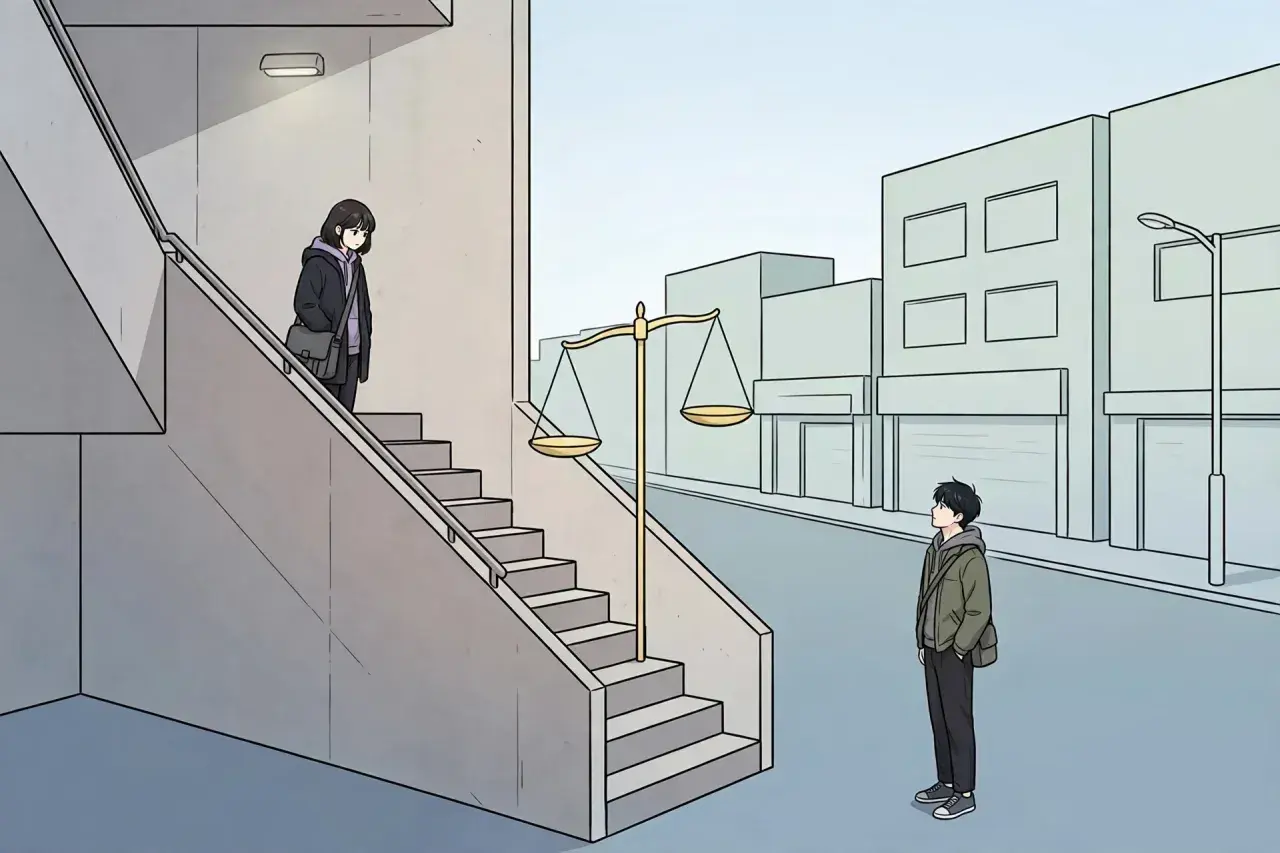
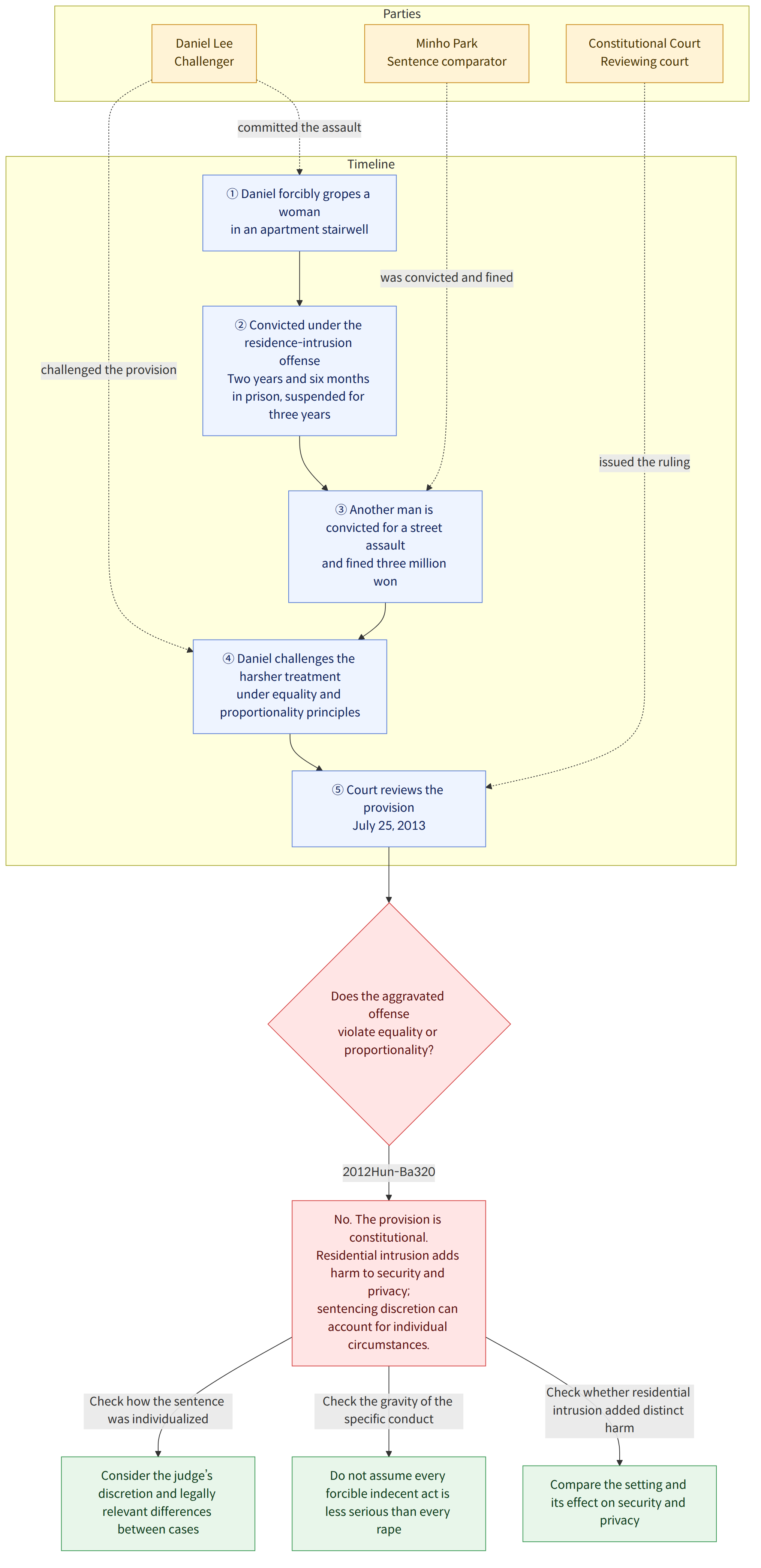
Daniel Lee had been visiting a friend in an apartment building when he encountered a woman on the stairwell. He followed her and forcibly groped her. The case ended with a conviction under the provision for forcible indecent acts involving intrusion into a residence: Daniel was sentenced to two years and six months in prison, suspended for three years.
A few streets away, another man, Minho Park, was convicted of forcibly groping a woman on a public road. He received a fine of three million won. Daniel could not understand why conduct that seemed similar to him had led to such different punishments. Was the law treating him unequally simply because the assault happened inside an apartment building?
2 — The Legal Question
The central question is whether Korea’s special offense for forcible indecent acts involving intrusion into a residence violates the constitutional guarantees of equality and proportionality by exposing an offender to substantially harsher punishment than a person who commits a similar assault in a public place.
3 — What Korean Law Says
The provision at issue was Article 3(1) of Korea’s Act on Special Cases Concerning the Punishment, etc. of Sexual Crimes. It treated a forcible sexual offense committed in connection with intrusion into a residence as a distinct, aggravated offense. The constitutional challenge arose because the provision could apply to forcible indecent acts as well as more serious sexual offenses, and could therefore lead to a marked difference in punishment from an assault committed outside a residence.
The Constitutional Court considered the provision in its decision of July 25, 2013, in case 2012Hun-Ba320. It held the provision constitutional, concluding that it did not violate either the principle of proportionality between responsibility and punishment or the constitutional principle of equality.
The Court’s central reasoning was that intrusion into a home or residential space can add a serious invasion of personal security and privacy. It also considered that some forcible indecent acts may be grave enough to warrant punishment comparable to, or more severe than, rape.
The decision rests on several basic principles:
- The setting can matter. An offense committed after entering a residential space may involve an additional invasion of the occupant’s security and privacy, beyond the sexual assault itself.
- The legislature has room to distinguish offenses. It may treat conduct involving a residential intrusion more seriously where it sees a distinct harm or danger.
- Punishment must still fit the offender’s responsibility. A statutory sentencing range does not erase the sentencing judge’s role in assessing the particular conduct and offender.
- A difference in sentences is not automatically unconstitutional. A comparison with another case must account for legally relevant differences, not just the broad label of the conduct.
Five justices expressed a limited-unconstitutionality dissent. They considered the provision disproportionate and unequal insofar as it applied to forcible indecent acts that were not as serious as conduct comparable to rape. That view did not prevail; the Court’s holding was that the provision was constitutional.
4 — How Korean Courts Approach This
In this type of constitutional challenge, Korean courts look at the purpose and structure of the law as well as the severity of the penalty. They ask whether the legislature had a reasonable basis for treating the conduct as a more serious offense, and whether the punishment is plainly out of proportion to the harm and the offender’s responsibility.
The Constitutional Court’s approach in this decision gave weight to the distinct harm of entering a residential space. A home is not simply another location: intrusion can make an occupant feel unsafe in a place where privacy and security should be protected. The Court also rejected the idea that every forcible indecent act is necessarily less serious than every rape. The circumstances and gravity of an individual assault can vary substantially.
The Court also relied on the judge’s ability to individualize punishment. In its view, sentencing discretion could address cases in which applying the aggravated offense might otherwise produce an unfairly severe result.
The dissent highlights the concern on the other side of that reasoning: if the aggravated provision reaches less serious indecent acts as well as the gravest conduct, a broad sentencing rule may impose too much punishment in some cases. But in the 2013 decision, that concern did not lead the Court to invalidate the provision.
5 — Applying the Law to the Case
Daniel’s comparison with Minho is understandable, but it does not establish that Daniel’s conviction was unconstitutional.
- The incidents occurred in different settings. Minho’s assault took place on a public road. Daniel’s took place in an apartment stairwell, a space connected with residents’ homes. The law treated intrusion into a residential setting as an additional harm, not merely as a change of scenery.
- The constitutional question concerns the law, not only the difference between two sentences. A fine in one case and a suspended prison term in another may look unequal. But the comparison alone does not show that the statutory distinction has no reasonable basis or that Daniel’s punishment was necessarily disproportionate. The details of each offense and each offender can also affect the sentence.
- The relevant provision had already survived constitutional review. Under the 2013 ruling, the fact that the provision covered forcible indecent acts—not only rape—did not make it unconstitutional on its face. The Court accepted that some indecent acts could be exceptionally grave and that the residential intrusion could justify aggravated treatment.
- The judge’s sentencing decision still mattered. Daniel received a suspended sentence rather than being required to serve the prison term immediately. The constitutional ruling treated individualized sentencing as one way to avoid an unjust result in a particular case. It did not mean that every person convicted under the provision must receive the same sentence.
The dissenting justices’ concern could support an argument that a particular case involved conduct too minor to justify the aggravated treatment. But it was a minority view, and it did not change the Court’s conclusion that the provision itself was constitutional.
If you are dealing with a similar issue, attorney Ji-sun Ahn of Ijun Law Firm can review the provision applied in your case, the ruling or notice you received, and the dates relevant to challenging it with you. These details can help clarify which options apply to your situation.
6 — Conclusion: What Happened, and What Should You Do?
Daniel’s constitutional challenge does not succeed merely because Minho received a fine for a similar assault in a different setting. In the 2013 decision addressing this provision, the Constitutional Court upheld the aggravated offense. It reasoned that an assault involving intrusion into a residential space may inflict an additional harm, that some forcible indecent acts can be extremely serious, and that judges can take individual circumstances into account when sentencing.
For anyone facing a similar issue:
- Compare the full facts, not just the headline sentences. The location, manner of entry, nature of the conduct, and individual circumstances may all matter.
- Get advice from a Korean criminal-defense lawyer promptly. A lawyer can assess the applicable version of the law, the evidence, and any available appeal or constitutional procedure.
- Keep the constitutional argument precise. If challenging the law or sentence, explain why the provision or its application is disproportionate in the specific circumstances; a sentence that differs from another case is not, on its own, enough.

















