1. A Human Story
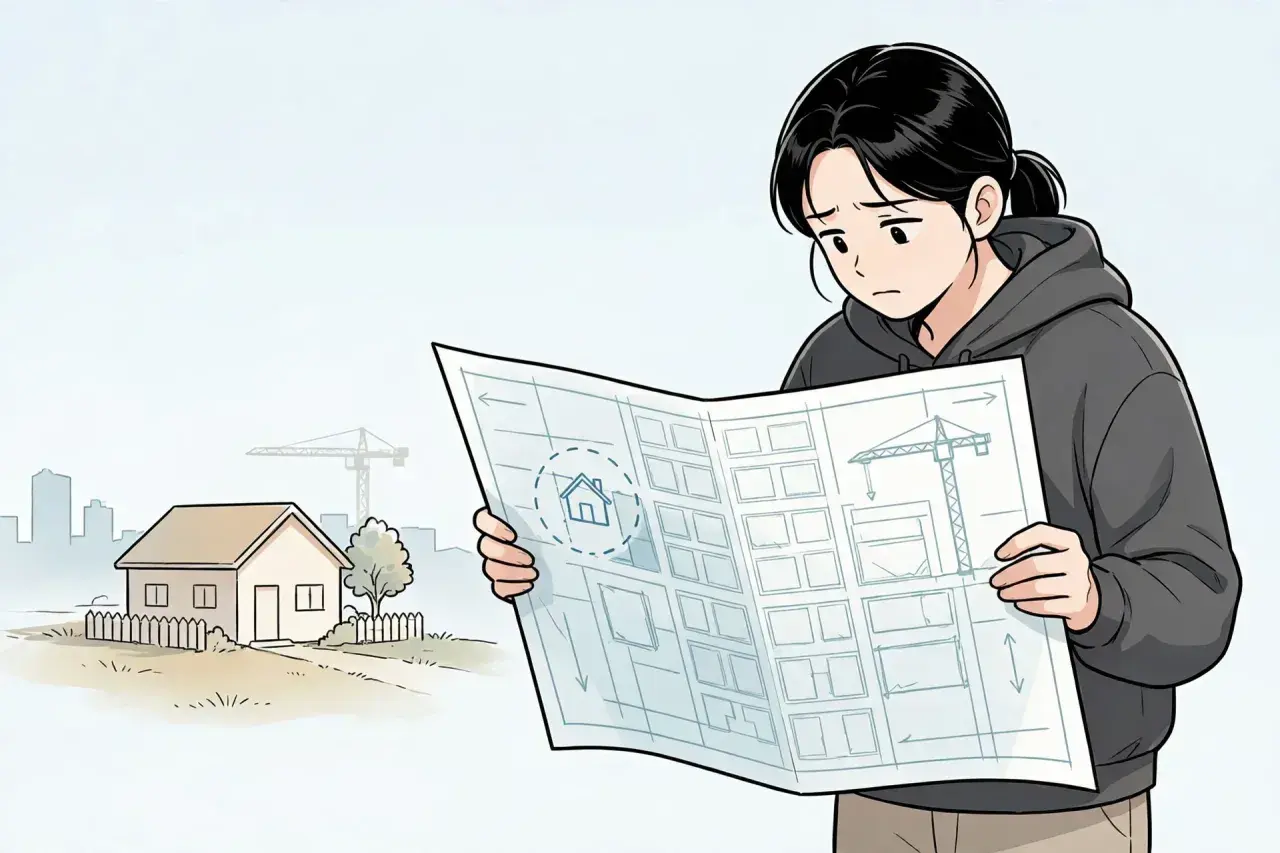
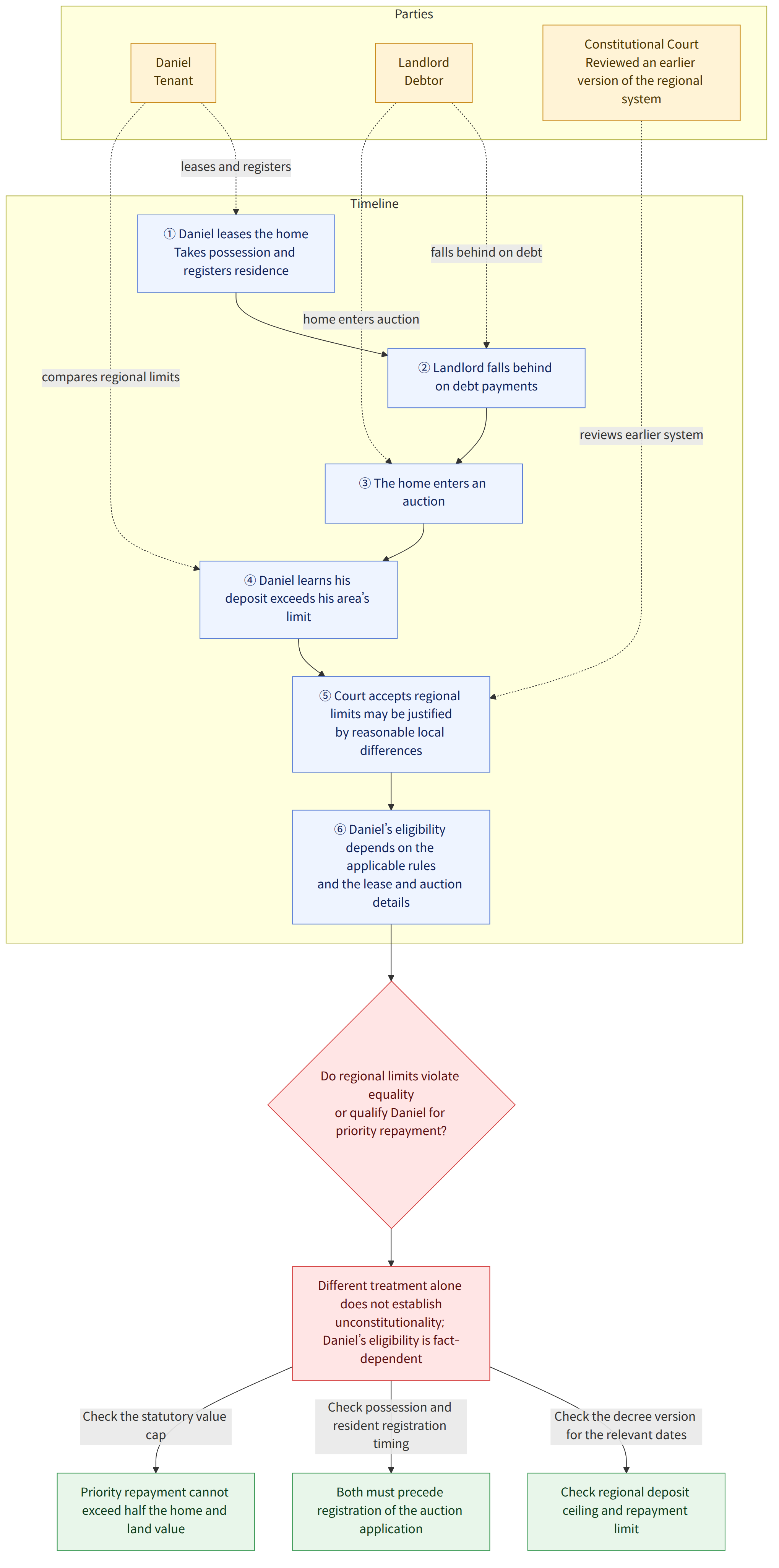
When Daniel, a restaurant manager, signed a lease for a modest apartment outside Seoul, he believed the hardest part of renting was saving the deposit. He moved in, registered his residence at the address, and built a life there with his young daughter. Then his landlord fell behind on debt payments, and the apartment was drawn into an auction.
As Daniel tried to understand what might happen to his deposit, he learned that Korean law can give certain small-scale tenants priority to recover part of what they paid, even ahead of some secured creditors. But the eligibility limits differ by region. A friend renting in Seoul told him that a tenant there might qualify with a larger deposit. Daniel’s own deposit sat just beyond the limit that applied to his area. He began to ask whether a city boundary could lawfully determine who receives protection.
2. The Legal Question
Does setting different deposit thresholds and priority-repayment amounts for different regions violate a tenant’s constitutional rights to property or equality? And, regardless of that challenge, can Daniel qualify for priority repayment under the rules applicable to his lease and the auction?
3. What Korean Law Says
The Korean Housing Lease Protection Act provides a limited safety net for certain tenants when a home is sold through an auction. A qualifying tenant may receive priority repayment of a specified portion of the deposit ahead of other holders of security interests. The law delegates the detailed eligibility limits and repayment amounts to a presidential decree.
The statute allows priority repayment only for a defined portion of the deposit. It also sets an overall limit: that portion cannot exceed half the value of the house and land together.
The decree divides locations into regional categories and sets limits for each. In broad terms, it specifies both:
- The maximum deposit a tenant may have and still qualify as a “small-scale tenant”; and
- The maximum portion of that deposit that may receive priority repayment.
Those figures and categories can change. The applicable version must be checked against the relevant dates and circumstances; amounts quoted in older materials should not be assumed to remain current.
A tenant must also meet the statutory conditions. In particular, the tenant must have taken possession of the home and completed resident registration before the registration of the auction application. Meeting those conditions is not, by itself, enough: the deposit must also fall within the applicable regional limit, and priority repayment remains subject to the statutory cap tied to the home’s value.
4. How Korean Courts Approach This
The Constitutional Court has considered a challenge to an earlier version of the regional system. It accepted that the legislature could set different limits for different areas, rather than requiring one national figure for every tenant.
The relevant principle is that lawmakers have room to balance tenants’ protection against the interests of property owners and secured creditors, while taking account of changing economic conditions. A regional distinction is not automatically unconstitutional if it has a reasonable basis and does not exceed that legislative discretion.
In assessing that basis, the Court has pointed to practical differences that can affect rents and deposits, including population density, land prices, housing supply and demand, transport, education, public facilities, and surrounding conditions. It has also considered that areas within the same administrative region may not have identical economic circumstances.
The general lesson is not that every regional line is necessarily fair or immune from challenge. It is that a difference in treatment, standing alone, does not prove a constitutional violation. A challenger must show more than the fact that another tenant in another area receives a different limit.
5. Applying the Law to Daniel’s Case
- Daniel can point to a real difference. If a tenant with a comparable deposit in Seoul qualifies while Daniel does not, because the regional deposit ceiling is different, the rules treat them differently. That is a starting point for an equality argument, but it is not the end of the analysis.
- The distinction has a recognized policy rationale. The system is designed to provide a measure of protection to tenants with comparatively modest deposits, while also accounting for differences in local housing markets and preserving the interests of other creditors and property owners. Under the Constitutional Court’s approach, those are legitimate considerations for lawmakers to weigh.
- Daniel’s constitutional claim faces a substantial obstacle. The Court has upheld the basic approach of setting regional categories and limits when those categories reflect relevant differences and remain within legislative discretion. On the facts given, Daniel’s argument that the rules are unconstitutional simply because his area has a lower ceiling than Seoul is unlikely to succeed.
- His individual eligibility remains a separate question. Daniel’s possession and resident registration before the auction application’s registration may satisfy important statutory conditions. But whether he qualifies also depends on the exact location of the apartment, the applicable version of the decree, his deposit, the relevant dates, and the value available for distribution. If his deposit exceeds the applicable ceiling, those other facts may not make him a small-scale tenant under the priority-repayment rules.
For Daniel, the key documents are the lease, proof of the deposit, his resident-registration record, and the auction notice and registration details. A lawyer could review those documents and the dates against the regional rules applicable to his case, without assuming that a general constitutional challenge will resolve his individual eligibility.
6. Conclusion: What Happened, and What Should You Do?
Daniel’s challenge does not succeed merely because tenants in different regions face different limits. Korean constitutional law has accepted that regional housing conditions may justify different thresholds, so the regional distinction alone is unlikely to establish a violation of his property or equality rights. His practical route is to determine whether he qualifies under the rules that actually apply to his lease and the auction. If he does not, the constitutional argument, on these facts alone, is unlikely to change the result.
For tenants in a similar position:
- Check the applicable rules for the property’s location and relevant dates. Do not rely on a threshold quoted for another city or in older guidance.
- Keep proof of possession, resident registration, the deposit, and the auction timeline. These facts may determine whether the statutory conditions are met.
- Get the lease and auction documents reviewed promptly. Priority repayment depends on details that can be easy to overlook, including the precise location and the version of the rules that governs.
If you are facing a similar auction, you could ask attorney Ji-sun Ahn of Ijun Law Firm to review your lease, deposit records, resident-registration history, and auction notice against the regional rules and dates that apply to your property.