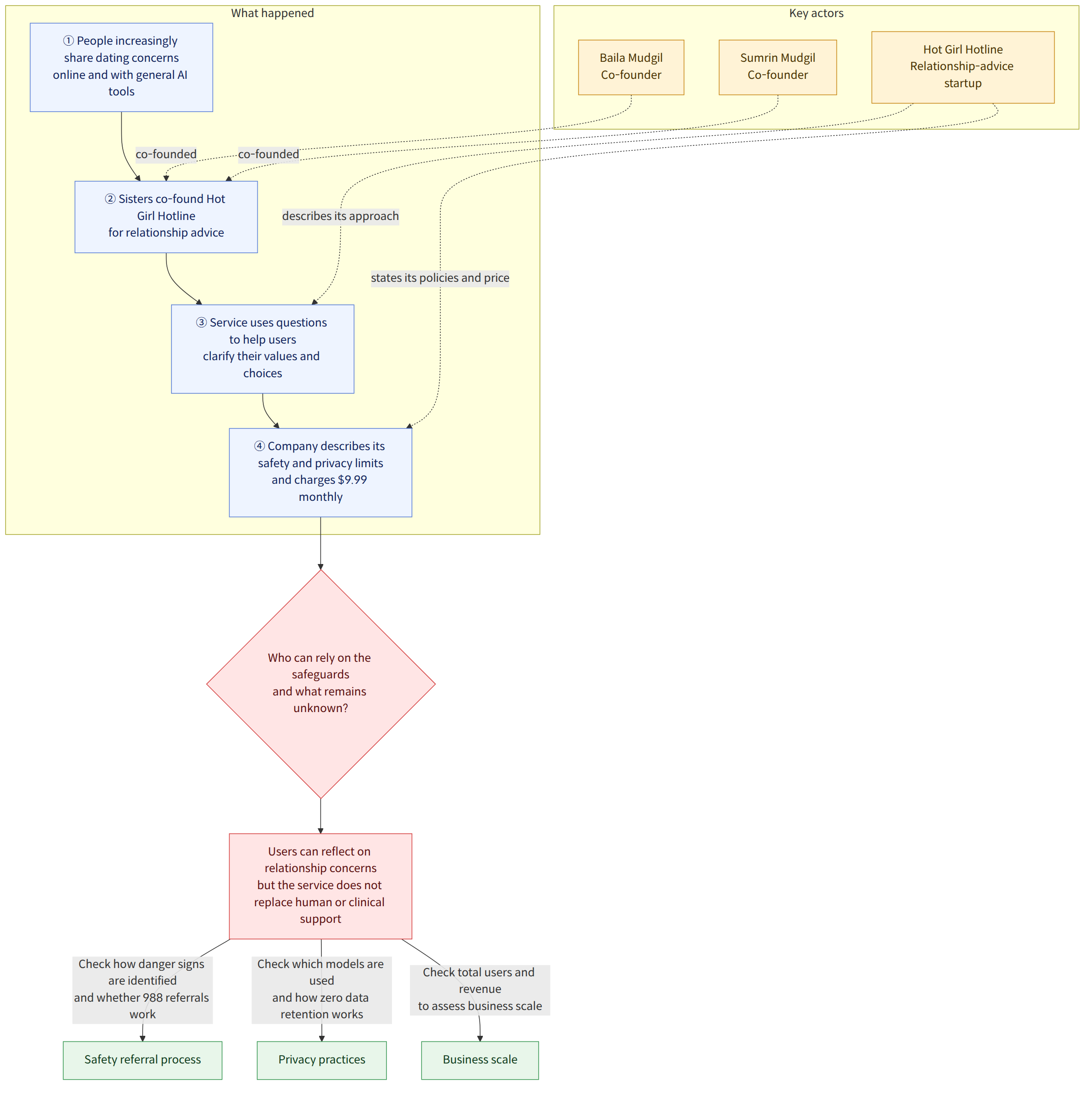
Sisters Baila Mudgil and Sumrin (“Sumi”) Mudgil co-founded Hot Girl Hotline, a startup that offers AI advice to young women dealing with dating and relationship concerns. The company describes the service as relationship advice, not an AI companion intended to alleviate loneliness. It operates on a $9.99 monthly subscription model and says hundreds of its most active users are already paying the fee.
Background and context
The ways people share their dating concerns have expanded from newspaper advice columns, letters to magazines, and conversations with friends to online forums and social media. The original reports that people are already using large language models (AI that generates sentences after being trained on large amounts of text) in apps such as ChatGPT for relationship advice. Rather than leaving these personal conversations to general-purpose chatbots, Hot Girl Hotline aims to create a service focused on relationship advice.
The two founders have different backgrounds. Baila Mudgil previously worked as a social media consultant, while Sumrin Mudgil studied computer science at Stanford University. Baila said the advice is grounded in behavioral science and that the service aims to feel like talking with a trusted friend or older sister.
Conversations often follow a Socratic approach, in which users answer questions and organize their own thoughts rather than receive instructions right away. The company says it personalizes advice to reflect each user’s values, goals, identity, and preferences. It also presents as a distinguishing feature that the service encourages users to end the conversation and take action in real life, rather than repeatedly asking follow-up questions to keep the conversation going.
What this news means
The service’s central idea is to help users examine their own thoughts and reasons, rather than having AI decide the outcome of a relationship problem for them. For example, if someone shares a conflict with their partner, the service could use questions to help that person clarify their values and what they want, and consider what action to take in real life. This is a hypothetical example based on the company’s description of the service; it does not mean every conversation follows the same pattern.
The company draws a clear line, saying the service does not replace conversations with people and does not provide clinical advice. Baila said that if a conversation reveals signs of danger, the service directs users to resources such as the 988 crisis hotline. This can be seen as an effort to distinguish the convenience of sharing relationship concerns from the limits of professional help. However, the public description does not explain how the service identifies signs of danger or how effective its referrals are.
Privacy is another factor that will shape trust in the service. The company says it combines multiple AI models and encrypts data both in transit and at rest. It says it does not sell user data or use it to train AI, and that when it uses external AI models, it follows a zero data retention policy (a policy under which external model providers do not retain data). But the information provided does not specify which models and providers it uses or how the policy is implemented in practice.
Paid subscriptions are both a business model for sustaining the service and a condition users choose by paying for it. The company charges $9.99 a month and says hundreds of its most active users are already subscribed. The total number of users and revenue have not been disclosed, so these figures alone are not enough to assess the size or sustainability of the business. The company has also mentioned the possibility of introducing advertising in the future and said it plans to expand from relationship advice into beauty and lifestyle.
What is confirmed and what remains unknown
Confirmed facts
- Hot Girl Hotline is a relationship-advice service co-founded by sisters Baila Mudgil and Sumrin Mudgil.
- The service is available on iOS and the web, and earns revenue through a $9.99 monthly subscription.
- The company highlights data encryption, not selling data or using it for AI training, and a zero data retention policy when using external models.
- The company says the service does not replace conversations with people or clinical advice, and that it directs users to resources such as 988 if signs of danger arise.
- The New York-based company currently operates without outside investment and is scheduled to take part in the Startup Battlefield 200 at TechCrunch Disrupt 2026, which will be held in San Francisco from October 13 to 15, 2026.
What remains unknown
- Specifically, how do the safeguards work, and has their effectiveness been verified?
- What are the service’s current total number of users and revenue?
- Which AI models and external providers does the service use?
What readers should check
- Before using the service, readers should understand that it does not replace advice from people or clinical help, and check whether the resources it directs users to in a crisis are appropriate for their situation.
- Before entering sensitive relationship information, readers should check what the principles of data encryption and not selling or using data for training mean, and how the policy against retaining data applies when external AI models are used.
- Anyone considering a subscription can weigh the $9.99 monthly fee against their intended use of the service. Since the company has mentioned the possibility of introducing advertising in the future, changes to its policies on advertising or expansion are also worth watching.