
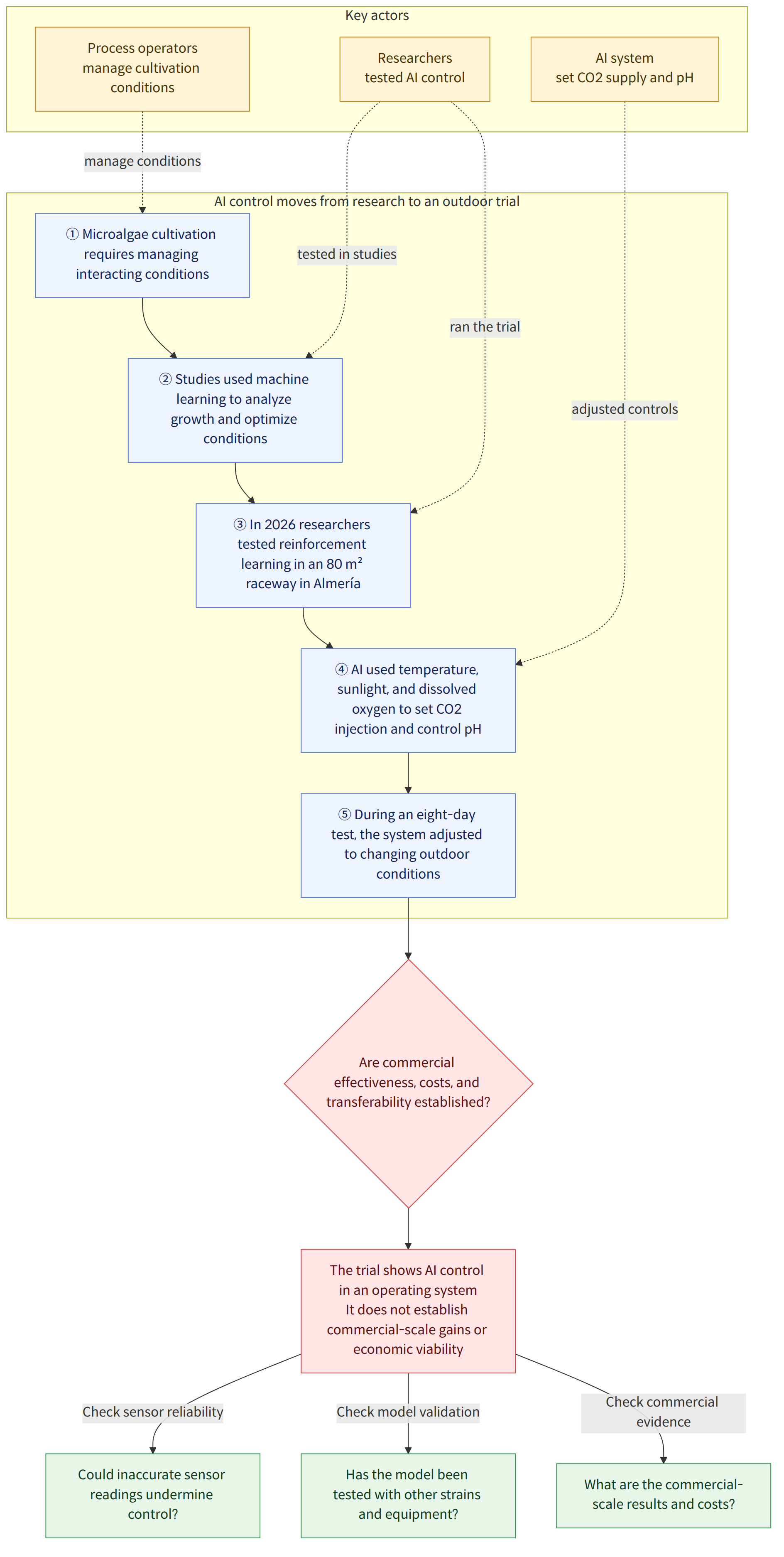
Microalgae, which grow using light and carbon dioxide, can be used to make animal feed and ingredients, pigments, and potential renewable fuels. But growing them efficiently at an industrial scale is difficult. Light, temperature, pH (a measure of acidity or alkalinity), oxygen levels, and other factors all need to be managed during cultivation.
Recent studies and trials show that artificial intelligence (AI) could assist with this work. By analyzing information from sensors and images, AI can help assess growth and adjust operating conditions such as carbon dioxide supply and pH. This does not mean, however, that AI has already been shown to improve industrial production or its economics.
Background and context
Microalgae are tiny organisms abundant in seas, rivers, and lakes. Through photosynthesis, they convert light into organic compounds such as proteins, fats, and carbohydrates. In a photobioreactor (a device that uses light to cultivate microorganisms), conditions must be kept suitable for growth.
These conditions affect one another. A lack of light can limit photosynthesis, while excessively intense light can cause photoinhibition (a drop in photosynthetic efficiency due to excessive light). As cells multiply in the culture medium, they can also block light from reaching one another. As a result, adjusting just one condition may not be enough to manage the cultivation process effectively.
Sensors can continuously measure temperature, pH, dissolved oxygen (oxygen dissolved in a liquid), light, carbon dioxide, and other factors. Machine learning (a method for finding and analyzing patterns in data) can be used to examine these measurements and identify cultivation conditions and growth-related changes. Researchers are also studying approaches that analyze images of the culture medium to estimate changes in biomass (material derived from living organisms) or culture density.
Machine learning has already been used in some cases to predict microalgae growth or optimize cultivation conditions. However, much of the production studied has remained at the laboratory or small pilot scale. Trials of AI control in some large outdoor cultivation systems offer examples of its potential beyond the laboratory, but do not in themselves establish results at commercial scale.
What this news means
AI’s role is less about replacing cultivation than about helping researchers and process operators make decisions by considering multiple conditions and measurements together. It can identify growth-related patterns in sensor data or detect changes that are difficult for people to monitor continuously, providing information to help adjust operating conditions. Image analysis can serve as another source of information for estimating the state of the culture medium.
In 2026, researchers in Almería, southeastern Spain, tested reinforcement learning in an 80 m² open raceway (a system in which the culture medium circulates through an outdoor channel) used to cultivate microalgae. Reinforcement learning is a method in which a computer learns which actions produce suitable results. The AI system used measurements of temperature, sunlight, and dissolved oxygen to determine the amount of carbon dioxide to supply, and controlled pH by adjusting carbon dioxide injection.
The system was tested for eight days under changing outdoor conditions, and the researchers said it adjusted the process in response to changes in operating conditions. This is an example of AI control being applied to an operating cultivation system. However, the information presented in the article does not show how effective it is at commercial scale or what its costs or economic viability are.
For example, imagine a cultivation facility using sensor data to adjust its carbon dioxide supply. An adjustment suggested by AI could help inform an operator’s judgment, but the same performance would be difficult to expect if the sensor readings were inaccurate or the model had not been adequately validated with other strains and equipment. For this reason, AI models must be considered alongside sensors, cultivation equipment, microalgae strains, and operating conditions.
What is confirmed and what remains unknown
What is confirmed
- Microalgae can be used for animal feed and ingredients, pigments, and potential renewable fuels, but cultivating them efficiently at industrial scale is difficult.
- Sensors and machine learning are being used to analyze cultivation conditions and growth-related patterns, and methods for estimating changes in biomass or culture density from images are also being studied.
- In 2026, a system in which AI controlled pH by adjusting carbon dioxide injection was tested for eight days in an 80 m² open raceway in Almería.
- Sensor fouling and changes in readings over time, as well as differences among strains and equipment, can pose problems when applying a model to other systems.
What remains unknown
- The extent to which AI-based control is effective in commercial-scale microalgae production has not been presented.
- The costs or economic viability of cultivation using AI have not been explained.
- It has not been established whether models developed in laboratories or specific outdoor systems will perform as well with other strains and equipment.
What readers should check
- Check whether sensors in the cultivation system are fouled or their readings change over time, and whether the data used for AI analysis are reliable.
- When applying a model developed for a particular strain or piece of equipment to another system, assess whether its performance holds under those conditions.
- When evaluating an AI control case, check the scale and duration of the trial and whether it responded to changing outdoor conditions; distinguish these points from whether commercial results or economic viability have been demonstrated.