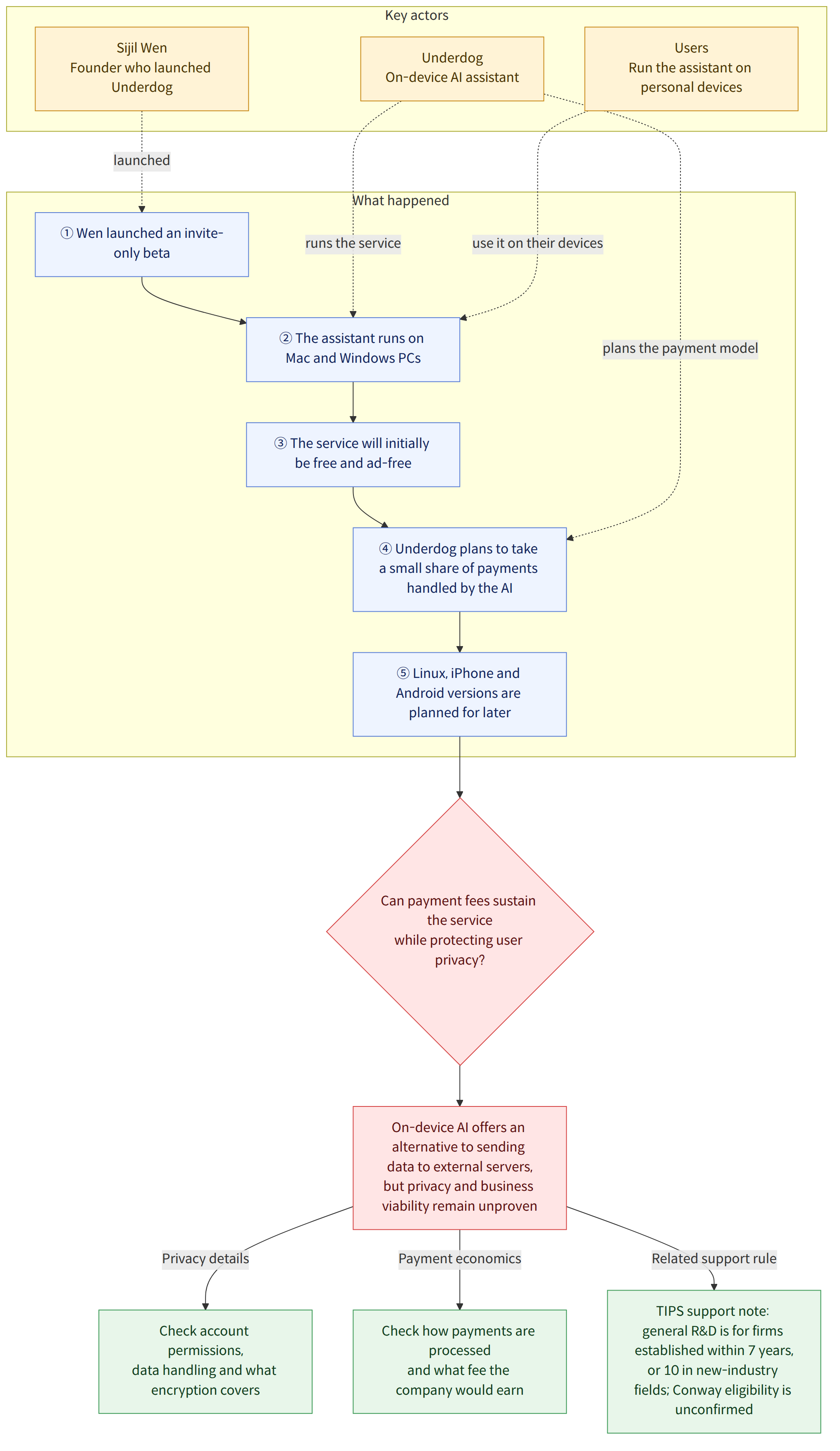
Sijil Wen launched the invite-only beta of Underdog, an AI assistant that runs on personal computers, on Monday. Underdog currently runs AI models directly on Mac and Windows PCs; versions for Linux, iPhone and Android are planned for later. Wen said the service will initially be free and will not rely on advertising, instead planning to earn revenue by taking a very small share of payment transactions handled by the AI assistant.
Background and context
Wen taught himself to code and moved to Silicon Valley at age 17, where he lived in an AI hacker house with AI researcher Andrej Karpathy. According to the article, he hacked and coded with Perplexity founder Aravind Srinivas, OpenAI researcher Noam Brown and others. He also said he figured out how to run GPT-2 on an Apple Watch.
Wen is participating in Peter Thiel’s Thiel Fellowship program, which invites young founders to focus on projects instead of attending college. His startup is Conway Research. The article says the company has received investment from Stripe co-founder Patrick Collison, Andreessen Horowitz, Khosla Ventures and others.
At the core of Underdog is Husky, an inference engine (software that calculates a model’s output based on its input) Wen built to run AI models quickly on users’ hardware. Wen said Husky moves less data between a computer’s main chip and graphics chip than competing on-device engines do.
Underdog currently uses a 27-billion-parameter inference model fine-tuned from Qwen3.8-27B. Wen claims that the model is comparable to Claude Opus 4.6 on some benchmarks and can handle everyday tasks such as researching purchases and answering questions about math homework. However, the article does not specify which benchmarks were used or what results the model achieved.
What this means
Underdog’s approach offers an alternative to sending users’ data to external servers to access AI features. According to the article, the model runs on the user’s device, and keys for email and other accounts that the service is allowed to access (credentials used to access accounts) are encrypted. This can be seen as an effort to make privacy part of the product’s operation and business model, rather than an add-on feature.
However, running a model on a device does not, by itself, guarantee complete privacy. Users need to understand account access permissions, how payments are processed and what information is covered by encryption. The article confirms on-device operation and encryption of account keys, but does not provide the full details of how data is handled.
From a business perspective, Underdog proposes earning fees from payment transactions instead of relying on advertising or an initial subscription charge. Wen explained that because the AI runs on users’ devices, the company does not need to pay large sums to inference providers. If payments become a real source of revenue, this could offer an alternative to using user data for advertising as the basis of the business. But it is not yet clear whether enough transactions will take place or how much revenue the fees would generate to operate the service.
For example, if a user asks Underdog to research a purchase and the assistant handles the payment, the company’s proposed model is to earn a share of that transaction. This is an example illustrating the business plan Wen described; the actual payment process and fee percentage cannot be confirmed from the information made public.
Wen claims that the model is comparable to Claude Opus 4.6 on some benchmarks, but has not provided details about the specific tests or results. It is therefore important to distinguish verified information about the model’s performance from the founder’s assessment.
Relevant programs and support information
Internal materials include a revised announcement of the 2026 TIPS Startup Support Plan (2026년 팁스(TIPS) 창업기업 지원계획 수정 공고) from the Ministry of SMEs and Startups (중소벤처기업부) and the Korea Angel Investment Association (한국엔젤투자협회). This does not mean that Conway Research, the company in the article, is eligible for support. The article contains no information confirming the company’s location in Korea or its eligibility for TIPS, so the announcement should be viewed as separate support information that Korean startups may find useful.
Under the announcement, the general R&D track is for companies established within the past seven years, with companies in new-industry fields eligible if they were established within the past 10 years. The TIPS Deep Tech R&D track is for companies that have completed the general TIPS track and received a completion determination. The commercialization and overseas marketing programs linked to TIPS non-R&D support are for companies that completed a TIPS R&D project agreement by 2025 and were established within the past seven years as of the application deadline in the announcement.
The maximum support amounts are 800 million won for the TIPS general R&D track, 1.5 billion won for the Deep Tech track and 300 million won for linked non-R&D programs. However, applicants should consult the announcement for detailed eligibility and support information. The materials list the period as “to be announced later” and the deadline as “ongoing or undecided.” Interested companies should check the latest announcement for application dates and eligibility.
What is confirmed and what remains unknown
Confirmed
- Underdog launched as an invite-only beta for Mac and Windows PCs, running directly on the device.
- The service uses Husky and currently runs a 27-billion-parameter model fine-tuned from Qwen3.8-27B.
- The article says that keys for email and other accounts that users allow the service to access are encrypted.
- Wen said the service is planned to be free initially, ad-free and monetized through a share of payment transactions.
Still unknown
- The process for joining the invite-only beta and the schedule for a full launch have not been made public.
- The exact share of payment transactions that Underdog will charge is unknown.
- The specific benchmarks Wen cited and their results have not been provided.
- The article does not establish how data is handled beyond on-device operation and encryption of account keys, or what information is exchanged during payments.
What readers should check
- Readers waiting to join the beta or for the full launch should check whether the invitation process and launch schedule have been announced. The article does not currently provide instructions for joining.
- When connecting accounts or using payment features, it is important to check which accounts the service can access, what information is stored or encrypted, and how payment authorization works. The security information described in the article is limited to encryption of account keys.
- Korean startups considering TIPS support should check the announcement for each track’s company-age limits and prior-completion requirements, as well as support caps and the latest application schedule. According to the materials, the schedule is to be announced later or remains undecided.