
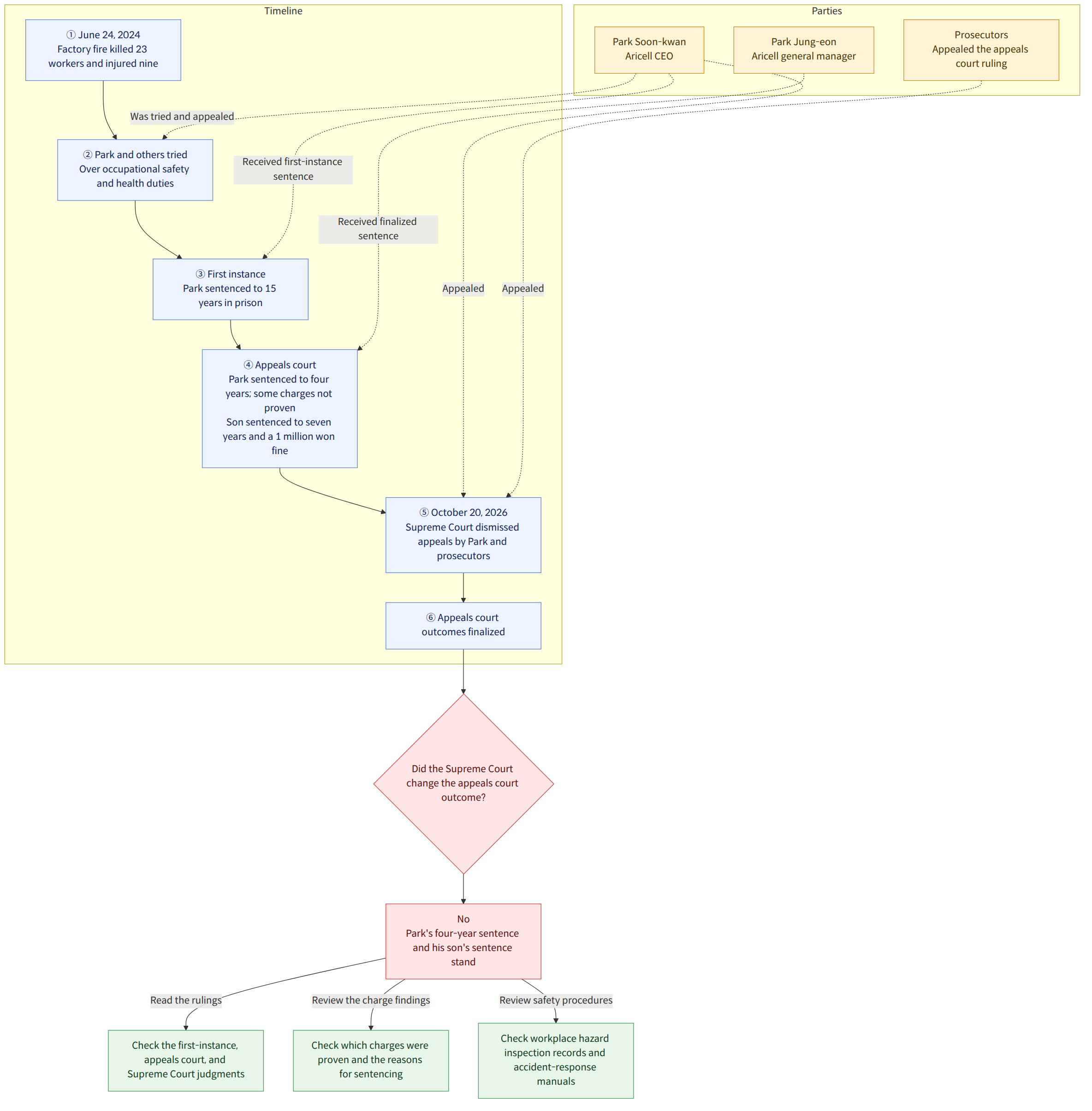
The four-year prison sentence handed down to Aricell CEO Park Soon-kwan in connection with a fire at the company’s factory was finalized on October 20, 2026. The Supreme Court’s First Division dismissed appeals by both Park and prosecutors, upholding the appeals court’s ruling. The appeals court’s sentence of seven years in prison and a fine of 1 million won for Park’s son, Park Jung-eon, Aricell’s general manager, was also finalized as is.
Background and context
The fire occurred on June 24, 2024, at Aricell’s factory in Hwaseong, Gyeonggi Province. Twenty-three workers died and nine were injured. Park and others were put on trial on charges of violating their duty to ensure occupational safety and health, including by failing to inspect workplace hazards and risks and to prepare a manual for responding to serious accidents.
The first-instance court viewed Park as the person responsible for management and therefore subject to punishment under the Serious Accident Punishment Act (중대재해처벌법), and sentenced him to 15 years in prison. However, the appeals court overturned the first-instance ruling and reduced Park’s sentence to four years in prison. According to reports, it found him not guilty of some charges and took factors including a settlement with the victims’ families into account in determining the sentence. The Supreme Court accepted the appeals court’s decision and finalized the sentence.
What this news means
The final ruling has drawn attention because it finalized the outcome of criminal punishment imposed on an individual company head in connection with a factory fire. In particular, the case addressed charges of violating the duty to ensure occupational safety and health, and the large difference between the sentences imposed by the first-instance and appeals courts shows that the assessment of individual charges and the appeals court’s reasons for determining the sentence can affect the outcome. However, this ruling alone does not mean that the responsibility of every company or executive will be determined in the same way.
For example, executives who operate workplaces can review records and procedures to see how checks for hazards and risks and the preparation of accident-response manuals relate to the duty to ensure occupational safety and health at issue in this case. This is an example related to the charges reported in this case; the legal obligations and responsibilities of individual workplaces may vary depending on the specific facts.
Relevant systems and support information
According to the in-house legal guide L1, imprisonment is a sentence under which a person is held in a correctional facility and required to perform labor. Accordingly, “four years in prison” as reported in this case refers to the type and duration of the sentence. Based only on the article provided, it is not possible to state more specifically which legal provisions were used to determine each charge or what procedures apply to the execution of the sentence.
L1 explains that a reduction in a sentence or exemption from its execution cannot be assumed to be automatic based on certain circumstances alone. In this case, reports say the appeals court found Park not guilty of some charges and took factors including a settlement with the victims’ families into account, but they do not give a detailed account of the specific legal reasoning behind the Supreme Court’s dismissal of the appeals.
What is confirmed and what remains unknown
Confirmed facts
- The four-year prison sentence for Park Soon-kwan, CEO of Aricell, was finalized.
- The Supreme Court’s First Division dismissed appeals by both Park and prosecutors.
- The fire at Aricell’s factory occurred on June 24, 2024, killing 23 workers and injuring nine.
- The sentence of seven years in prison and a fine of 1 million won for Park’s son, general manager Park Jung-eon, was also finalized.
- The appeals court found Park not guilty of some charges and reduced his sentence for reasons including a settlement with the victims’ families.
What remains unknown
- What specific legal grounds did the Supreme Court cite when dismissing the appeals?
- What was the specific scope of the charges found proven and not proven by the appeals court?
- What are the detailed procedures related to the execution of the sentence?
What readers should check
- Those seeking details of the ruling should consult the first-instance and appeals court judgments and the Supreme Court decision, distinguishing the findings on each charge from the reasons for determining the sentences.
- For workplace safety management, readers can check records of inspections for hazards and risks and whether accident-response manuals have been prepared and put into operation.
- The fact that “the sentence has been finalized” should be distinguished from details about its execution. It is important not to treat execution procedures or additional measures not mentioned in the article as confirmed facts.
If you are dealing with a similar issue, attorney Ji-sun Ahn of Ijun Law Firm can review the timeline of the incident, who was responsible for safety, and any incident reports or treatment records with you. These details can help clarify which options apply to your situation.
References
- Guide to Types of Criminal Punishment and Sentence Reduction and Enforcement
- Other coverage consulted: hani.co.kr

















