
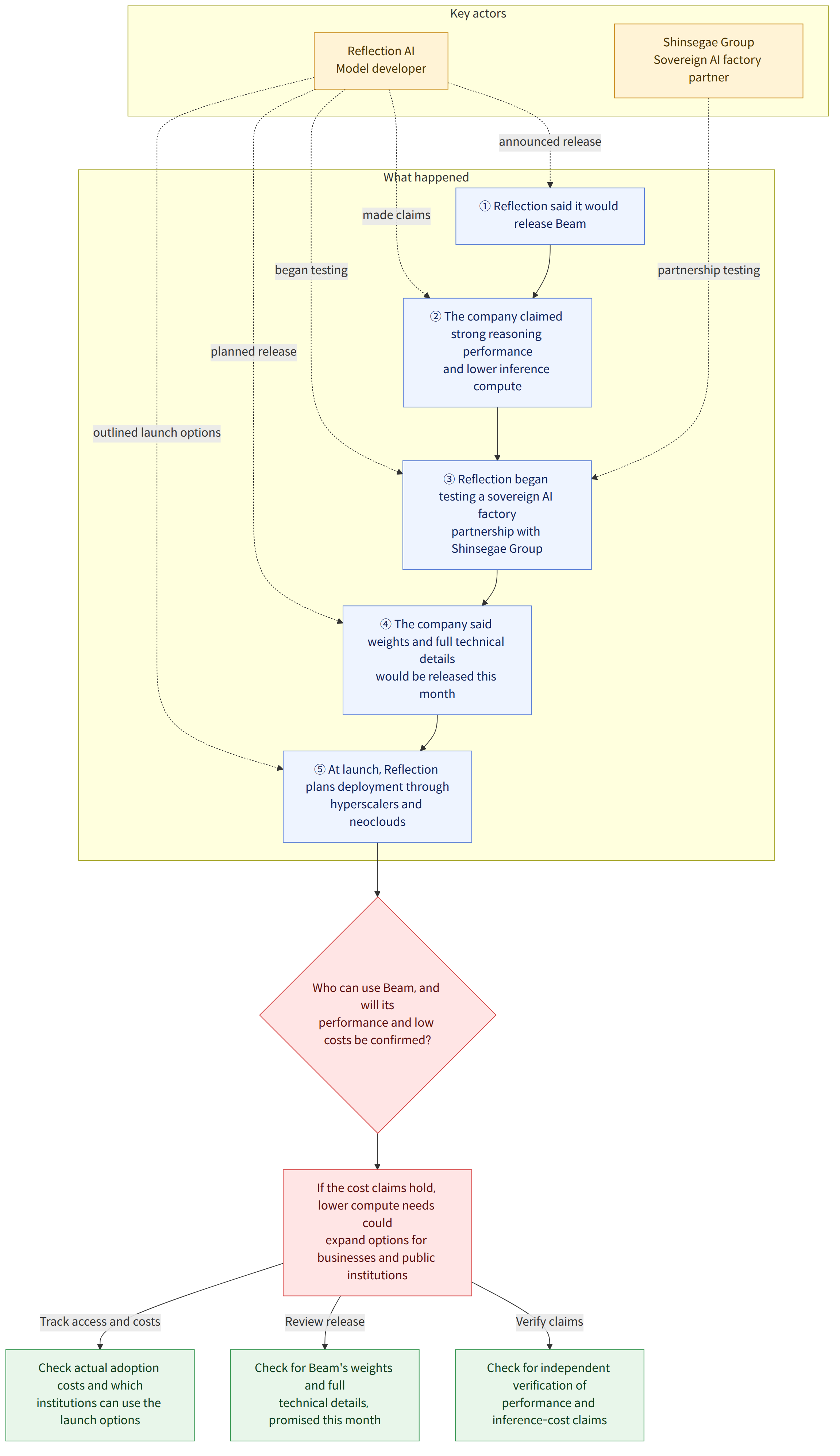
Brooklyn-based startup Reflection AI, now in its second year, said it would release its first frontier open-weight AI model, Beam. Open weights means making a model’s weights—the internal values determined through training—available for others to use. Reflection claims Beam performs comparably to leading Chinese open models on advanced reasoning benchmarks while using far less inference compute. These performance and cost claims, however, have not been independently verified.
Background and context
According to information released by Reflection, Beam is a text-only mixture-of-experts (MoE) model. MoE refers to an architecture that processes information using some of several specialized submodels. The company says it trained the model with high-compute reinforcement learning to perform well on reasoning, coding and agent tasks.
Beam is a model with 501 billion total parameters, of which 23 billion are active. It was pretrained on 23.8 trillion tokens and has a 1-million-token context window—the range of input it can consider at one time. Z.ai’s GLM-5.2, presented as a comparison, has about 744 billion total parameters, of which 40 billion are active.
Reflection claims Beam is on par with GLM-5.2 on advanced reasoning benchmarks and scores higher than current leading Western open models while using 3–4 times less inference compute. In another comparison presented by the company, Beam scored higher than Inkling on the four coding tests for which both models published results. Inkling, however, is a multimodal model—that is, it handles multiple types of information beyond text—while Beam is text-only, so the two models do not have the same uses or input range.
Beam’s performance and inference-cost claims have not yet been independently verified. Benchmark results presented by the company alone are not enough to establish how the model will perform or what it will cost in real-world services.
Reflection describes Beam as a “workhorse model” for businesses, the public sector and developers. The release aligns with the company’s plan to introduce a Western model that can compete with Chinese open models. However, the weights and full technical details—the key information needed to assess the model’s performance—are among the materials the company says it will release this month.
Reflection was founded in 2024 by two former Google DeepMind researchers. According to PitchBook, it has raised about $4.7 billion from investors including Nvidia, Sequoia Capital and Lightspeed Venture Partners, and was valued at $25 billion pre-money in its most recent funding round. This summer, the company signed contracts worth more than $7 billion combined with SpaceX and Nebius, giving it access to Nvidia GB300 chips through 2029.
What this means
If Beam’s open weights and low inference-cost claims are borne out, the range of options available to businesses and public institutions that want to use models directly could expand. Reflection’s “AI factory” concept is designed to let institutions train Reflection models on their own proprietary data and build customized local AI systems. The idea is attracting attention because lower model-use costs or compute requirements could reduce the burden on institutions considering such systems. This is a potential impact if the company’s cost claims are substantiated, not an established outcome.
For example, an institution considering an AI system based on its own data could assess the performance and compute requirements for its environment after Beam’s weights and technical documentation are released. But the actual cost of adoption and deployment terms have not been disclosed. It is therefore not possible to conclude that the claim of using less compute will automatically translate into lower adoption costs.
Reflection has begun testing a concept for a sovereign AI factory partnership with Shinsegae Group. According to Axios, hedge funds and trading firms have also expressed interest in building such systems. The company says it will release Beam’s weights and full technical details this month and, at launch, offer deployment through hyperscalers and neoclouds, as well as integration with open-source libraries. What institutions will actually be able to use the model, and how, is therefore the next thing to watch.
What is confirmed and what remains unknown
Confirmed
- Reflection said it would release its first frontier open-weight model, Beam.
- Beam is a text-only model with 501 billion total parameters, of which 23 billion are active.
- The model was pretrained on 23.8 trillion tokens and has a 1-million-token context window.
- The company has begun testing a concept for a sovereign AI factory partnership with Shinsegae Group.
Still unknown
- It is not yet known how Beam’s performance and inference-cost claims will hold up under independent verification.
- The company has not specified exactly when this month it will release the weights and technical documentation.
- Details of how the test with Shinsegae Group is being conducted have not been disclosed.
- Beam’s actual pricing and deployment terms have not been revealed.
What readers should watch
- Businesses and developers evaluating the model should review the benchmark conditions, the basis for the inference-compute comparison and results relevant to their own work after the weights and technical documentation are released.
- Institutions considering adoption should check not only whether deployment through hyperscalers and neoclouds is available, but also whether actual pricing and terms of use are disclosed.
- Those interested in AI systems that use their own data can look for details on the approach and scope of the test concept with Shinsegae Group.