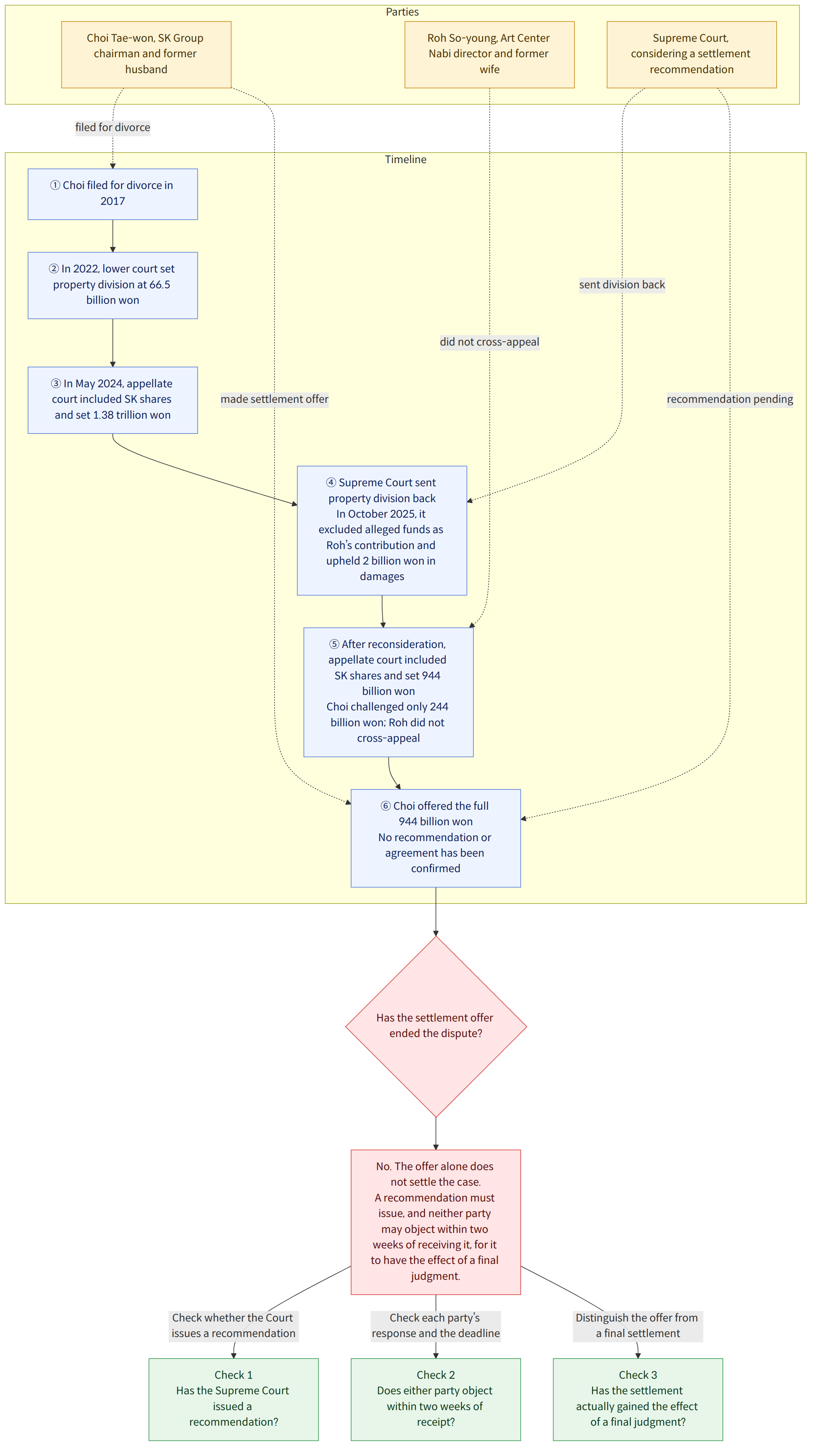
SK Group (SK그룹) Chairman Choi Tae-won has asked the Supreme Court (대법원) to recommend a settlement with his former wife, Roh So-young, director of Art Center Nabi (아트센터 나비), offering to pay the full 944 billion won in property division. Choi’s side said the offer was intended to end the long-running dispute, but added that it did not mean the case had been resolved.
Even if the Supreme Court recommends a settlement, either party may object within two weeks of receiving the decision. The settlement has the same legal effect as a final judgment only if neither party objects. The parties have therefore not yet reached a settlement; they are waiting to see whether the court will make a recommendation and how the parties will respond.
Background and context
The dispute began in 2017, when Choi filed for divorce against Roh. The two married in 1988. The property division dispute has centered on whether Choi’s SK shares can be considered property the couple acquired together.
In 2022, a lower court treated the SK shares as Choi’s personal property and ordered him to pay Roh 66.5 billion won in property division. In May 2024, the appellate court included the shares in the property subject to division and increased the payment to 1.38 trillion won. The Supreme Court later sent the property division case back to the appellate court.
The second source says that in October 2025, the Supreme Court ruled that even if slush funds linked to Roh’s father, former President Roh Tae-woo, had flowed to SK Group, they could not be considered a contribution by Roh to the formation of the property. It says the court upheld 2 billion won in damages and sent back only the property division ruling for reconsideration. After reconsidering the case, the appellate court ruled in July that Choi’s SK shares were subject to division and set the payment at 944 billion won.
According to the second source, Choi appealed the appellate court’s ruling but narrowed the scope of his challenge: he stopped contesting 700 billion won and maintained his objection only to the remaining 244 billion won. Roh did not cross-appeal the parts of the ruling that were unfavorable to her. Choi’s settlement offer is to pay the entire proposed amount, but neither Roh’s agreement nor a court recommendation has been confirmed.
What this news means
If a settlement is recommended and neither party objects, the property division dispute could be concluded through a process with the same legal effect as a final judgment. Conversely, if either party objects within the specified period, the conditions for the settlement to become final will not have been met. It is important to distinguish Choi’s stated willingness to pay the full amount from whether the case has actually ended.
This distinction matters to the parties. If the offer is accepted, the long-running legal dispute over property division could end, but the dispute could continue if either party objects or the Supreme Court does not recommend a settlement. For example, if Roh objects after receiving the decision, the condition for the settlement to have the same legal effect as a final judgment will not be met. The parties’ actual responses and how the proceedings unfold will determine what happens.
Related systems and support information
Property division is a claim separate from damages. Property the couple effectively acquired together may be subject to division even if it is registered in only one spouse’s name. Courts consider various factors, including each spouse’s contribution to acquiring, maintaining and increasing the property, as well as the length of the marriage. Household labor can also be taken into account as a contribution to the property.
As the differing rulings in the lower court and appellate court in this case show, whether property is subject to division cannot be determined solely by whose name it is registered under. Evidence showing how the property was acquired and each party’s contribution may be at issue. An in-house legal guide says that if it is difficult to determine what property the other party has, a person can apply to the Family Court (가정법원) for an asset disclosure or asset inquiry.
According to the guide, the right to claim property division may expire two years after the date of divorce, so anyone considering making a claim after divorce should check the deadline. This is general information for readers in similar situations about matters they may want to consider regarding their rights; it is separate from the settlement process in this ongoing case.
If you are considering property division, you can review documents showing how the property was acquired and maintained, along with the judgment or court decision, with attorney Ji-sun Ahn of Ijun Law Firm and identify what issues may arise from your own marriage and circumstances surrounding the formation of the property.
Points reported differently by the sources
The two sources agree that the offer is for 944 billion won, but describe differently which court ordered that amount to be paid. One source says it was the amount ordered by a lower court, while the other says it was set by the appellate court in July after the Supreme Court sent the case back. The second source also gives the history of the property division awards: 66.5 billion won in the lower court in 2022 and 1.38 trillion won in the appellate court in 2024.
What is confirmed and what remains unknown
Confirmed facts
- Chairman Choi asked the Supreme Court to recommend a settlement and offered to pay the full 944 billion won in property division.
- Choi’s side said the offer was intended to end the dispute and stated that the offer alone did not mean the case had ended.
- A party receiving a settlement recommendation may object within two weeks of receiving the decision; if there is no objection, the settlement has the same legal effect as a final judgment.
- It has not been confirmed whether Roh So-young agrees to the offer or whether the Supreme Court will recommend a settlement.
What remains unknown
- It is not known whether Roh will agree to the offer or object.
- It is not known whether the Supreme Court will actually recommend a settlement.
- The course of the proceedings has not been determined; it will depend on whether either party objects.
What readers can check
- In a similar property division situation, readers can check not only whose name the property is registered under, but also evidence of how it was acquired, maintained and increased, and of each party’s contribution.
- If it is difficult to determine what property the other party has, readers can check whether they can apply for an asset disclosure or asset inquiry.
- Anyone considering a property division claim after divorce should check the two-year deadline related to the expiration of the right to claim, measured from the date of divorce.