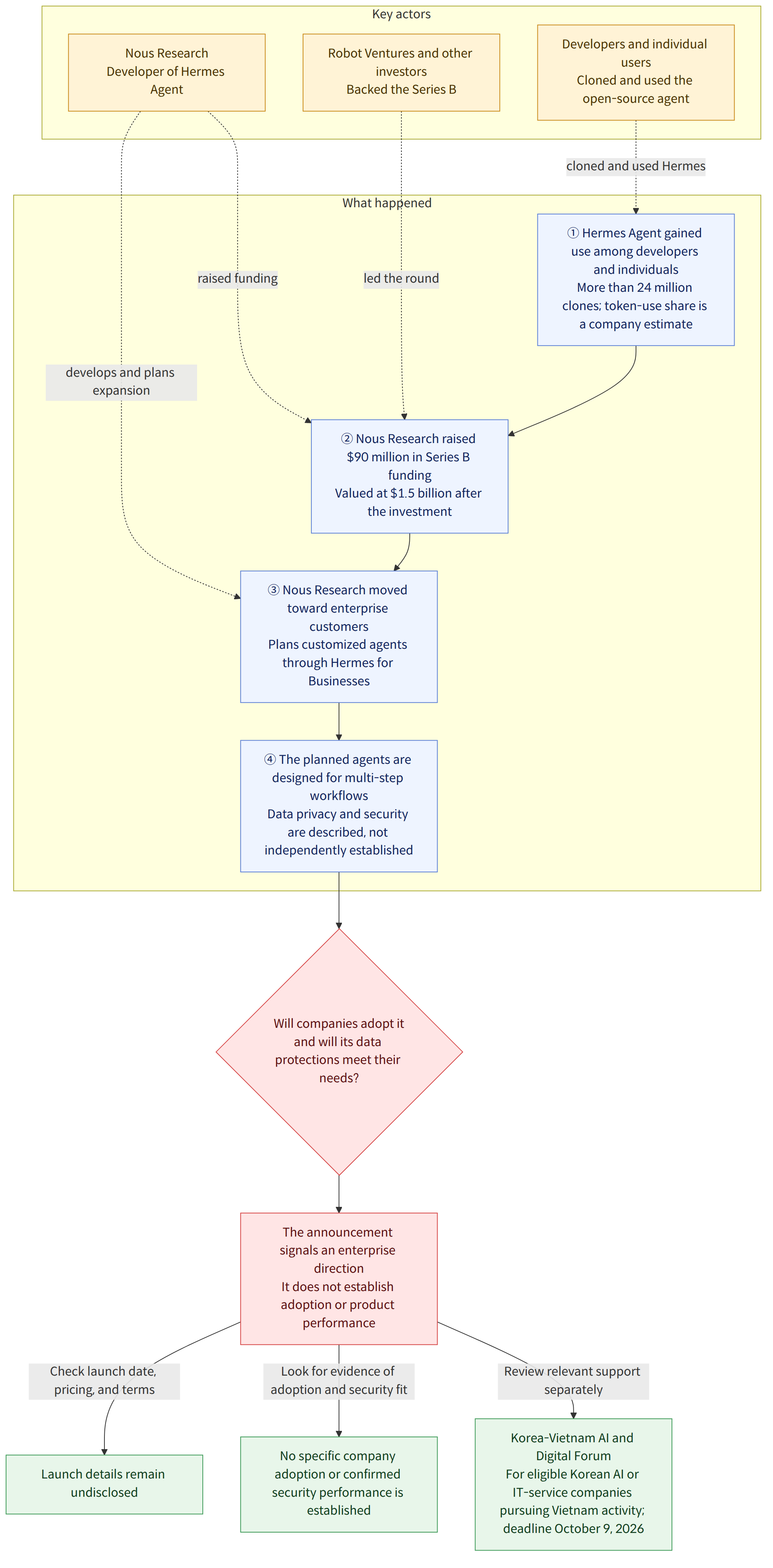
Nous Research, developer of the open-source Hermes Agent, has raised $90 million in a Series B round and is moving into the enterprise market. The company was valued at $1.5 billion after the investment. It plans to launch “Hermes for Businesses,” which will allow companies to deploy customized AI agents.
The round was led by Robot Ventures, with participation from Nvidia, Union Square Ventures, Menlo Ventures, Samsung, 1789 Capital and others. Donald Trump Jr. is a partner at 1789 Capital. With this funding, the three-year-old Nous Research has raised a total of $158 million.
Background and context
Hermes Agent is an open-source agent that has gained popularity among developers and individual users. The original article says the product has been cloned more than 24 million times and, according to the startup’s estimate, accounts for about 2.5% of global AI token usage. The number of clones is not the same as the number of users, and the share of token usage is also a company estimate; neither figure can be interpreted as the number of enterprise customers or the company’s share of revenue.
The central aim of this expansion is to offer an open-source product that users have been using themselves in a form tailored to enterprise work. According to the article, the enterprise agent is designed to handle multi-step workflows and keep company data private and secure. That description alone, however, does not confirm actual security performance or adoption by any specific company.
There have also been reports about revenue. According to The Wall Street Journal, Nous Research had annualized revenue of about $36 million in mid-September 2026 and expected it to exceed $100 million by the end of 2026. These are figures and projections reported by the publication; they do not mean that revenue from the enterprise product or future performance has been confirmed.
What this news means
Nous Research is targeting enterprise customers with an open-source agent that is already used by developers and individual users. If the enterprise product supports the deployment of customized agents and the handling of multi-step workflows, attention may shift from whether an agent can be used to whether it can be configured for actual business processes. However, the article does not establish whether companies will adopt the product or whether its data-protection design will meet each company’s requirements.
The size of the investment and the company’s valuation show the financial backing available for expansion, but they do not by themselves demonstrate market performance. Similarly, the clone count and token-usage estimate are indicators cited by the company to show that Hermes Agent is being widely cloned and used. Individual users and enterprise customers may have different needs and requirements, so these figures alone are not enough to conclude that there is demand in the enterprise market.
For example, if a company wants to assign repetitive, multi-step tasks to an agent, the descriptions of customization and data privacy and security could be relevant to its adoption review. But there is no publicly available evidence on when that company would actually be able to use the product, its price or its terms of use. This announcement therefore indicates the direction of the enterprise business, not confirmed adoption results.
Related programs and support information
The internal materials contain no support program directly related to Nous Research’s investment or Hermes for Businesses. However, companies pursuing AI or IT businesses in South Korea may separately review the announcements below, depending on their stage of development, location and plans for overseas expansion. The materials do not establish whether the company in question meets the eligibility requirements.
- Recruitment of Companies for the Korea-Vietnam AI and Digital Forum (한국-베트남 AI·디지털 포럼 참가기업 모집) (G3): Open to Korean companies in AI- and IT-service-related fields that are pursuing or planning activities in Vietnam. Support includes a standard booth, business matchmaking, translation of exhibition materials, an MOU-signing ceremony and temporary office space. The application deadline is October 9, 2026.
- Seoul Startup Center Gwanak × SK ecoplant Open Innovation (서울창업센터 관악 × SK에코플랜트 오픈이노베이션) (G4): Open to startups located in Seoul that have been in operation for no more than seven years; a limit of no more than 10 years applies in new-industry fields. Applicants must have ideas or implementation technology related to the program’s recruitment themes in semiconductors, AI or robotics. Support includes KRW 10 million per company for PoC commercialization, joint technology development and PoC implementation, and links to commercialization. The application deadline is October 10, 2026.
These are separate programs for Korean companies. There is no confirmation that Nous Research meets eligibility requirements such as the target region or location, and interested companies should check the detailed requirements and application procedures in the announcements.
What is confirmed and what remains unknown
Confirmed facts
- Nous Research develops the open-source Hermes Agent and was valued at $1.5 billion after raising $90 million in a Series B round.
- The round was led by Robot Ventures, with participation from Nvidia, Union Square Ventures, Menlo Ventures, Samsung, 1789 Capital and others.
- The company has raised a total of $158 million, and Hermes Agent has been cloned more than 24 million times.
- By the company’s estimate, Hermes Agent accounts for about 2.5% of global AI token usage.
- The company is pursuing “Hermes for Businesses”; its enterprise agent is intended to handle multi-step workflows and keep data private and secure.
What remains unknown
- No publicly available evidence specifies the launch date, pricing or terms of use for Hermes for Businesses.
- The amounts contributed by individual investors in the Series B round are unknown.
- The original article does not say whether any customers have actually adopted the enterprise product, what the adoption results have been or what the security design specifically entails.
What readers should check
- Companies considering the enterprise product should check whether official details are released on the launch schedule and pricing, as well as the scope of customization, data handling and protection, and terms of use.
- Korean AI and IT service companies planning to expand into Vietnam can check the eligibility requirements for G3 and its October 9, 2026 deadline.
- Early-stage startups located in Seoul can check G4’s location, years-in-operation and recruitment-field requirements and, if eligible, prepare for the October 10, 2026 application deadline.