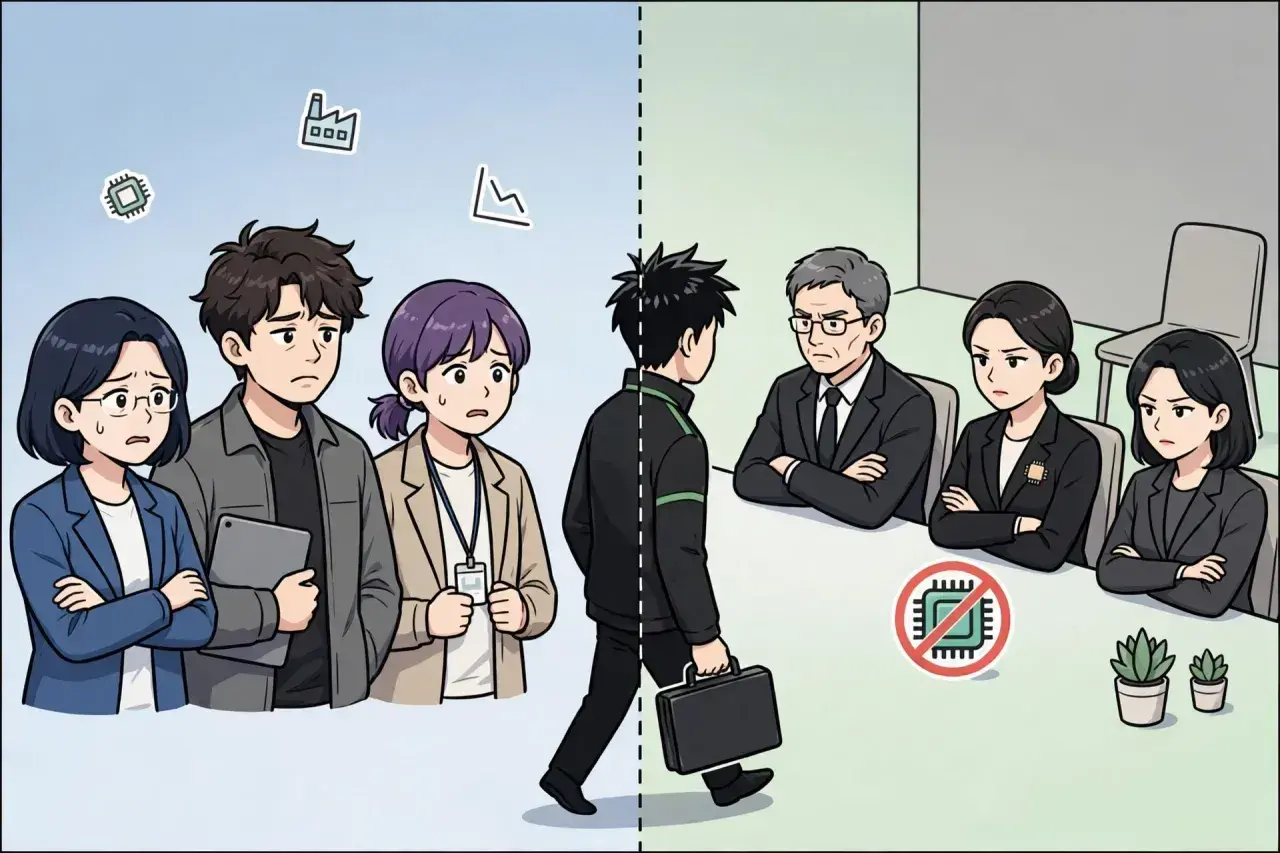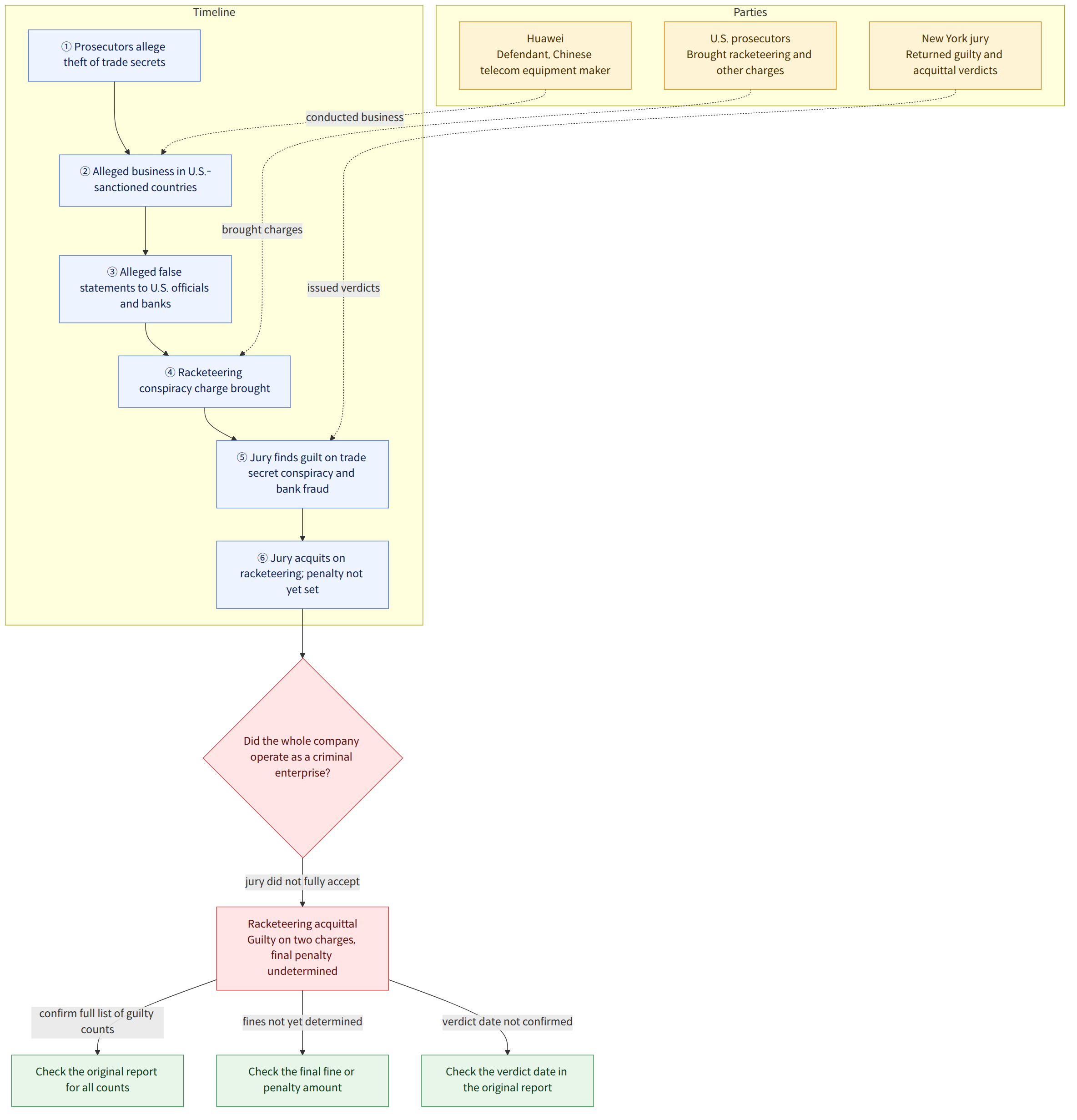
In New York, a U.S. jury returned guilty verdicts against Huawei Technologies, the Chinese telecommunications equipment company, on charges of conspiring to steal trade secrets and defrauding banks. However, the jury acquitted the company of racketeering conspiracy, the most serious charge brought against Huawei.
The verdict shows that in corporate crime cases, judgments can diverge charge by charge.
Background and Context
Huawei has grown into one of the world's largest suppliers of wireless communications network equipment. Prosecutors applied racketeering conspiracy charges, which are commonly used in organized crime and drug cases, arguing that Huawei unlawfully sought to obtain the intellectual property and technology secrets of competitors and business partners.
The guilty verdicts included charges that the company conducted business in countries subject to U.S. sanctions, including Iran and North Korea, and charges that it made false statements to U.S. government officials and banks to conceal its misconduct. The original report states that Huawei potentially faces fines of billions of dollars.
Huawei's attorney called the acquittal on the racketeering conspiracy charge a "profound rejection" of the government's narrative portraying the entire company as corrupt. This statement reflects Huawei's interpretation. The original report does not explain in detail why the jury reached its acquittal.
What This News Means
The outcome is notable because the jury did not fully accept the government's argument that the company as a whole operated like a criminal organization.
For example, if a South Korean company continued transactions with an overseas trading partner without adequately checking whether that partner was subject to sanctions, and then gave banks explanations that were not accurate, issues similar to those in this case could arise. However, this is a hypothetical scenario, and actual liability depends on the facts and on the laws of each country.
Related Systems and Support Information
The original case was decided by a U.S. court, so the following is provided only as a reference for understanding South Korean legal standards. According to the internal legal guide (사내 법률 가이드) (L1), the key question under the South Korean Criminal Act (형법) for fraud is whether a person deceived another into a mistaken belief and thereby obtained property or financial benefit. In the case of loan fraud, the standard is whether the borrower had the intent and ability to repay at the time of borrowing. The mere fact that the money was not repaid later does not automatically establish fraud.
The same material explains that if a person knew of facts that the other party would have considered decisive in deciding not to transact and did not disclose them, fraud by breach of the duty to disclose may arise depending on the specific circumstances. It also explains that extortion is a crime in which a person obtains property or financial benefit by intimidating the victim with threats, and that it is necessary to examine whether the victim made a disposition of property as a result.
Regarding infringement of intellectual property, the internal legal guide (L2) is a useful reference. This material covers infringement of copyright, trademarks, and patents. It advises that even when infringement is suspected, one should consider legal remedies prescribed by law, such as provisional injunctions, rather than forcing the other party to cancel a contract or remove products. It also notes that in cases of trademark infringement, damages can be calculated based on factors such as the infringer's profits. However, this material does not directly address trade secret theft, so it is difficult to apply directly to the issues in this case.
Differences Among Reports
Because only one source was confirmed, no differences among reports could be verified.
Confirmed Facts and Unknowns
Confirmed Facts
- In New York, a U.S. jury returned guilty verdicts against Huawei on charges of conspiracy to steal trade secrets and bank fraud.
- The jury acquitted the company on the most serious charge, racketeering conspiracy.
- The guilty charges included business conducted in U.S.-sanctioned countries, including Iran and North Korea, and false statements to U.S. government officials and banks.
- Huawei potentially faces fines of billions of dollars.
Unknowns
- The complete list of charges on which the jury found guilt, and the exact number of guilty verdicts, cannot be confirmed from the original report.
- The amount of fines or other penalties ultimately imposed on Huawei is unknown.
- The exact date of the verdict cannot be confirmed from the original report.
What Readers Should Check
- It is advisable to review the full original report directly to examine the list of guilty charges and the number of verdicts.
- For companies engaged in overseas transactions, it is helpful to check whether trading countries are subject to sanctions and to review records of explanations submitted to banks.
- If you are asserting intellectual property infringement, or have received such a claim, it is advisable to first consider the legal remedies outlined in the internal guide (L2), rather than demanding contract cancellation or removal.