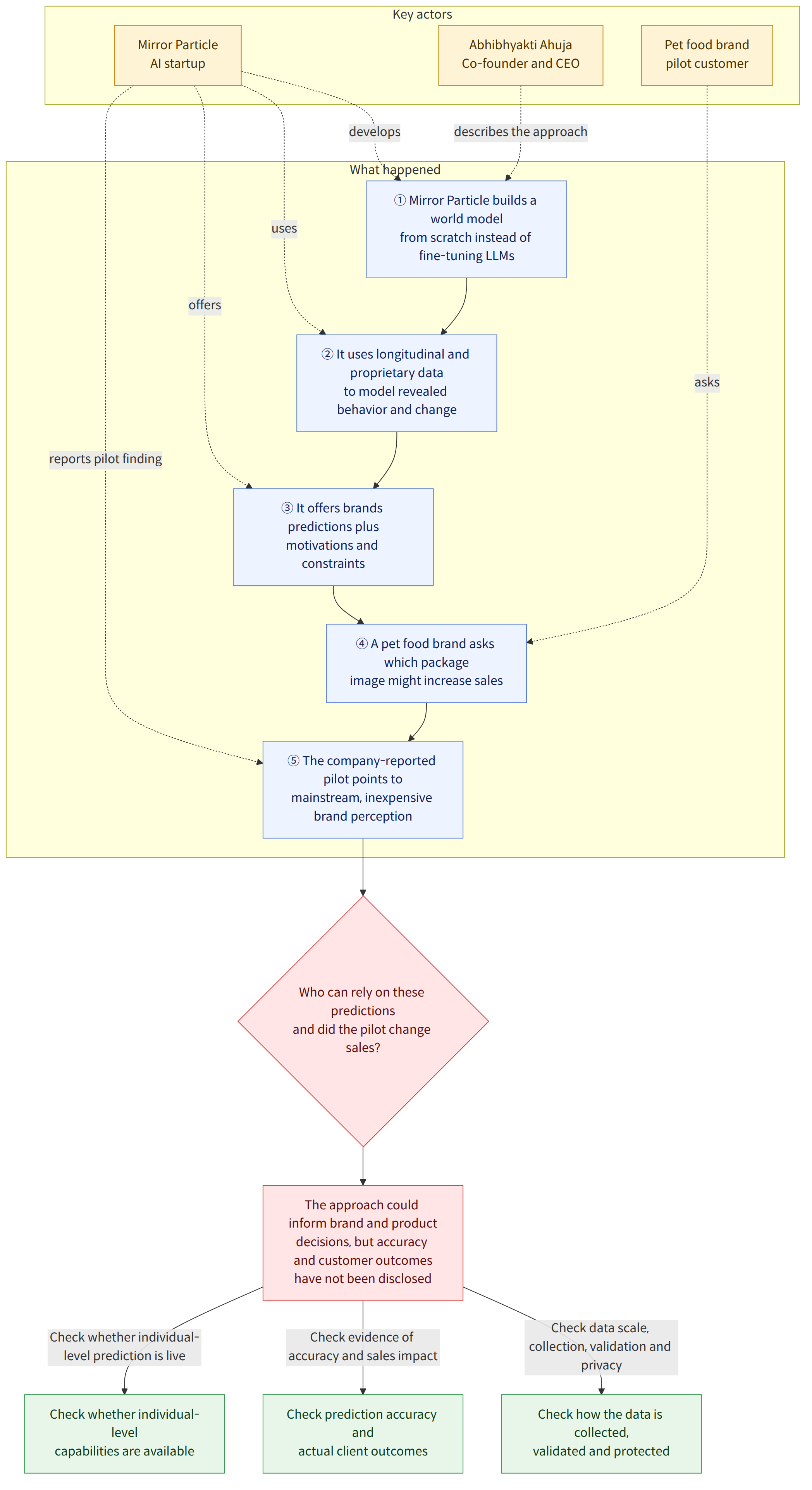
San Francisco-based startup Mirror Particle is developing its own “world model” and offering brands an AI engine to predict consumer behavior and the reasons behind it. Co-founder and CEO Abhibhyakti Ahuja argues that large language models (AI trained on vast amounts of text to process language) have fundamental limitations when it comes to predicting human behavior. Rather than fine-tuning language models, the company’s approach is to build a foundation model (a core AI model designed for use across a range of applications) from scratch to simulate, over time, what people do and why they change their behavior.
Background and context
Investment and product launches are continuing among AI companies seeking to predict human behavior. According to the article, Simile raised $200 million at a $2 billion valuation over the past year, while Aaru raised $88 million at a $1 billion valuation. Humans& announced a $480 million seed round at a $4.48 billion valuation in January, then launched Persimmon, a product for modeling human behavior.
Alongside these companies, a key competitive question is what data to use and how to represent people. Ahuja says existing approaches rely on assigning large language models the role of a specific demographic group or training them further, but argues that the language on which models are primarily trained is not the same as human perception, spatial understanding or social intelligence. This is the company’s critique; the article does not present a direct comparison of the performance of existing language models and Mirror Particle’s model.
Mirror Particle says it models people not as a set of fixed traits, but as individuals who change through experience. According to Ahuja, the company uses longitudinal data (information collected by observing the same subjects or groups over time) to track how people change, what triggers those changes and how much they change. The company also treats the absence of change as a signal, he said.
The company’s proprietary data includes customer data, current affairs, popular culture and social media. It combines these sources to model specific demographic groups and focuses on what people actually do—“revealed behavior”—rather than what they say in surveys. The article does not, however, specify the size of the data, how it is collected or validated, or what privacy protections are in place.
What this news means
Mirror Particle’s claimed differentiator is that it provides customers not only with behavior predictions, but also with the motivations and constraints behind the behavior and the context for its recommendations. The idea is to help brands move beyond asking what a consumer will choose and examine what factors might prevent or encourage that choice, then incorporate those insights into decision-making. To win early customers, the company is focusing on areas with existing budgets, such as market research and brand and product strategy.
An early pilot shows how this approach might be used. A well-known pet food brand asked whether it should put an image of chicken, beef or vegetables on its packaging to increase sales. Mirror Particle concluded that the problem was not the image, but the perception that the brand was mainstream and inexpensive, and that sales could stagnate if that perception did not change. This is a pilot result reported by the company; the article does not say how sales actually changed after the analysis.
For example, if a brand is considering which image to use in an advertisement for a particular product, this approach might look beyond asking which image people prefer and examine whether the target group wants the product itself, as well as whether perceptions or constraints are keeping them from buying it. However, it cannot be assumed that such analysis will improve sales. The article provides no figures that would establish the accuracy of Mirror Particle’s model’s predictions or the results achieved by its clients.
Ahuja said the model would develop in a way that resembles how a baby learns about the world, progressing from vision to language, bodily awareness and social intelligence. The company’s long-term vision is to move from broad demographic analysis to individual-level insights and become a general-purpose foundation for predicting human behavior. This is the direction the company has described; it does not mean that individual-level prediction capabilities have already been implemented.
What is confirmed and what remains unknown
Confirmed facts
- Mirror Particle is a two-year-old startup that offers brands an AI engine to predict consumer behavior and the reasons behind it.
- The company says it combines customer data with current affairs, popular culture, social media and other sources, and focuses on actual behavior rather than survey responses.
- In an early pilot, it attributed stagnant sales for a pet food brand to brand perception, rather than the packaging image.
- The company said it had raised an angel round and was close to closing its first venture round.
- The article says the company is scheduled to participate next week in the Startup Battlefield 200 at TechCrunch Disrupt, which will take place in San Francisco from October 13–15, 2026.
What remains unknown
- The amount raised in the angel round and the investors have not been disclosed.
- The size and final terms of the first venture round, which the company said was close to closing, are unknown.
- The article does not provide the model’s prediction accuracy, comparisons with existing approaches or actual results for customers.
- The specific sources of the data and how it is processed and protected have not been provided.
What readers should check
- If considering a tool like this for brand or product strategy, readers should examine not only the recommendations but also the behavioral data behind them and the explanations of motivations and constraints.
- Given the company’s premise that survey responses can differ from actual behavior, readers can ask what data and validation procedures underpin its predictions.
- The funding news confirmed here is the company’s statement that it raised an angel round and is close to closing its first venture round. Whether specific investment amounts and terms are disclosed should be checked separately.