

1. A Human Story
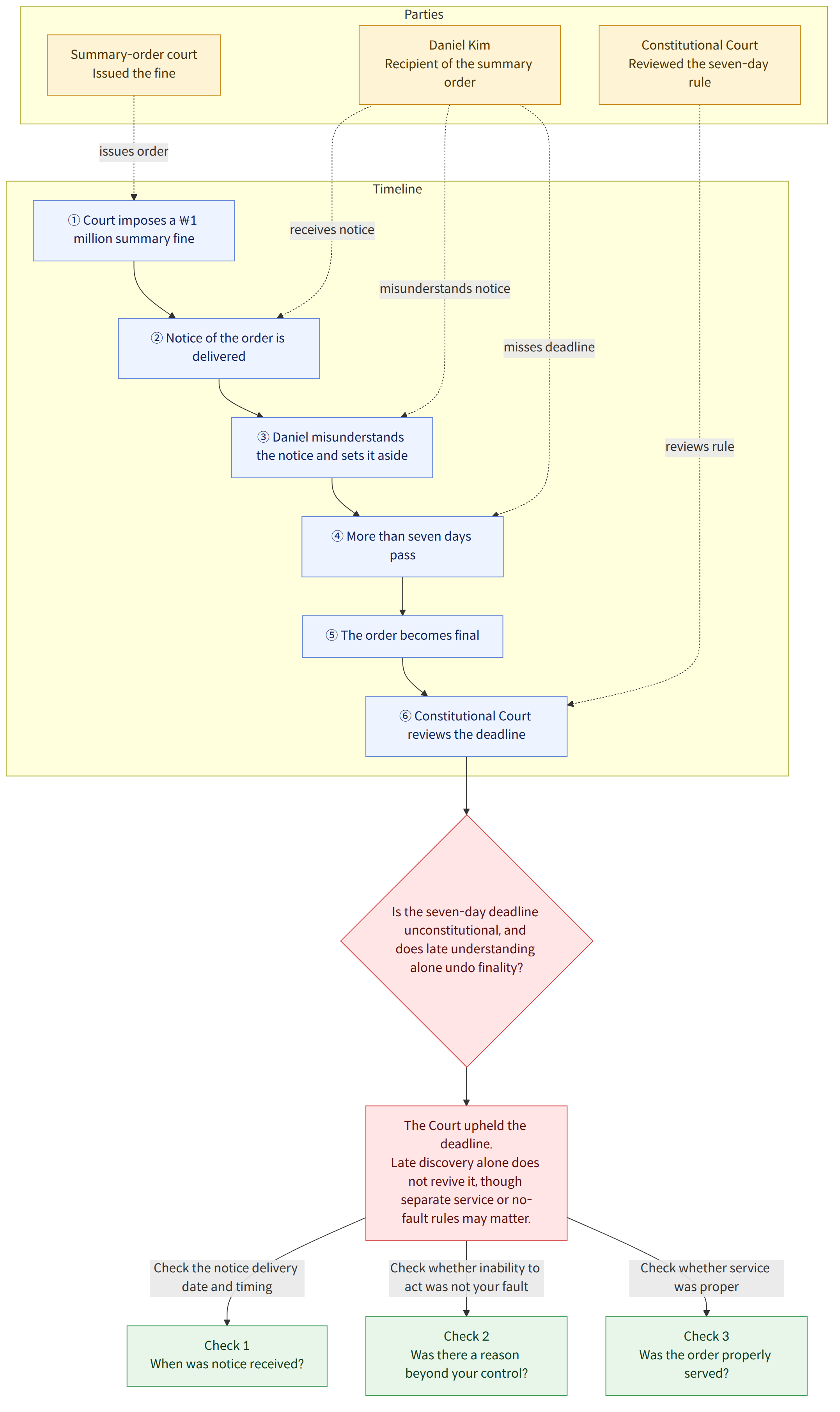
Daniel Kim had expected a quiet evening. Instead, a brief argument outside a neighborhood restaurant turned into a minor assault investigation. Several weeks later, an official notice arrived: a court had issued a summary order imposing a ₩1 million fine. Daniel glanced at the paperwork, assumed it was another notice about the investigation, and put it aside.
By the time he understood that the court had already imposed a penalty—and that he could have asked for a full trial—more than seven days had passed from the notice’s delivery. He then learned that the order had become final. Daniel felt the deadline was unforgiving: how could a person lose the chance to contest a criminal penalty so quickly, especially when he had not understood what the document meant?
2. The Legal Question
Does Korea’s seven-day deadline for requesting a formal trial after a summary order violate the constitutional right to a fair trial or the principle of equality because it is too short?
A second, practical question follows: when the deadline has already passed, can a person’s late understanding of the notice undo the finality of the order?
3. What Korean Law Says
Korean criminal procedure allows certain relatively minor cases to be decided through a summary order. Instead of first holding an ordinary trial, the court can impose a fine or another permitted penalty on the written record. The person who receives the order can ask for a formal trial, where the case is considered through the ordinary court process.
The Criminal Procedure Act sets a short period for making that request:
In substance, Article 453(1) allows the accused or the prosecutor to request a formal trial within seven days of receiving notice of the summary order.
The request is meant to be straightforward. The person does not have to provide detailed reasons for disagreeing when filing it. This matters because the initial step is simply to ask for a trial; the person need not complete a full legal argument within those seven days.
The Constitutional Court has held that the seven-day period does not violate the constitutional right to a trial or the principle of equality. Its reasoning included these points:
- Summary orders are used for relatively minor cases, and resolving them quickly helps courts allocate limited judicial resources efficiently.
- A prompt deadline helps prevent minor cases from remaining uncertain for an extended period.
- Because a formal-trial request need not explain the grounds for challenging the order, the Court considered that deciding whether to request a trial should not ordinarily require extensive time or effort.
There was significant disagreement within the Court: four justices considered the restriction unconstitutional and favored a declaration of constitutional nonconformity. But the Court’s controlling decision upheld the provision.
Missing the deadline does not necessarily answer every procedural question. If a person could not act for a reason that was not their fault, or if there is a genuine problem with whether the order was properly served, separate procedural rules may potentially matter. Whether those rules apply depends on the facts and timing. Late discovery by itself should not be assumed to revive the deadline.
4. How Korean Courts Approach This
Korean courts generally balance two concerns. On one side is the individual’s right to have a criminal accusation examined in a formal trial. On the other is the need to resolve minor cases without leaving them open indefinitely or consuming resources needed for more complex cases.
The Constitutional Court concluded that the seven-day period struck a permissible balance. In its view, the deadline did not make the right to request a trial merely theoretical: the person could file a short request without setting out legal grounds. The Court also treated the efficiency of the summary procedure as a way to support the justice system’s ability to serve the public more broadly.
The Court’s central principle was that a short deadline is not automatically unconstitutional if the process remains practically accessible and the time limit serves a legitimate purpose.
The four dissenting justices saw the constitutional problem differently. Their position underscores that a short deadline can have serious consequences for someone who does not understand the notice. Nevertheless, the Court’s majority ruling means that the seven-day rule remains in force.
5. Applying the Law to Daniel’s Case
Daniel’s situation can be analyzed in several steps.
- The order was a summary order. The court imposed a fine without first holding an ordinary trial. Daniel’s route to challenge that decision was to request a formal trial.
- The seven-day period began with notice. Under the rule upheld by the Constitutional Court, the relevant period runs from receipt of notice of the order. If Daniel received the notice and more than seven days passed, his ordinary opportunity to request a formal trial had expired.
- He did not need to explain his case in the initial request. Daniel might have assumed that challenging the order required preparing a detailed defense first. It did not: the request itself could have been filed without stating the reasons. That feature was central to the Constitutional Court’s conclusion that seven days was not unconstitutionally short.
- His constitutional objection is unlikely to reopen the case. The argument that seven days is inherently too short was considered and rejected by the Court’s majority. The presence of four dissenting justices shows that the question is contested, but it does not change the rule that governs Daniel’s case.
- The notice and the reason for missing the deadline still matter. Daniel should check when and how the order was served and whether the paperwork was delivered in accordance with the applicable rules. If he was genuinely prevented from acting for a reason beyond his control, or if service was defective, he should promptly ask a Korean criminal-law lawyer whether a procedure for restoring the missed deadline or another remedy is available. The fact that he did not understand the document may be relevant to his account, but it does not automatically make the order invalid or restart the seven-day period.
On the facts as described—notice was received, the deadline passed, and Daniel only later understood the document—the constitutional challenge alone would not undo the final order. A separate procedural remedy would require its own legal basis and supporting facts.
If you are dealing with a similar issue, attorney Ji-sun Ahn of Ijun Law Firm can review the provision applied in your case, the ruling or notice you received, and the dates relevant to challenging it with you. These details can help clarify which options apply to your situation.
6. Conclusion: What Happened, and What Should You Do?
Daniel’s fine remains final unless he can establish a separate procedural ground for relief, such as a legally significant defect in service or a qualifying reason, not attributable to him, for missing the deadline. The Constitutional Court’s ruling forecloses the broad argument that the seven-day period is unconstitutional simply because it feels too short. It does not, however, make questions about proper service or exceptional inability to act irrelevant.
For anyone who receives a summary order:
- Check the document and the delivery date immediately. Keep the order, envelope, delivery record, and any messages related to service.
- If you want a formal trial, file the request within seven days. You do not need to wait until you have prepared every argument; the request need not state the reasons for challenging the order.
- If the deadline may have passed, get advice promptly. Ask a Korean criminal-law lawyer to assess service and any no-fault reason for the delay. Do not assume that late discovery alone restores the right to challenge the order.

















