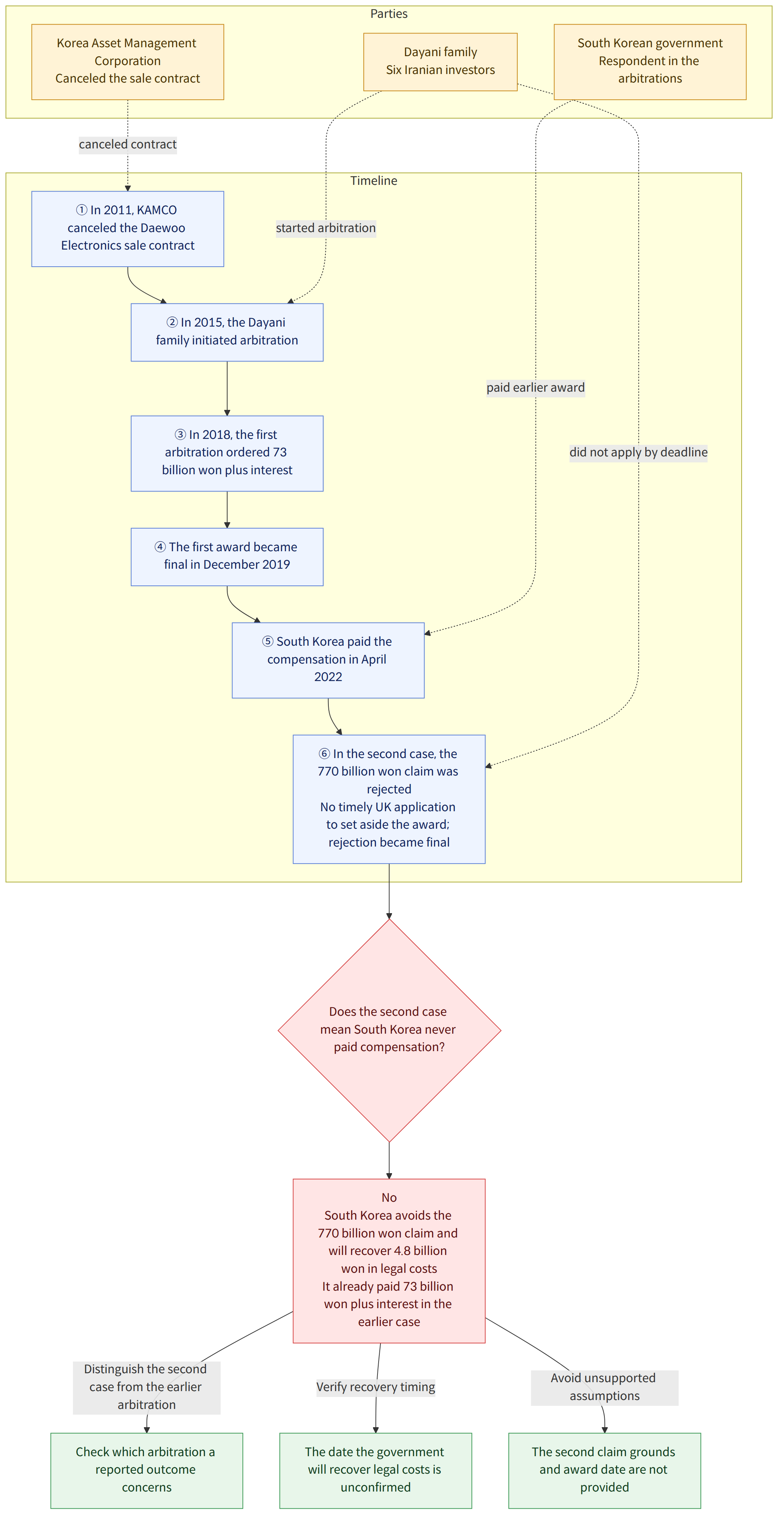
South Korea’s victory was finalized in the second investor-state dispute settlement (ISDS, a process for resolving disputes between foreign investors and states through arbitration) case brought by six members of Iran’s Dayani family. According to the Ministry of Justice (법무부), the Dayani family did not file an application with a UK court within the statutory deadline to set aside the arbitral award rejecting the entire 770 billion won (US$573 million) claim. The government will not have to pay the claim and will recover 4.8 billion won in legal costs.
However, this outcome should not be taken to mean that the South Korean government paid no compensation at all in its dispute with the Dayani family. In an earlier arbitration related to the sale of Daewoo Electronics, which led to this case, South Korea paid compensation and interest.
Background and context
The dispute began when the Korea Asset Management Corporation (한국자산관리공사) canceled a 2011 contract to sell a substantial portion of its stake in Daewoo Electronics to Entekhab. The Dayani family, a major shareholder in the Entekhab Industrial Group, initiated arbitration in 2015.
In a 2018 arbitration, South Korea was ordered to pay the Dayani family 73 billion won plus interest in connection with the failed acquisition of Daewoo Electronics. The award became final in December 2019, and South Korea paid the compensation in April 2022. The victory now finalized concerns a second arbitration, distinct from that earlier proceeding.
What this news means
The government gains two direct outcomes from the final ruling: it is not required to pay the claim of 770 billion won, and it will recover 4.8 billion won in legal costs. There is also a procedural significance: the rejection became final because no application to set aside the arbitral award was filed within the statutory deadline.
However, the fact that South Korea paid 73 billion won plus interest in the earlier arbitration must be considered alongside this victory. In other words, this outcome resolves the second claim; it does not mean the government never paid compensation in any dispute over the cancellation of the 2011 contract. If readers do not distinguish between the two cases, they could mistakenly conclude that “South Korea paid no money to the Dayani family.”
For example, it would be incorrect to assume, based only on the result of this arbitration, that the government will also recover compensation it paid in the past. What has been confirmed is that it will not pay the claim in this case and will recover legal costs, while the compensation from the earlier arbitration has already been paid.
Relevant rules and support information
An internal legal guide explains, in general terms, that a party cannot terminate a contract (end the contractual relationship) whenever it wishes; there must be a contractual provision or a legal ground for termination. In principle, to terminate a contract because of delay in performance, the party must demand performance by setting a reasonable period, and performance must still not be completed during that period. After termination, issues may arise both over the return of what was received and over damages.
However, this guide summarizes general principles for terminating domestic contracts. It does not explain the circumstances in which the Daewoo Electronics sale contract was canceled or the basis for the arbitral award in this ISDS case. It therefore cannot be used to conclude how domestic contract-termination rules applied to that arbitration. It is also important to note that the outcome of an actual contract dispute may depend on the contract’s wording, the circumstances in which it was made, and the parties’ performance.
Confirmed facts and what remains unknown
Confirmed facts
- The entire 770 billion won claim was rejected in the second ISDS case brought by six members of the Dayani family.
- The Dayani family did not apply to a UK court to set aside the arbitral award within the statutory deadline.
- The Ministry of Justice said the rejection had become final and that the government was not required to pay the claim.
- The government will recover 4.8 billion won in legal costs.
- In the earlier 2018 arbitration, South Korea was ordered to pay 73 billion won plus interest, and it paid the compensation in April 2022.
What remains unknown
- The date of the second arbitral award is not provided in the reporting available here.
- The specific grounds for the Dayani family’s claim in the second arbitration were not provided.
- The actual date when the legal costs will be recovered has not been confirmed.
What readers should check
- If you are considering terminating your own contract, check what grounds and procedures for termination are set out in the contract.
- If the termination is based on delay in performance, review the demand for performance, the period given, and any records showing whether the other party performed.
- Since restitution or damages may remain at issue after a contract is terminated, it may be helpful to review the termination notice and records of the contract’s performance separately.
If you are dealing with termination of your own contract, you should review the termination clause, any demand for performance or notice of termination sent to the other party, and the actual record of performance together. Reviewing these materials with a attorney Ji-sun Ahn of Ijun Law Firm may help you understand how the termination process and issues of restitution and damages relate to your situation.