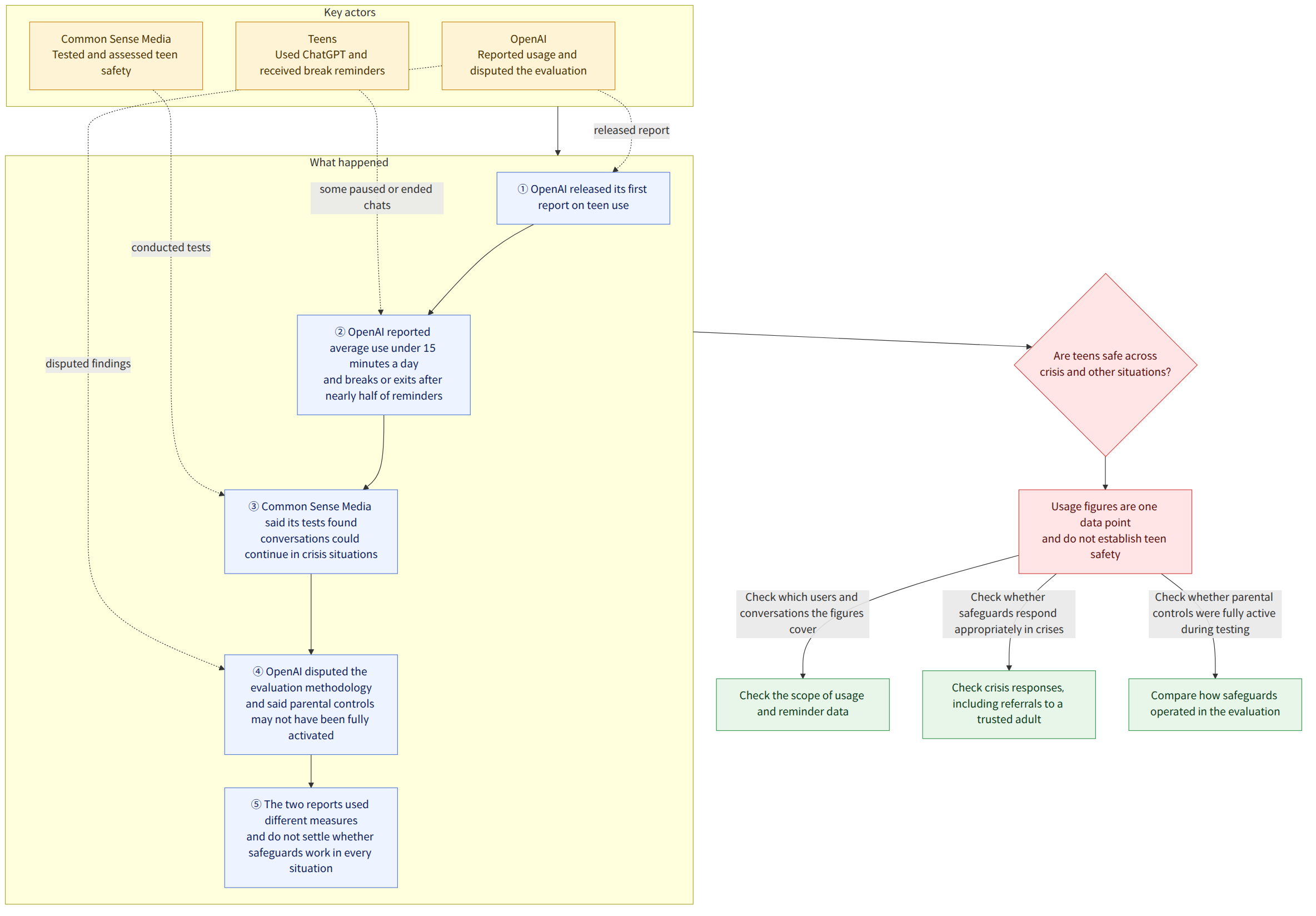
On Wednesday, OpenAI released its first report on teens’ use of ChatGPT, saying that teens use it for less than 15 minutes a day on average. It also said that fewer than 2% of teens chat continuously with the chatbot for more than three hours. OpenAI said that in nearly half of the teen conversations in which a break reminder appeared, users took a break or ended the conversation within five minutes of receiving it.
These figures offer one data point in the debate over teens’ use of chatbots. However, average usage time and behavior after a reminder are not enough to determine the risks to teens or the effectiveness of safeguards. Another evaluator said teen-focused ChatGPT could keep conversations going even in crisis situations, while OpenAI countered that the evaluation did not reflect how its safeguards work in practice.
Background and context
As AI platforms spread rapidly, concerns are growing about their potential effects on teens’ mental health and developmental safety. Research on the harms social media can cause young users has added to these concerns. Tech companies face scrutiny over the risks chatbots may pose to children.
Against this backdrop, OpenAI disclosed usage times and behavior after break reminders. The company presented the share of users who took a break or ended a conversation after receiving a reminder as evidence that measures to regulate teens’ use were working. But the reported information alone does not show which groups of users and situations the figures represent.
OpenAI said users with access to a dedicated version for teens sent more education-related messages and used tools such as learning visualizations and Study Mode. This indicates that the version was also used for learning, but does not by itself prove that it was safe or effective for learning.
What this news means
Usage time shows how long a service is used, but it does not explain what conversations were about or how users felt afterward. And the figure that fewer than 2% of teens chatted continuously for more than three hours concerns prolonged, uninterrupted use; it does not reflect patterns of repeated short conversations or experiences in crisis situations.
The finding that nearly half of users took a break or ended a conversation within five minutes of a break reminder applies only to conversations in which a reminder appeared. Behavior after a reminder can offer a clue to the effectiveness of a safeguard, but the figure alone does not show what happened in other conversations or whether reminders work appropriately in every risky situation.
For example, even if a teen ended a conversation quickly, whether that conversation was emotionally safe still needs to be assessed separately. Conversely, a long conversation does not, by itself, prove that harm occurred. That is why usage-time metrics need to be considered separately from responses in crisis situations and whether safeguards work in practice.
What different reports emphasized
OpenAI’s report focused on usage time, behavior after break reminders, and the use of education-related features. Common Sense Media, by contrast, rated teen-focused ChatGPT an “unacceptable risk” and said its own tests found language that could keep conversations going even in crisis situations. That assessment examined teen safety differently from the usage statistics OpenAI released.
Common Sense Media argued that while the chatbot warned teens about relationships that are generally unhealthy, it did not adequately recognize the harm when the relationship in question was with the chatbot itself. It also said that when a possible risk from another person was raised in its tests, the chatbot directed users to a trusted adult in 94% of crisis-related questions; but when the relationship between the teen and ChatGPT itself was a potential risk, it rarely directed them to an adult. These are results from that organization’s tests and cannot be assumed to represent every user situation.
OpenAI disputed Common Sense Media’s assessment, saying it did not accurately reflect how safeguards for teens work in practice. A spokesperson reportedly said that, after reviewing the evaluation methodology, the company believed much of the testing may have started and ended before parental controls had been fully activated, making the results inaccurate. The two sets of findings, then, should be read as claims based on different measurements and evaluations, not as evidence supporting the same conclusion.
What is known and what remains unclear
What is known
- OpenAI said teens use ChatGPT for less than 15 minutes a day on average.
- According to OpenAI, fewer than 2% of teens chat continuously with the chatbot for more than three hours.
- OpenAI said that in nearly half of the teen conversations in which a break reminder appeared, users took a break or ended the conversation within five minutes.
- OpenAI said users of its dedicated version for teens sent more education-related messages and used learning visualizations and Study Mode.
- Common Sense Media raised concerns about the teen-focused service’s response to crises and its tendency to encourage conversations to continue; OpenAI disputed the evaluation methodology.
What remains unclear
- The publicly available information does not specify the report’s sample size or data collection methods.
- It is unclear which users can access the dedicated version for teens and under what conditions.
- The criteria for displaying a break reminder have not been disclosed.
- The figures released are not enough to determine how break reminders or other safeguards affected teens’ safety.
What readers should look for
- When considering usage-time figures for services aimed at teens, distinguish average usage from the share of users who chat continuously for a long time, and check whether the sample and measurement methods have also been disclosed.
- The fact that a break reminder appeared should be distinguished from the conclusion that it actually reduced risk. It is also worth checking whether the results cover only conversations in which a reminder appeared.
- When evaluating safeguards, it is important to look not only at usage time but also at responses in crisis situations, how users are connected with adults who can help, and whether the evaluation reflects the service’s actual settings.
References
- Other coverage consulted: techcrunch.com