1. A Human Story
Daniel Cho had worked for years in a municipal procurement office, reviewing bids for public construction projects. When a contractor offered him money to “make sure the paperwork moved smoothly,” Daniel accepted. He told himself it was a one-time lapse, not a decision that would define his career. The payment was ₩20 million.
The investigation that followed did not treat the payment as a private favor. Daniel was charged with bribery connected to his public duties. His greatest fear was prison, but as he read the relevant law, another figure unsettled him: the court could impose a fine measured not by what he could afford, but by multiples of what he had received. A fine of two to five times the payment would mean ₩40 million to ₩100 million, in addition to any other punishment.
2. The Legal Question
Can Korea constitutionally require a public official convicted of bribery to pay a fine of two to five times the bribe amount, even when that fine exceeds the money the official received?
3. What Korean Law Says
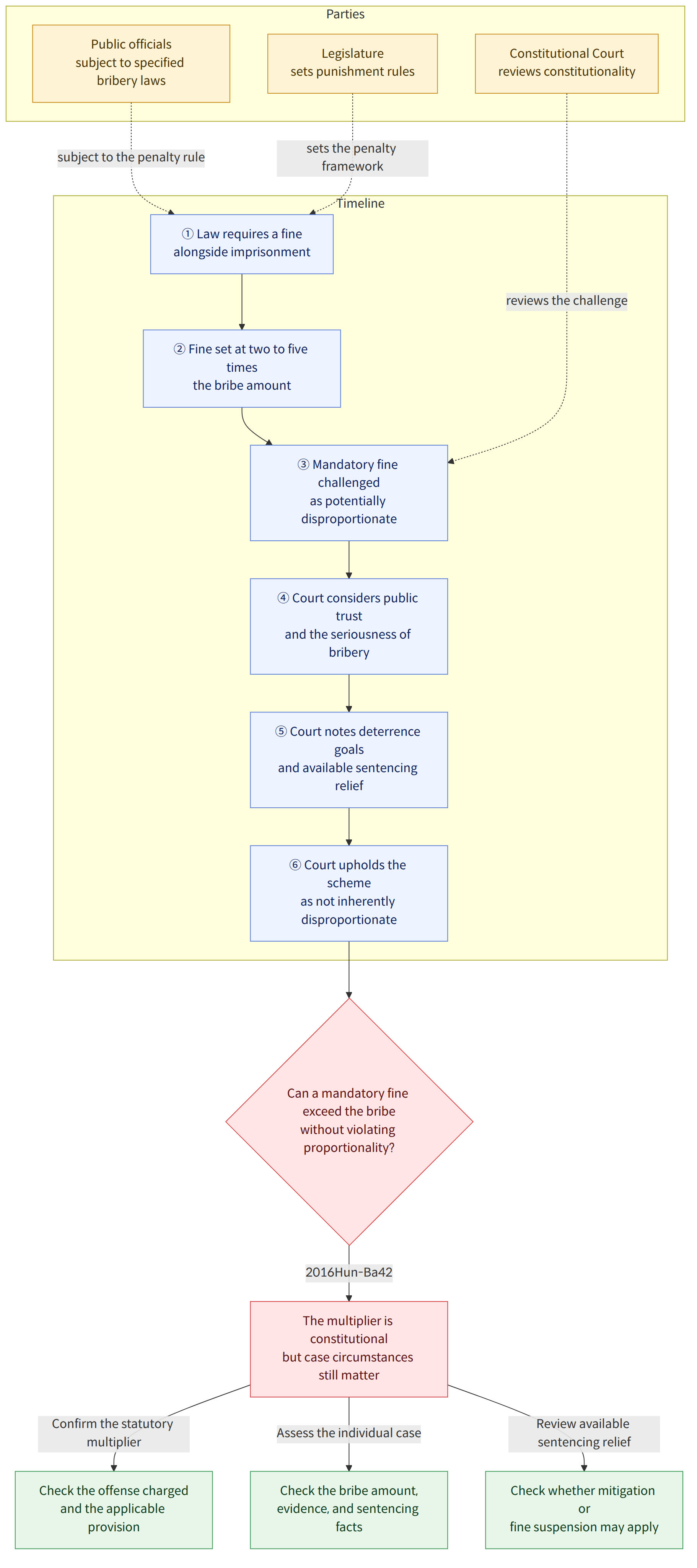
Korean law treats bribery as an attack not only on a particular decision, but also on the public’s confidence that government work is carried out impartially. For specified bribery offenses, the Act on the Aggravated Punishment, etc. of Specific Crimes provides for a fine linked to the amount of the bribe. The legal framework at issue requires a fine alongside imprisonment and sets the fine within a range of two to five times the bribe amount. The applicable provision and amount depend on the offense and the facts of the case.
The Constitutional Court considered a challenge to this mandatory additional fine in 2016Hun-Ba42. It concluded that the provision did not violate the constitutional principle that punishment must be proportionate to responsibility.
The legislature has broad authority to choose the kinds and ranges of punishment, taking account of the seriousness of the offense, the interests the law protects, and the need to prevent crime.
The Court emphasized that public office must not be for sale. Even a relatively small bribe can damage the integrity expected of public service. It also reasoned that prison alone may not adequately deter corruption, and that taking away the proceeds of crime may not always be possible or sufficient.
Because the amount received is an important measure of the seriousness of bribery, using that amount to set a fine is not automatically punishment beyond the offender’s responsibility.
Key points for a person facing this kind of charge include:
- The fine is generally mandatory when the relevant statutory provision applies; it is not simply an optional add-on for the judge to disregard.
- The amount is tied to the bribe. Under the provision considered by the Court, the range was two to five times the amount received.
- The precise outcome still depends on the case. The offense charged, the amount involved, the evidence, and the sentencing circumstances all matter.
- Mitigation may remain available. A court may reduce a fine through legally authorized sentence mitigation. In qualifying cases, it may also suspend the imposition of a fine sentence. The court can consider the fine when deciding the overall punishment as well.
4. How Korean Courts Approach This
Korean courts generally begin with the legislature’s judgment that bribery undermines the fairness and trustworthiness of public administration. In reviewing whether a punishment is constitutionally excessive, the Constitutional Court does not replace the legislature’s policy choice with its own simply because a different penalty might also have been reasonable. It asks whether the legislature acted outside its permitted discretion and whether the punishment is grossly out of proportion to the offense and the offender’s responsibility.
In 2016Hun-Ba42, the Court accepted the legislature’s reasons for imposing a fine in addition to imprisonment: discouraging corruption for financial gain, preventing officials from treating a bribe as a manageable business cost, and protecting the integrity of public office. It also considered the amount of the bribe a practical indicator of the offense’s seriousness.
The Court acknowledged that a mandatory formula narrows a judge’s freedom to choose a fine. But it did not regard that limitation as decisive. It pointed to mechanisms available during sentencing, including mitigation and, where the legal requirements are met, suspension of the fine sentence. On that basis, it held that the scheme was not inherently incompatible with proportional punishment.
The constitutional ruling does not mean every fine must be set at the maximum, or that individual circumstances are irrelevant. It means the statutory multiplier is not unconstitutional merely because it can produce a fine larger than the bribe itself.
5. Applying the Law to Daniel’s Case
Daniel’s situation would be assessed in several stages.
- Establish what offense and provision apply. The prosecution must prove the elements of bribery connected to Daniel’s public duties. The applicable statutory rule will depend on the charge and the facts, including the amount involved.
- Determine the relevant bribe amount. If the court finds that Daniel received ₩20 million, and the applicable provision sets the fine at two to five times that amount, the statutory range would be ₩40 million to ₩100 million. That calculation is based on the amount of the bribe, not on Daniel’s salary or ability to pay.
- Consider his constitutional objection. Daniel could argue that a fine exceeding the payment is too harsh. But the Constitutional Court has already rejected the idea that the multiplier is unconstitutional simply because it can exceed the amount received. The state’s interest in deterring corruption and maintaining confidence in public office weighs heavily in the analysis.
- Assess possible sentencing adjustments. The statutory range does not necessarily dictate the final fine at its upper end. The court may consider legally available mitigation and the circumstances relevant to sentencing. Depending on the statutory and procedural requirements, suspension of the fine sentence may also be possible. Any imprisonment and the additional fine are considered as parts of the overall sentence.
- Distinguish the fine from recovering the bribe. A criminal fine is a punishment imposed for the offense. Confiscation or collection of the value of the bribe serves a different function: removing criminal proceeds. The fact that Daniel might have to return or lose the money would not, by itself, answer whether a separate fine is required.
Daniel’s argument that the penalty could be several times his payment would therefore be unlikely, on its own, to invalidate the statutory scheme. His more practical focus would be the precise charge, the amount the prosecution can prove, and whether the facts support mitigation or another lawful sentencing adjustment.
If you are dealing with a similar issue, attorney Ji-sun Ahn of Ijun Law Firm can review the procedural history, the specific facts or evidence in dispute, and the relevant court or agency notices with you. These details can help clarify which options apply to your situation.
6. Conclusion: What Happened, and What Should You Do?
Daniel’s constitutional challenge would not succeed merely because the potential fine was larger than the bribe. Under the Constitutional Court’s ruling, a fine of two to five times the amount received can be constitutionally permissible, even when imposed alongside imprisonment. But that does not mean Daniel would automatically receive the maximum fine: the court would still need to apply the relevant law to the proven facts and consider available sentencing adjustments.
For anyone facing a similar charge:
- Get a criminal defense lawyer promptly. The exact offense and statutory range can turn on details of the alleged payment and the official’s duties.
- Preserve records and avoid discussing the case informally. Messages, financial records, and explanations about the payment may become important evidence; do not alter or destroy anything.
- Ask counsel to examine both the amount and sentencing options. The amount attributed to the bribe affects the fine calculation, while mitigation and possible suspension depend on the case and the applicable legal requirements.