1. A Human Story
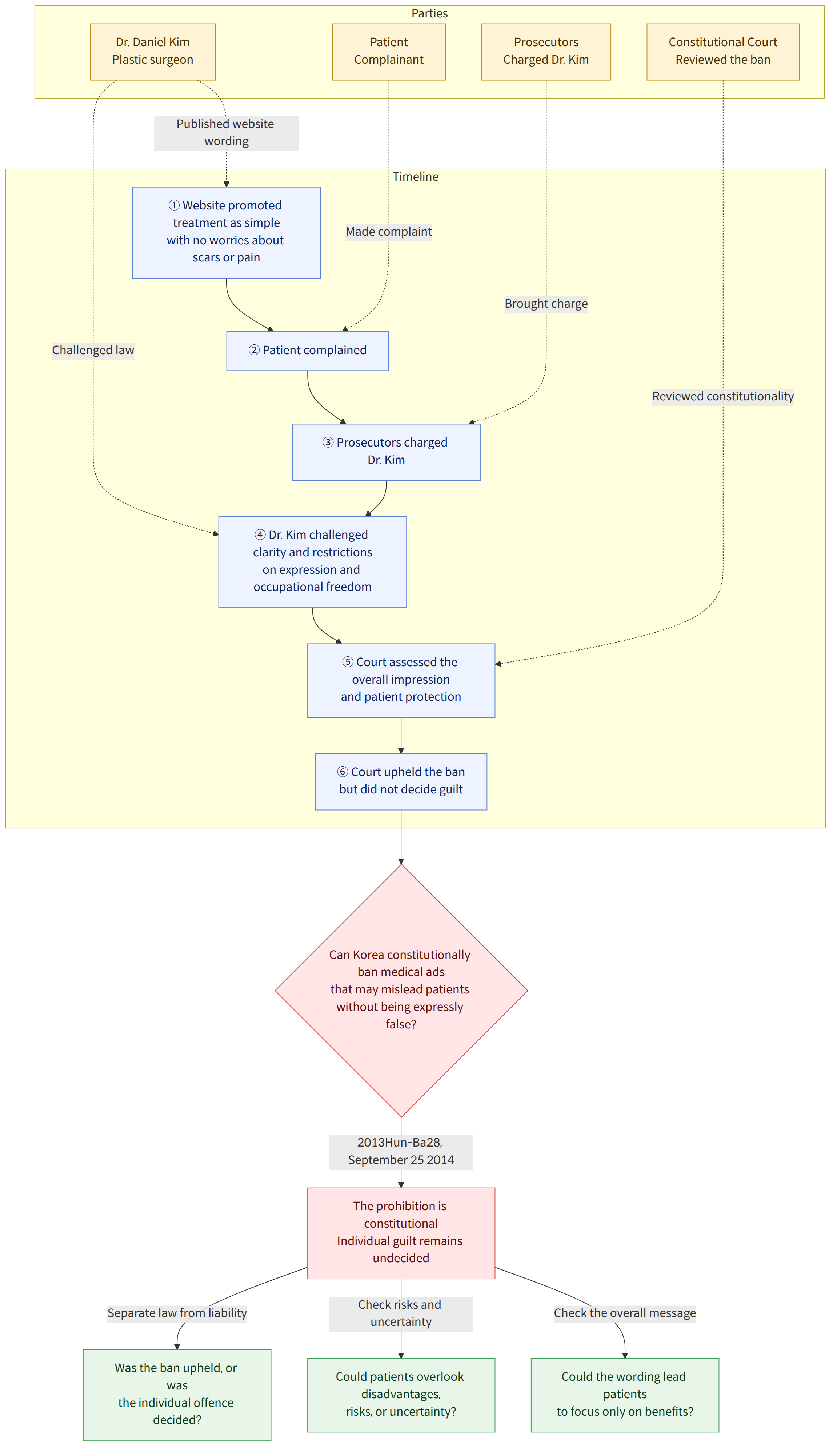
When Dr. Daniel Kim updated his plastic surgery clinic’s website, he wanted the wording to sound reassuring. The page promoted a breast-procedure device as offering a “simple and precise” treatment, with “no worries about scars or pain.” To Dr. Kim, the language described the appeal of the service. To a patient deciding whether to undergo surgery, it could sound like a promise that the usual risks would not apply.
A patient complained, and prosecutors charged Dr. Kim with violating Korea’s restrictions on medical advertising. He argued that the law was too vague: How could a doctor know when positive language became “misleading”? He also said the restriction intruded too far into his freedom to speak about his work and to run his clinic. His case raised a question broader than one website: how much protection should the law give patients from persuasive medical marketing?
2. The Legal Question
Can Korea constitutionally prohibit medical advertisements that may mislead consumers, even when the advertisement’s wording is not expressly false? Or is that prohibition so unclear, or so restrictive, that it violates the constitutional protections for expression and occupational freedom?
3. What Korean Law Says
The provisions at issue in this dispute were part of the Medical Service Act. Article 56(2)(2) prohibited medical corporations, medical institutions, and medical practitioners from placing advertisements containing material that could mislead consumers, including claims that guarantee treatment results. A related penalty provision, Article 89, made violations punishable by up to one year in prison or a fine of up to five million won.
The important point is that the law did not require prosecutors to show that an advertisement was a deliberate lie. The concern was also with the overall impression: whether the wording emphasized only the benefits of a medical service in a way that could confuse patients and interfere with a reasonable choice.
The Constitutional Court interpreted the prohibited category as advertising that, through language stressing only the positive aspects of a medical service, could confuse consumers and hinder their ability to make a reasonable choice. The assessment does not turn solely on whether each statement can be proven true or false.
The constitutional challenge involved two main principles:
- Clarity in criminal law: A person must be able to understand what conduct may lead to punishment. The Constitutional Court concluded that the words “mislead” and “risk” could be understood in context, alongside the rest of the Medical Service Act.
- Proportionality: Restrictions on constitutional rights must pursue a legitimate purpose and not go further than reasonably needed. Protecting patients’ health and their ability to make informed decisions is a significant public interest.
- Freedom of expression and occupational freedom: Doctors may communicate about their services, but medical advertising is not treated as ordinary commercial promotion. Its subject is healthcare, which can directly affect life and health and may have a substantial influence on consumers.
The Court therefore upheld the relevant prohibition as constitutional in its decision of September 25, 2014 (2013Hun-Ba28).
4. How Korean Courts Approach This
Korean courts recognize that healthcare providers have legitimate interests in describing their services. But they also take account of the special position of patients: people may have difficulty evaluating medical claims, and a treatment decision can involve risks that are not apparent from an advertisement.
The Constitutional Court’s approach was not that every optimistic statement by a doctor is automatically unlawful. Rather, the law targets advertising whose presentation could lead consumers to focus on benefits while overlooking relevant disadvantages, risks, or uncertainty. The overall message matters, not just whether a phrase can be defended as literally accurate in isolation.
In the Court’s view, misleading medical advertising can expose consumers to unexpected medical harm by preventing them from adequately considering a service’s negative aspects. Unchecked advertising competition may also encourage increasingly aggressive promotion, with consequences for patients and the proper order of healthcare.
The Court held that these concerns justified the restriction and that the statutory language was sufficiently understandable to satisfy the constitutional requirement of clarity. That ruling addressed the validity of the law, however—not whether a particular doctor had committed the offence.
5. Applying the Law to the Case
Dr. Kim’s case can be analyzed in several steps.
- Identify the claims and their combined impression. The page did not merely name a device or describe a procedure. “Simple and precise,” paired with “no worries about scars or pain,” could leave readers with the impression that the procedure avoids common adverse effects.
- Ask whether the wording presents a one-sided picture. A medical procedure may involve individual variation, discomfort, scarring, or other risks. If the page highlighted reassurance without providing context about those possibilities, a court could find that it stressed the positive side and hindered an informed choice.
- Consider the medical context. Patients may rely on a clinic’s promotional claims when deciding whether to seek treatment. Because the decision concerns an invasive procedure, the potential consequences of misunderstanding are more serious than in many ordinary consumer transactions.
- Separate constitutionality from guilt. Dr. Kim’s argument that the statute was inherently too vague or constitutionally excessive would fail under the Constitutional Court’s ruling. But prosecutors would still have to prove that this particular advertisement fell within the prohibited category. The criminal court would examine the wording, its presentation, and the surrounding context rather than treating the constitutional decision as proof of guilt.
On the assumed facts—especially the unqualified assurance of no worries about pain or scars—the advertisement strongly risks conveying that important downsides can be disregarded. A trial court could reasonably find that it was misleading under Article 56(2)(2). The Court’s constitutional ruling does not make that conclusion automatic, but it leaves the prohibition available for the trial court to apply.
If you are dealing with a similar issue, attorney Ji-sun Ahn of Ijun Law Firm can review the applicable permit, business records or advertisements, and the legal grounds given by the authority with you. These details can help clarify which options apply to your situation.
6. Conclusion: What Happened, and What Should You Do?
In this fictional case, the constitutional challenge fails: the restriction is sufficiently clear and serves the legitimate purpose of protecting patients. The criminal case then proceeds on its facts. Because Dr. Kim’s advertisement gave an unqualified, reassuring impression about pain and scarring, the trial court finds that it crossed the statutory line and convicts him under the applicable provision. That outcome rests on the specific wording and context—not simply on the fact that he advertised a medical service.
For doctors and patients facing similar issues, three practical steps can help:
- For clinics: Avoid guarantees and absolute assurances about results, pain, scarring, or other risks. Describe benefits in accurate, qualified language and include information needed for a balanced understanding.
- Before publishing an advertisement: Review the overall impression from a patient’s perspective, not just whether individual words are technically defensible. Keep records supporting factual claims and obtain specialist legal review where appropriate.
- For patients: Treat sweeping promises as a reason to ask more questions. Seek a clear explanation of likely benefits, risks, alternatives, and uncertainty before deciding on treatment.