1. A Human Story
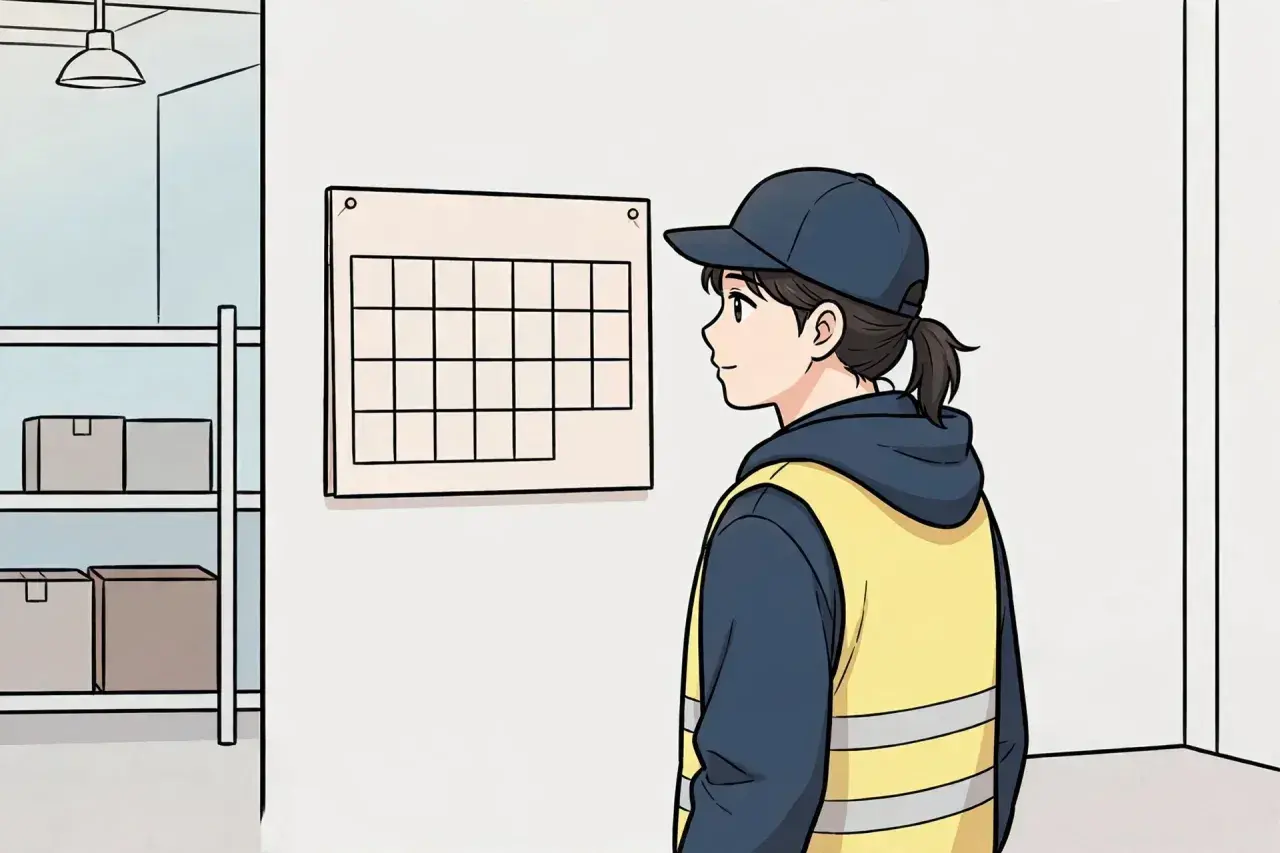
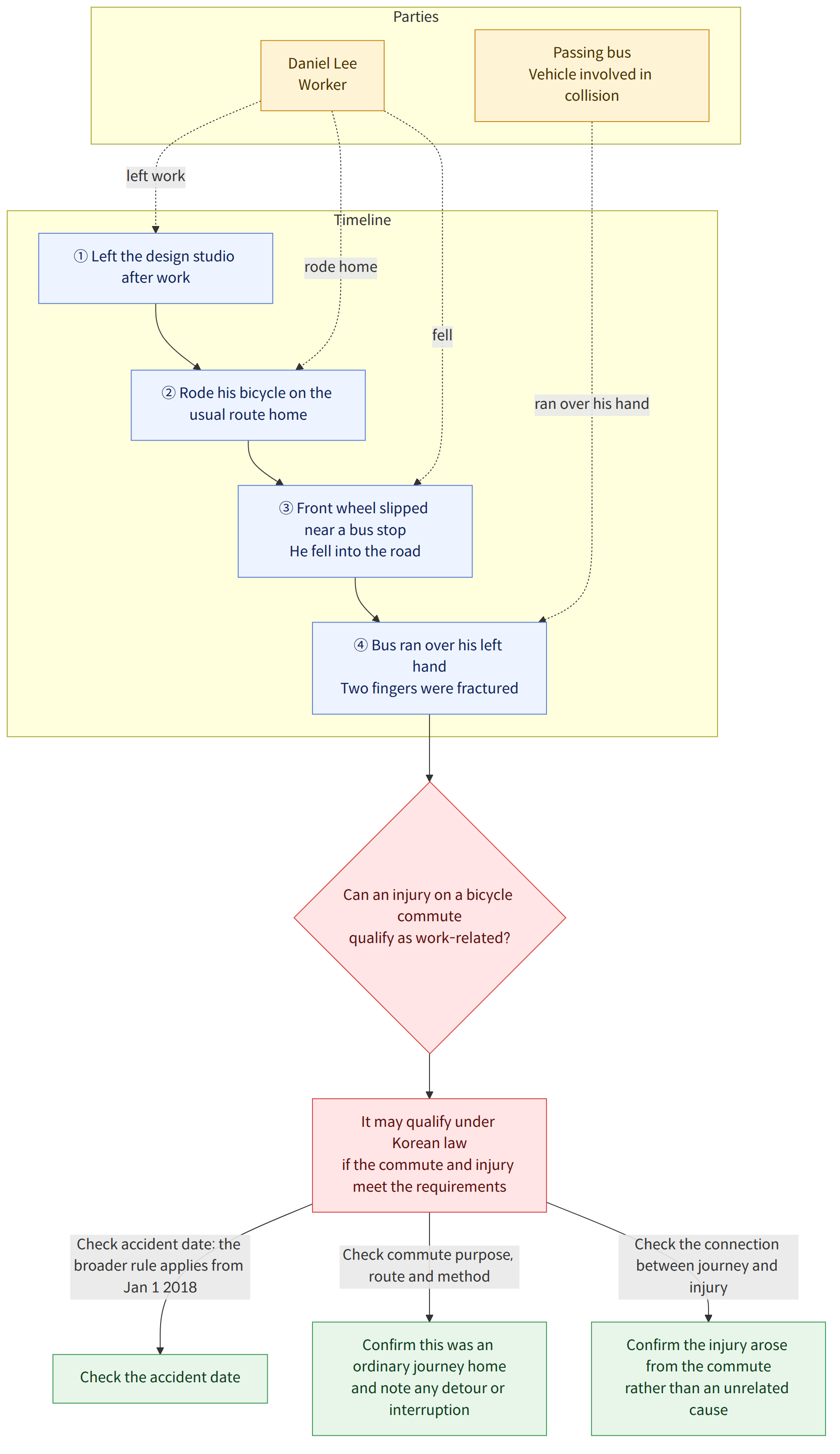
At 6:20 on a rainy evening, Daniel Lee left the small design studio where he worked and set off for home on his bicycle. The route was familiar: past the market, along the main road, then across the bridge to his apartment. He had ridden it dozens of times.
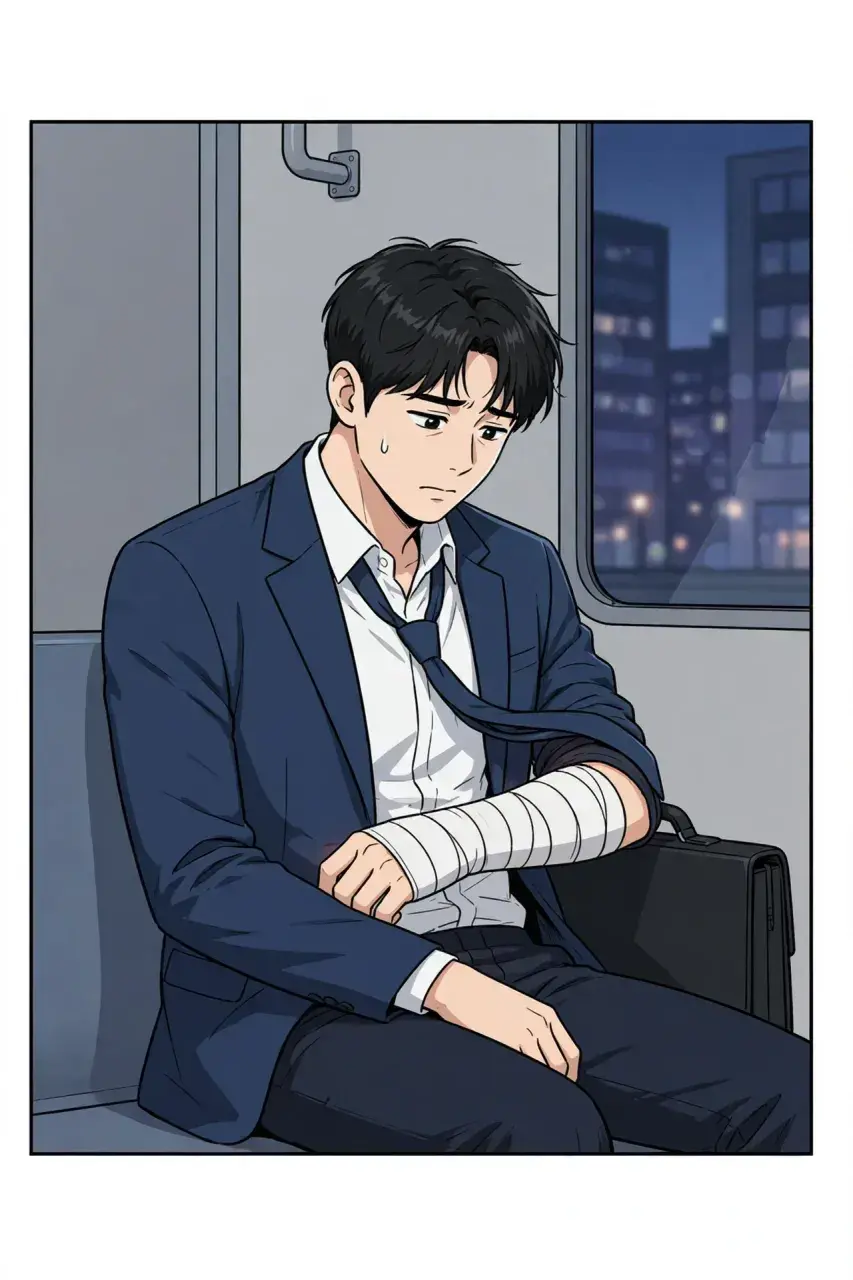
Near a bus stop, Daniel’s front wheel slipped. He fell into the road, and a bus passing behind him ran over his left hand. By the time he reached the emergency room, two fingers were fractured. His first worry was obvious: whether he could work. His next question was less obvious, but just as important: would Korea’s industrial accident insurance cover an injury that happened after he had clocked out, while he was riding his own bicycle?
2. The Legal Question
Does a worker’s injury on the journey home count as a work-related accident when the worker was commuting by bicycle, rather than in transport provided or controlled by the employer?
For accidents occurring on or after January 1, 2018, the answer can be yes—if the worker was travelling by an ordinary route and method and the accident was connected to that commute.
3. What Korean Law Says
Korea’s Industrial Accident Compensation Insurance Act recognizes commuting accidents as a category of work-related injury. The current framework is not limited to employees whose employer supplies a vehicle or otherwise controls their journey.
Under Article 37(1)(3), a commuting accident may be treated as a work-related accident if it occurs while the worker is travelling under the employer’s control using employer-provided or equivalent transport, or while travelling by another ordinary route and method. The Act also requires a sufficient causal relationship between the work and the injury.
In practical terms, the second part is central to Daniel’s situation. It can cover an ordinary commute even when the worker uses a private bicycle, walks, or takes public transport, rather than relying on an employer’s vehicle.
The main questions are:
- Was Daniel actually commuting? The journey must be between work and home, rather than a personal trip unrelated to getting to or from work.
- Was his route and method ordinary? A regular bicycle journey on a reasonable route is not disqualified merely because it is not the only possible route.
- Did the accident occur during that journey? A substantial personal detour or interruption may complicate whether the trip still qualifies as a commute.
- Is there a sufficient connection between the commute and the injury? The circumstances must support that the injury arose from the journey, rather than from an unrelated cause.
The date matters. Before the 2018 amendment, the law generally recognized commuting accidents only when the journey took place under the employer’s control—for example, in transport the employer provided. In 2016, the Constitutional Court found that this distinction unfairly excluded workers who had no employer-provided transport, despite being insured. The legislature then broadened the law, effective January 1, 2018, to include accidents during ordinary commuting by other routes and methods.
4. How Korean Courts Approach This
Korean courts and decision-makers examine the substance of the journey, not simply whether the worker had left the workplace or whether the employer arranged the transport. The key is whether the worker was making a normal trip to or from work and whether the accident occurred as part of that trip.
The law does not make employer control of the vehicle a condition for every commuting claim. For an ordinary commute, the relevant questions are whether the route and method were ordinary and whether the accident was sufficiently connected to the journey.
That does not mean every injury occurring after work is automatically covered. A lengthy private errand, a major deviation from the usual journey, or an accident unrelated to commuting may lead to closer scrutiny. Nor does the fact that a bus was involved, by itself, settle the claim. The full sequence of events and the worker’s purpose in travelling matter.
5. Applying the Law to the Case
Daniel’s claim can be assessed step by step.
- The accident happened during a journey home. He had left work and was riding along his usual route toward his apartment. On these facts, the trip was a commute, not a separate recreational ride.
- The bicycle was an ordinary method of travel. The law does not require an employer to provide the transport. If Daniel regularly used his bicycle to travel home, that supports treating it as an ordinary commuting method. Even if he did not ride every day, the question would be whether cycling that route was a reasonable way of making that particular commute.
- The accident occurred on the route. Daniel fell near a bus stop while travelling toward home. There is no indication that he had made a substantial personal detour or stopped the commute for an unrelated purpose.
- The injury was directly connected to the accident. The fall and the bus’s rear wheel caused the fractures to his left hand. Medical records and evidence about the collision can help establish both the injury and how it happened.
- The date brings the claim within the broader rule. Daniel’s accident occurred in 2024, after the amendment took effect. The former restriction to employer-controlled transport therefore does not exclude him simply because he rode his own bicycle.
On these facts, Daniel has a strong basis to seek recognition of the injury as a commuting accident under the Act. The insurance authority would still assess the evidence and the precise circumstances, but the fact that he was cycling rather than riding in an employer-provided vehicle should not, by itself, defeat his claim.
If you are dealing with a similar issue, attorney Ji-sun Ahn of Ijun Law Firm can review the timeline of the incident, who was responsible for safety, and any incident reports or treatment records with you. These details can help clarify which options apply to your situation.
6. Conclusion: What Happened, and What Should You Do?
Daniel filed a claim for industrial accident compensation, documenting that he was travelling directly home from work on his usual bicycle route. Because the accident happened in 2024 and appears to have occurred during an ordinary commute, his injury may qualify as a work-related commuting accident. The final decision depends on the evidence, but he should not assume that using his own bicycle leaves him outside the system.
If something similar happens to you:
- Record the details promptly: note the time, route, destination, and any stops or detours; keep photographs, witness details, and traffic or police records if available.
- Keep medical and work records: obtain records describing the injury and its cause, and preserve proof of your work schedule and usual commute.
- Ask about the claim without delay: contact the Korea Workers’ Compensation and Welfare Service or a qualified adviser, especially if the accident occurred before January 1, 2018, when different rules and transitional issues may matter.